Ashwagandha for Stress and Sleep: What’s Been Studied
Some ashwagandha extracts have helped adults with stress or sleep in short trials, but the preparation and your safety considerations matter.
Ashwagandha extracts may reduce perceived stress and offer a small sleep benefit, especially for people with insomnia. Most trials lasted weeks, used different preparations, and did not report results separately for women. Before buying a product, compare its plant part and formulation with the study behind its claim, and check pregnancy, thyroid, liver, and medication concerns alongside the possible benefit. 1

The strongest evidence is for stress and sleep
Ashwagandha is the common name for Withania somnifera. Its traditional use helps explain its popularity, but the practical question is narrower: did a preparation help people with a concern like yours, compared with a placebo? 1
For stress and anxiety, a review described seven randomized studies involving 491 adults in India. Participants had self-reported high stress or anxiety, or a diagnosed anxiety disorder, and took ashwagandha or placebo for six to eight weeks. Overall, the ashwagandha groups reported lower stress and anxiety scores. The studies used root extracts, root-and-leaf extracts, and dried-root granules, so their combined result is not a promise about every bottle labeled ashwagandha. 1
Later trials add useful detail, not a universal formula. In a 60-day placebo-controlled trial, 135 stressed adults were randomized to one of two amounts of a sustained-release root extract called AshwaSR or to placebo. Both extract groups had better perceived-stress and sleep-quality outcomes than the placebo group at day 60. That finding belongs to the tested formulation and population; it doesn’t establish the same effect for ordinary root powder or a different extract. 5
Stress, fatigue, and sleep are also different outcomes. In a separate 12-week trial summarized by the NIH Office of Dietary Supplements, a root extract reduced fatigue compared with placebo but did not reduce perceived stress. If a product promises help with both, look for evidence for both rather than treating one result as proof of the other. 1
What “better sleep” meant in the trials
A review of five studies involving 372 adults in India found a small overall sleep benefit with ashwagandha extract compared with placebo over six to 12 weeks. The benefit appeared more pronounced among participants with insomnia. The studies tested root extracts and, in one study, a root-and-leaf extract. 1
Some trials measured more than whether people felt they slept well. In a six-week study of adults reporting sleep problems, both the ashwagandha and placebo groups reported improvement, but the ashwagandha group improved more. Wrist activity monitors also suggested changes in time asleep, time taken to fall asleep, and waking after sleep onset. Those measures help describe the finding; they don’t show that ashwagandha will fix every cause of poor sleep. 1
One US college-student trial is a reminder to read beyond a positive headline. After 30 days with a root extract or placebo, the study’s overall group-by-time analysis for sleep and stress was not statistically significant, although a follow-up analysis found a difference in final sleep scores after accounting for initial sleep. Participants also described perceived benefits in a separate qualitative analysis. Their accounts are worth hearing, but they are not the same as a clear overall stress result. 32
Match the bottle to the claim
If you’re looking at a product, start with its serving size: is the amount on the front of the bottle per capsule or per full serving? Then check whether it contains root, root and leaf, or whole-root powder, and whether it names a specific extract. Finally, compare that with the study’s participants, measured outcome, and length. Root and leaf differ chemically, and studies have used different extraction and standardization methods. Matching a milligram amount or a withanolide percentage alone does not make two products equivalent. 1
For example, the sustained-release AshwaSR trial tested a particular root formulation against placebo for 60 days. Its results can help you assess a claim about that formulation; they cannot rank other ashwagandha products or supply an amount to copy from an unrelated label. 51
What changes across women’s life stages?
Several stress and sleep trials enrolled women and men but reported results for participants together. They do not establish whether women respond differently, or whether a benefit changes during cycling years, perimenopause, or postmenopause. These general stress and sleep findings also should not be recast as evidence that ashwagandha treats menopause symptoms or balances hormones. 1
Pregnancy deserves a separate decision. One randomized, open-label study enrolled 70 women in their second trimester and compared ashwagandha root extract plus standard hematinic therapy with standard therapy alone for 12 weeks. It reported improvements in perceived stress and aspects of sleep, with no adverse events reported. Because it was small, unblinded, and limited to part of pregnancy, it cannot establish safety in early pregnancy, through birth, or during breastfeeding. Expert cautions about use during pregnancy and breastfeeding remain relevant; claims that ashwagandha root causes miscarriage are disputed, not established. 61
Put safety beside the possible benefit
Ashwagandha has generally been tolerated in trials lasting up to about three months. Stomach upset, loose stools, nausea, and drowsiness can occur; safety over many months or years is unknown. Liver injury has been reported in people taking ashwagandha-containing products, although some products contained other ingredients or were not independently verified. Those reports cannot tell us how often injury happens or establish the cause in every case. Yellowing of the skin or eyes, itching, and abdominal discomfort were among the symptoms reported in these cases. 1
Ashwagandha may also affect thyroid function. Potential interactions include thyroid hormone medicine, diabetes and blood-pressure medicines, immunosuppressants, and sedatives. If you take one of these, or have a thyroid condition, a pharmacist or prescriber can assess the specific product with your medicines and health history before you use it. A short trial in generally healthy adults cannot answer that question for you. 1
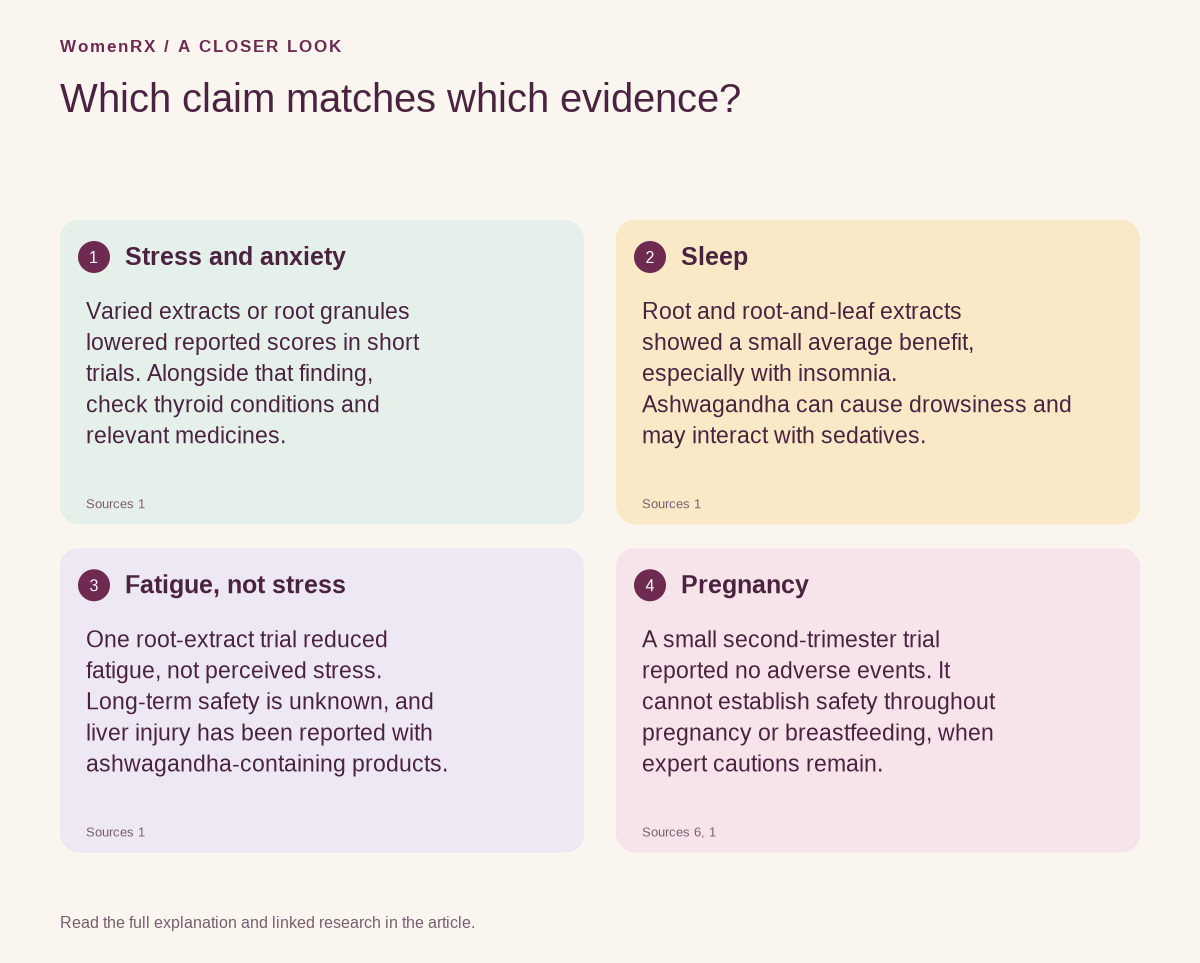
Which claim matches which evidence?
Stress and anxiety: Varied extracts or root granules lowered reported scores in short trials. Alongside that finding, check thyroid conditions and relevant medicines.1
Sleep: Root and root-and-leaf extracts showed a small average benefit, especially with insomnia. Ashwagandha can cause drowsiness and may interact with sedatives.1
Fatigue, not stress: One root-extract trial reduced fatigue, not perceived stress. Long-term safety is unknown, and liver injury has been reported with ashwagandha-containing products.1
Pregnancy: A small second-trimester trial reported no adverse events. It cannot establish safety throughout pregnancy or breastfeeding, when expert cautions remain.61
Read the figure as text
Each outcome sits beside the preparation studied and a safety question to consider.- Stress and anxiety: Varied extracts or root granules lowered reported scores in short trials. Alongside that finding, check thyroid conditions and relevant medicines.1
- Sleep: Root and root-and-leaf extracts showed a small average benefit, especially with insomnia. Ashwagandha can cause drowsiness and may interact with sedatives.1
- Fatigue, not stress: One root-extract trial reduced fatigue, not perceived stress. Long-term safety is unknown, and liver injury has been reported with ashwagandha-containing products.1
- Pregnancy: A small second-trimester trial reported no adverse events. It cannot establish safety throughout pregnancy or breastfeeding, when expert cautions remain.61
More questions, answered
Does a lower cortisol result prove someone felt less stressed?
No. Cortisol and a person’s stress rating measure different things. One 84-day trial reported improvements in stress ratings with a particular ashwagandha formulation, but no significant between-group difference in serum cortisol. Judge a claim by the outcome you care about, not a hormone measure alone. 4
Sources you can check
- Ashwagandha: Is it helpful for stress, anxiety, or sleep? - Health Professional Fact SheetAccessed 2026-09-25Return to first citation
- The Perceived Impact of Ashwagandha on Stress, Sleep Quality, Energy, and Mental Clarity for College Students: Qualitative Analysis of a Double-Blind Randomized Control Trial.Baker C, Kirby JB, O'Connor J, Lindsay KG, Hutchins A, Harris M. · Journal of medicinal food · 2022Return to first citation
- The Impact of Ashwagandha on Stress, Sleep Quality, and Food Cravings in College Students: Quantitative Analysis of a Double-Blind Randomized Control Trial.O'Connor J, Lindsay K, Baker C, Kirby J, Hutchins A, Harris M. · Journal of medicinal food · 2022Return to first citation
- A New Ashwagandha Formulation (Zenroot™) Alleviates Stress and Anxiety Symptoms While Improving Mood and Sleep Quality: A Randomized, Double-Blind, Placebo-Controlled Clinical Study.Mahadevan M, Gopukumar K, Gupta R, Morde A, Patni P, Srinivas SS, Bhuvanendran A, Phanindra A. · Advances in therapy · 2025Return to first citation
- Efficacy and safety of Ashwagandha root extract sustained-release (AshwaSR) capsules in healthy adult, stressed subjects: A randomized, double-blind, placebo-controlled, parallel-group, 3-arm clinical trial.Thanawala S, Shah R, Alluri KV, Bhupathiraju K, Desomayanandanam P, Bhuvenendran A. · Medicine · 2026Return to first citation
- Efficacy and safety of Ashwagandha (Withania somnifera) root extract in pregnant women: a prospective, randomized, comparative, open-label, 12-week study.Ajgaonkar A, Tayade H, Nayak A. · Frontiers in global women's health · 2026Return to first citation