Ashwagandha Doses Studied for Stress and Sleep
Some extracts have helped adults with stress or sleep in short trials, but the dose on one bottle can’t be applied to every product.
There’s no single daily ashwagandha dose that fits every product or goal. Stress trials have tested extracts at doses from 125 to 1,250 mg per day; one trial used 12,000 mg per day of whole-root granules, equivalent to 6,000 mg of root powder. Sleep trials have used different preparations. These are study doses, not a recommendation for your bottle. Pregnancy, breastfeeding, thyroid or liver concerns, and certain medicines change the safety decision.14
Start with the extract, not the milligrams
If you’re comparing two ashwagandha bottles, the larger milligram number isn’t necessarily the more relevant one. Supplements may contain root extract, root-and-leaf extract, or whole root powder. Extracts also differ in how they’re made and standardized. That makes a dose tested with one preparation a poor stand-in for the same number of milligrams from another.1
For example, an eight-week placebo-controlled trial tested 125, 250, and 500 mg per day of a particular water-extracted root-and-leaf preparation in adults with self-reported high stress. All three doses reduced measures of stress in that study; 98 of the 131 enrolled adults were included in the final analysis. The finding tells you something about that extract and those participants. It doesn’t establish 125 mg as an effective dose for ashwagandha products generally.4
A different study illustrates why even a standardized withanolide percentage doesn’t settle the question. In 20 healthy adults, researchers compared blood levels of selected withanolides after single doses of three formulations. The 125-mg formulation produced higher measured exposure than the two higher-milligram comparators. This was a bioavailability study, not a test of whether that formulation relieved stress or improved sleep.3
What the stress and sleep trials actually tested
For stress and anxiety, a systematic review of 12 randomized trials involving 1,002 participants found improvements compared with placebo, but rated the certainty of the evidence low. The trials did not establish one dose that works across preparations. An international taskforce has provisionally suggested 300 to 600 mg per day of a root extract standardized to 5% withanolides for generalized anxiety disorder, while calling for more research. That specific proposal shouldn’t be transferred to a root-and-leaf product with a different composition.21
Sleep has its own evidence. In one eight-week trial, adults with and without insomnia took 600 mg per day of a particular root extract or placebo; improvements were more apparent among participants with insomnia. Another six-week trial tested 120 mg per day of a root-and-leaf extract in adults reporting sleep problems. A review of five sleep trials, involving 372 adults, found a small overall benefit compared with placebo. These results don’t mean that 120 mg and 600 mg are interchangeable doses.1
Most of these studies were short, and several included both men and women. They don’t establish a dose specifically for cycling years, postpartum, perimenopause, or postmenopause. If a product promises a special benefit for your life stage, the general stress and sleep trials don’t verify that promise.1
The safety checks that matter before a bottle
Pregnant or breastfeeding? Avoid treating a trial dose as evidence of safety. Experts advise against ashwagandha during pregnancy and breastfeeding. Reports raising concern about pregnancy loss are disputed; that dispute does not establish that use in pregnancy is safe.1
Have a thyroid condition or take thyroid hormone? In a small placebo-controlled trial of 50 people with subclinical hypothyroidism, a root extract changed thyroid hormone measures over eight weeks. Thyrotoxicosis has also been reported in women taking ashwagandha, though case reports cannot show how often it happens. This is a reason to review ashwagandha with the clinician managing your thyroid care, not a reason to use it to adjust thyroid treatment yourself.1
Have liver concerns? Liver injury has been reported in people taking products containing ashwagandha, including people with pre-existing liver disease. Reported signs included jaundice, itching, nausea, lethargy, and abdominal discomfort. Some products in these reports contained other ingredients, and their contents were not always independently verified, so the reports do not establish an individual product’s risk.1
Take other medicines? Potential interactions include sedatives, medicines for diabetes or blood pressure, immunosuppressants, and thyroid hormone medicines. A useful review is specific: bring the product’s ingredient list and your medicine list to a pharmacist or the clinician who prescribes them, rather than asking whether “herbal supplements” are safe in general.1
Short-term trials have generally found ashwagandha tolerable for up to about three months, with stomach upset, loose stools, nausea, and drowsiness among reported side effects. They don’t tell us whether taking it for many months or years is safe. The most useful question isn’t simply “How many milligrams per day?” It’s “Was this preparation studied for my goal, and do my health conditions or medicines change the choice?”1
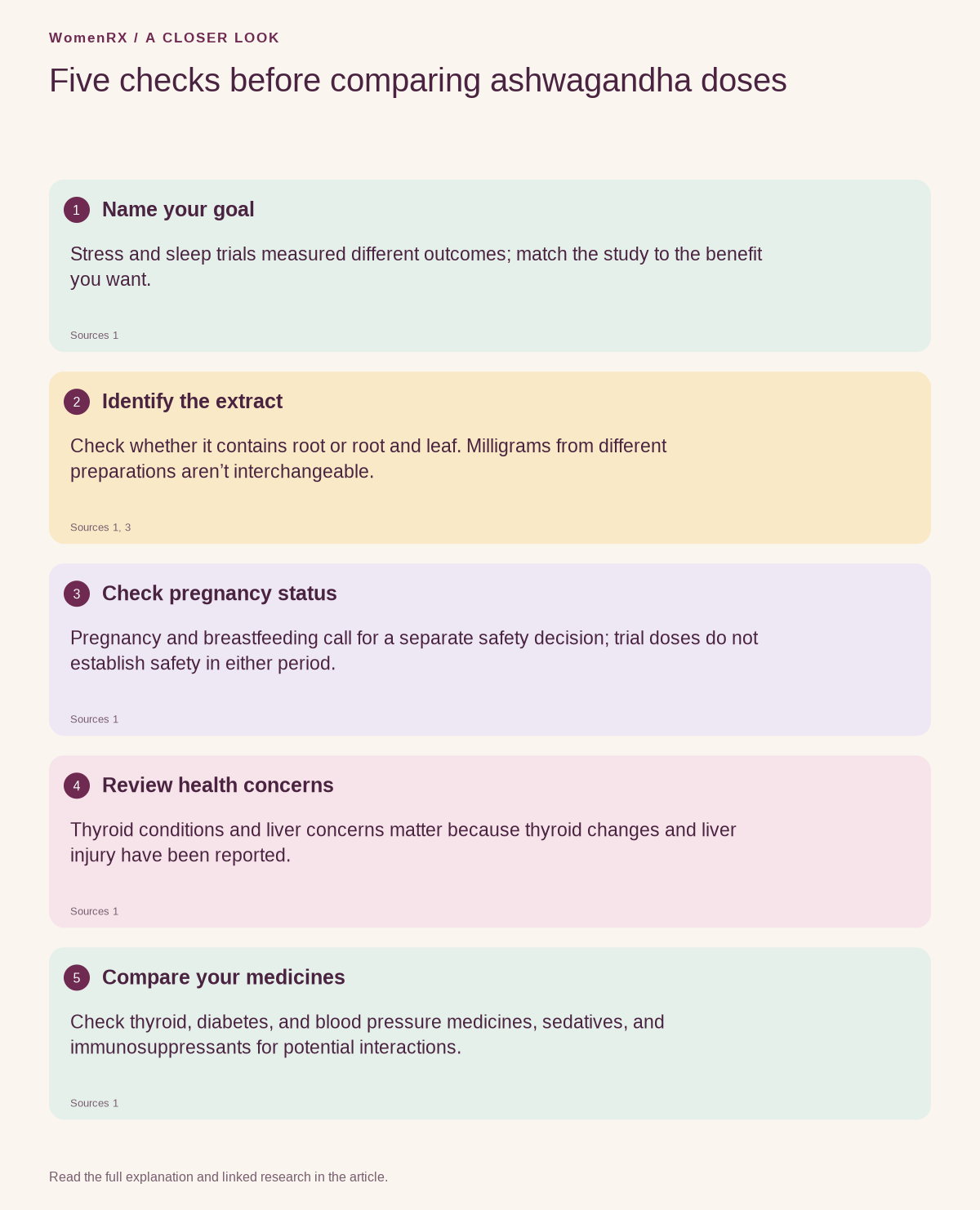
Five checks before comparing ashwagandha doses
Name your goal: Stress and sleep trials measured different outcomes; match the study to the benefit you want.1
Identify the extract: Check whether it contains root or root and leaf. Milligrams from different preparations aren’t interchangeable.13
Check pregnancy status: Pregnancy and breastfeeding call for a separate safety decision; trial doses do not establish safety in either period.1
Review health concerns: Thyroid conditions and liver concerns matter because thyroid changes and liver injury have been reported.1
Compare your medicines: Check thyroid, diabetes, and blood pressure medicines, sedatives, and immunosuppressants for potential interactions.1
Read the figure as text
Use these questions to compare a product with the research and spot reasons its safety needs a closer look. This is not a diagnostic score.- Name your goal: Stress and sleep trials measured different outcomes; match the study to the benefit you want.1
- Identify the extract: Check whether it contains root or root and leaf. Milligrams from different preparations aren’t interchangeable.13
- Check pregnancy status: Pregnancy and breastfeeding call for a separate safety decision; trial doses do not establish safety in either period.1
- Review health concerns: Thyroid conditions and liver concerns matter because thyroid changes and liver injury have been reported.1
- Compare your medicines: Check thyroid, diabetes, and blood pressure medicines, sedatives, and immunosuppressants for potential interactions.1
More questions, answered
Does a higher withanolide percentage mean a better product?
Not necessarily. Extracts can differ in plant parts, processing, and which compounds their labels measure. A single-dose study found different blood exposure across formulations, but did not test whether higher exposure led to better stress or sleep outcomes.13
Sources you can check
- Ashwagandha: Is it helpful for stress, anxiety, or sleep? - Health Professional Fact SheetAccessed 2026-09-25Return to first citation
- Does Ashwagandha supplementation have a beneficial effect on the management of anxiety and stress? A systematic review and meta-analysis of randomized controlled trials.Akhgarjand C, Asoudeh F, Bagheri A, Kalantar Z, Vahabi Z, Shab-Bidar S, Rezvani H, Djafarian K. · Phytotherapy research : PTR · 2022Return to first citation
- Superior Bioavailability of a Novel 1.5% Ashwagandha Formulation (Zenroot™): A Randomized, Double-Blind, Single-Dose, Comparative, Oral Bioavailability Study in Healthy Adults.Ramapalaniappan A, Loganathan V, Morde A, Padigaru M, Patni P, Joshua L, Thomas JV. · Advances in therapy · 2025Return to first citation
- Effects of Withania somnifera Extract in Chronically Stressed Adults: A Randomized Controlled Trial.Pandit S, Srivastav AK, Sur TK, Chaudhuri S, Wang Y, Biswas TK. · Nutrients · 2024Return to first citation