Ashwagandha in Cortisol Supplements: What the Evidence Shows
Some ashwagandha extracts have lowered cortisol in short-term stress trials, but the result depends on the preparation and doesn’t establish a benefit for every product.
If a product marketed to lower cortisol contains ashwagandha, check the extract, the outcome behind the claim, and the safety information before judging it. Some short-term trials found lower cortisol than with placebo; another found improvements in reported stress and sleep without a significant cortisol difference. Evidence for ashwagandha cannot establish what a different ingredient or an untested blend will do. 1 3
Cortisol is a hormone involved in the body’s response to stress. A label that promises to “lower cortisol” doesn’t tell you whether the product was tested, whether people felt better, or whether its ingredients are a good fit for you. 1 The human evidence discussed here is for ashwagandha (Withania somnifera), an ingredient found in some stress supplements. It isn’t a verdict on every product sold with a cortisol claim.
A cortisol result and a stress result aren’t the same thing
In a review summarized by the NIH Office of Dietary Supplements, seven randomized studies enrolled a total of 491 adults in India who had self-reported high stress or anxiety or an anxiety disorder. Over six to eight weeks, participants taking various ashwagandha preparations generally reported less stress and anxiety and had lower serum cortisol than those taking placebo. The preparations included root extracts, root-and-leaf extracts, and root granules. That variety makes it hard to apply the findings to an extract identified only as “ashwagandha” on a label. 1
Results haven’t been uniform. In a randomized trial of 90 adults with mild to moderate stress, a particular ashwagandha formulation improved reported stress and sleep measures compared with placebo over 84 days, but serum cortisol did not differ significantly between groups. Someone considering that formulation might care about how they sleep, even though this trial doesn’t support a claim that it lowered cortisol. 3
Another eight-week trial compared three groups: a blend containing ashwagandha, Triphala, and Trikatu; a separate ashwagandha root extract; and placebo. Cortisol fell within all three groups. The reported results showed advantages for the blend on several stress and mood measures, but they don’t isolate which ingredient in the blend contributed to those effects. Nor does a fall in cortisol in every group, by itself, establish that either ashwagandha preparation lowered cortisol more than placebo. 2
These are studies of stress-related outcomes in adults, not tests of whether a supplement can diagnose or treat a cortisol disorder. “Lower” also isn’t automatically the outcome you need: the useful question is what problem you’re trying to solve and whether the evidence measured that problem. 1 3
Read the ingredient line before the front label
Start with the exact product, not the phrase “cortisol support.” If it lists ashwagandha, look for the plant part and the kind of extract. Root-only and root-and-leaf preparations have both been studied, but their trial results shouldn’t be treated as interchangeable. A stated amount alone may not tell you that the product matches the preparation used in a study. 1
Then look at every other ingredient. A trial of ashwagandha alone doesn’t test a multi-ingredient product. A trial of a particular blend doesn’t prove that each component works on its own, or that a different blend has the same effect. 1 2 For an additional ingredient, you’d need evidence and safety information specific to that ingredient and the product’s formulation before extending the claim to it.
Finally, read what the cited study actually measured. “Participants reported less stress,” “participants slept better,” and “serum cortisol differed from placebo” are three distinct findings. The 84-day trial is a good example of why that wording matters: its stress and sleep findings were favorable, while its cortisol comparison was not significant. 3
Safety can change the decision
Ashwagandha was generally well tolerated in trials lasting up to about three months, but its long-term safety isn’t known. Stomach upset, loose stools, nausea, and drowsiness are among the reported short-term effects. There have also been reports of liver injury associated with ashwagandha products, although the contents of some products weren’t independently verified. Liver-injury cases have included yellowing of the skin or eyes, itching, nausea, and abdominal discomfort. 1
Ashwagandha may affect thyroid function. It may interact with thyroid hormone medicine, sedatives, immunosuppressants, and medicines for diabetes or high blood pressure. If one of those applies to you, the exact ingredient list is more useful to a pharmacist or clinician than the product’s “cortisol” promise. 1
Pregnancy and breastfeeding need their own safety check. Some experts advise against ashwagandha in pregnancy; the NIH summary also describes advice against its use while breastfeeding. The concern about pregnancy includes disputed evidence about a possible risk of miscarriage, so it shouldn’t be presented as a proven effect. Short-term stress trials in other adults cannot settle safety in pregnancy or breastfeeding. 1
Hormone-related marketing deserves similar care. Ashwagandha has shown possible effects on thyroid hormones, but a small trial of stressed adults did not establish a testosterone benefit for women: testosterone did not rise over time in the female participants, and the ashwagandha-versus-placebo difference was not statistically significant. The stress evidence is largely from mixed-sex adult samples, not findings established separately for cycling years, perimenopause, or postmenopause. 1 4
A useful next move is to put the label beside the claim: identify the ashwagandha preparation, separate cortisol results from changes in how people felt, and check your own safety considerations. If the bottle contains other ingredients, the ashwagandha evidence answers only the ashwagandha part of that decision.
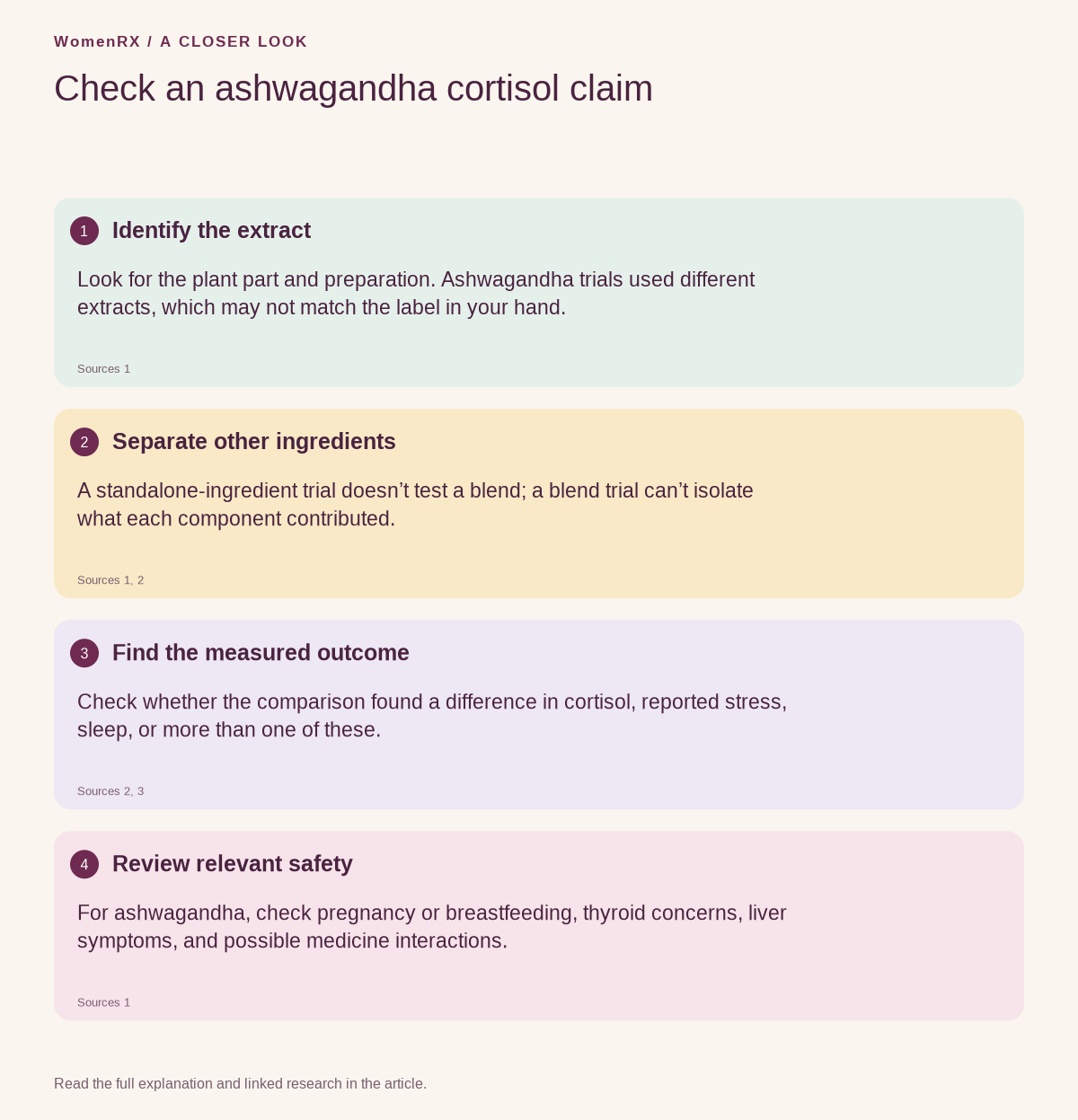
Check an ashwagandha cortisol claim
Identify the extract: Look for the plant part and preparation. Ashwagandha trials used different extracts, which may not match the label in your hand.1
Separate other ingredients: A standalone-ingredient trial doesn’t test a blend; a blend trial can’t isolate what each component contributed.12
Find the measured outcome: Check whether the comparison found a difference in cortisol, reported stress, sleep, or more than one of these.23
Review relevant safety: For ashwagandha, check pregnancy or breastfeeding, thyroid concerns, liver symptoms, and possible medicine interactions.1
Read the figure as text
Use these four checks to see what an ashwagandha study can tell you about a product, and where the comparison stops.- Identify the extract: Look for the plant part and preparation. Ashwagandha trials used different extracts, which may not match the label in your hand.1
- Separate other ingredients: A standalone-ingredient trial doesn’t test a blend; a blend trial can’t isolate what each component contributed.12
- Find the measured outcome: Check whether the comparison found a difference in cortisol, reported stress, sleep, or more than one of these.23
- Review relevant safety: For ashwagandha, check pregnancy or breastfeeding, thyroid concerns, liver symptoms, and possible medicine interactions.1
Sources you can check
- Ashwagandha: Is it helpful for stress, anxiety, or sleep? - Health Professional Fact SheetAccessed 2026-09-25Return to first citation
- A proprietary herbal extract of ashwagandha root for stress and anxiety in healthy adults: a randomized, double-blind, three-arm, placebo-controlled efficacy and safety study.West RE, Biswas A, Rao R, Tayade H, Ademola J. · Journal of medicine and life · 2026Return to first citation
- A New Ashwagandha Formulation (Zenroot™) Alleviates Stress and Anxiety Symptoms While Improving Mood and Sleep Quality: A Randomized, Double-Blind, Placebo-Controlled Clinical Study.Mahadevan M, Gopukumar K, Gupta R, Morde A, Patni P, Srinivas SS, Bhuvanendran A, Phanindra A. · Advances in therapy · 2025Return to first citation
- An investigation into the stress-relieving and pharmacological actions of an ashwagandha (Withania somnifera) extract: A randomized, double-blind, placebo-controlled study.Lopresti AL, Smith SJ, Malvi H, Kodgule R. · Medicine · 2019Return to first citation