Can Supplements Lower Cortisol? How to Judge the Claims
Some ashwagandha trials found changes in cortisol and reported stress, but a hormone reading alone doesn’t tell you whether a supplement will help.
Some ashwagandha extracts have lowered measured cortisol compared with placebo in short trials of adults experiencing stress or anxiety. Those trials also found improvements in reported stress or anxiety, but they used different preparations and don’t establish that every product works. Evidence from athletes under intense training answers a different question, especially when you’re looking for help with everyday stress. 1 4
What would a lower cortisol reading mean for you?
Cortisol is a stress hormone, but stress hormones also help your body become alert and respond to a challenge. A lower cortisol measurement isn’t automatically a better health outcome. What matters alongside the reading is whether people slept better, felt less stressed, or experienced another change they cared about. 1 2
That gives you three questions for any “cortisol support” claim: What ingredient was tested? Who took it, and under what circumstances? Did a meaningful outcome change, or only a measurement? The answers can be quite different from one study to the next.
Ashwagandha: the clearest match for everyday stress claims
A 2021 systematic review described seven randomized trials involving 491 adults in India. Participants reported high stress or anxiety, or had an anxiety disorder. Over six to eight weeks, the ashwagandha groups overall had lower serum cortisol and better scores on validated stress or anxiety scales than placebo groups. The trials tested different extracts and a dried-root preparation, not one interchangeable product. 1
Later trials offer a more mixed picture. In one study of adults reporting stress, an ashwagandha group had lower saliva cortisol than placebo and participants reported improvements on stress-related scales. Another trial found lower serum cortisol alongside better reported stress and sleep. But a 12-week trial in adults experiencing low energy and fatigue found less fatigue without a reduction in perceived stress. 1
So ashwagandha has evidence for both cortisol measurements and outcomes people can feel, but not a reliable promise for every product or every concern. The studies don’t show that the cortisol change caused the improvements in reported stress or sleep. Their varied preparations also make it difficult to choose one extract or amount from the results. 1
The trials described by the NIH Office of Dietary Supplements include men and women, but the reported summaries don’t provide separate effect estimates for women. They can’t establish a distinct benefit during cycling years, postpartum, perimenopause, or postmenopause. Pregnancy and breastfeeding raise separate safety concerns, rather than being life stages to which these stress findings can simply be extended. 1
Why an athlete’s cortisol result may not fit your question
A randomized trial tested CoQ10 and taurine against placebo in 24 male under-19 soccer players completing repeated intense exercise sessions. Researchers reported a cortisol result favoring CoQ10 among several exercise-related biomarkers. That’s preliminary evidence in a specific training setting, not evidence that CoQ10 helps women feel less stressed in daily life. 4
A study involving women doesn’t necessarily settle the question either. In a randomized trial of 28 female weightlifters reducing weight before competition, the intervention combined personalized nutrition, supplementation, food logs, and consultations. Researchers reported a higher testosterone-to-cortisol ratio and better fatigue and sleep outcomes in the intervention group. Because so many parts changed together, the trial can’t tell you whether a particular supplement lowered cortisol. 3
These studies are useful reminders to read past the word cortisol. A hormone measured during strenuous exercise, a hormone ratio, and a person’s experience of ongoing stress are different outcomes.
A quick screen for a “cortisol support” label
- Match the ingredient. If a product contains phosphatidylserine or a blend, an ashwagandha trial doesn’t establish what that product will do. Even ashwagandha studies used preparations that differed from one another. 1
- Look for the outcome you want. If sleep is the problem, check sleep results. If it’s feeling overwhelmed, look for reported stress outcomes, not just a cortisol measurement. 1
- Check who was studied. Adults reporting stress and male adolescent athletes under intense training aren’t interchangeable groups. Neither study setting establishes a women-specific effect without results reported for women. 1 4
- Notice the timeframe. Most of the relevant ashwagandha stress trials were short. A result after several weeks doesn’t establish what happens with long-term use. 1
Safety belongs in the decision, too
Ashwagandha was generally tolerated in studies lasting up to about three months, but longer-term safety isn’t known. Reported concerns include possible liver injury and effects on thyroid function. It may interact with thyroid hormone medicines, sedatives, blood-pressure medicines, diabetes medicines, and immunosuppressants. If you take one of these, that matters before trying it, not only after a side effect appears. 1
The NIH Office of Dietary Supplements reports that some experts advise against ashwagandha during pregnancy; it also notes a French food-safety agency recommendation against use during pregnancy and breastfeeding. Those cautions reflect safety uncertainty and shouldn’t be mistaken for a finding that every exposure causes harm. 1
The practical choice isn’t between “lowering cortisol” and doing nothing. It’s deciding whether a specific product has evidence for the change you actually want, in people whose situation resembles yours, with safety limits you can weigh.
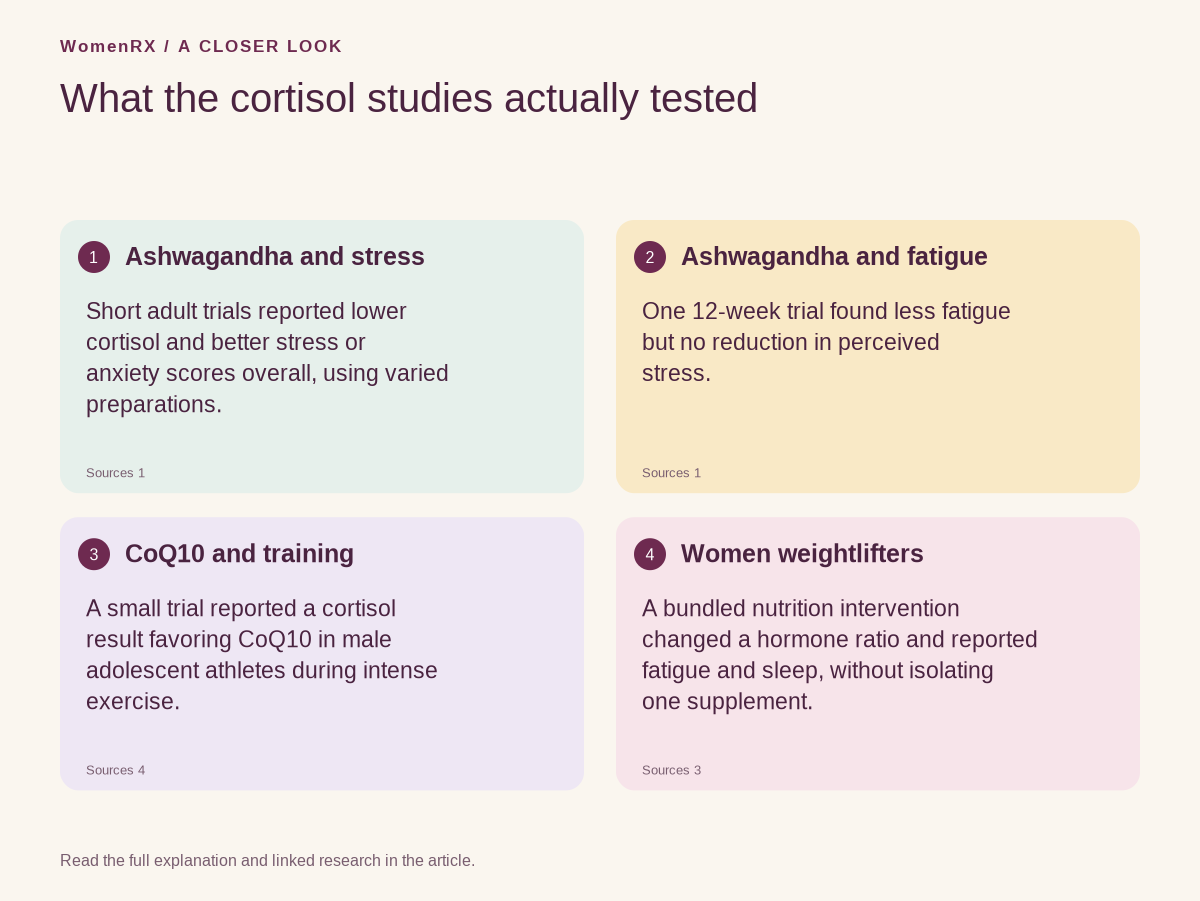
What the cortisol studies actually tested
Ashwagandha and stress: Short adult trials reported lower cortisol and better stress or anxiety scores overall, using varied preparations.1
Ashwagandha and fatigue: One 12-week trial found less fatigue but no reduction in perceived stress.1
CoQ10 and training: A small trial reported a cortisol result favoring CoQ10 in male adolescent athletes during intense exercise.4
Women weightlifters: A bundled nutrition intervention changed a hormone ratio and reported fatigue and sleep, without isolating one supplement.3
Read the figure as text
Compare the population and outcome before applying a supplement claim to your own situation.- Ashwagandha and stress: Short adult trials reported lower cortisol and better stress or anxiety scores overall, using varied preparations.1
- Ashwagandha and fatigue: One 12-week trial found less fatigue but no reduction in perceived stress.1
- CoQ10 and training: A small trial reported a cortisol result favoring CoQ10 in male adolescent athletes during intense exercise.4
- Women weightlifters: A bundled nutrition intervention changed a hormone ratio and reported fatigue and sleep, without isolating one supplement.3
Sources you can check
- Ashwagandha: Is it helpful for stress, anxiety, or sleep? - Health Professional Fact SheetAccessed 2026-09-25Return to first citation
- Stress: MedlinePlusAccessed 2026-09-25Return to first citation
- Enhancing performance through biochemical monitoring and nutritional support in female weightlifters during pre-competition weight reduction: a randomized trial.Yu L, Cheng L. · Journal of the International Society of Sports Nutrition · 2024Return to first citation
- Practical Nutritional Strategies to Attenuate Physiological Stress in Adolescent Soccer Players: A Comparative Trial of CoQ10 and Taurine.Alsinani Y, Al-Busafi M, Shirvani H. · Nutrients · 2026Return to first citation