Taurine Supplements: What Human Studies Really Show
Taurine is found in the body and diet, but supplement studies test specific doses in specific groups, not a general wellness benefit.
Taurine is made by the body and also comes from food, so a supplement isn’t automatically necessary. Human studies have tested it for outcomes such as metabolic markers, exercise capacity, and fatigue, using different doses and populations. Some results are promising, but they don’t establish one dose or benefit for everyone, and evidence for women, pregnancy, and breastfeeding is limited in these studies. 1 2 4 5
Taurine from your body and your diet
Taurine is a sulfur-containing compound present in body tissues. Your body can make it from other amino acids, and you also get it through food. It isn’t a protein-building amino acid, and a review reports that the body’s own production and dietary intake appear sufficient for basic health. That makes a supplement different from correcting a proven deficiency: taking more isn’t automatically necessary just because taurine has important roles in the body. 1 4
What human studies have tested
A 2026 systematic review and meta-analysis combined 27 clinical trials involving 1,030 adults. The trials tested taurine in populations with conditions that share some processes of interest, such as inflammation or metabolic dysfunction. The review reported improvements in several measured markers, including blood sugar and blood lipids, as well as blood pressure and exercise capacity. It found no significant effect on neurocognition. These are varied outcomes, and changes in a lab marker don’t by themselves show that a person will feel better or avoid illness. 2
The review did not include trials specifically testing taurine in people diagnosed with long COVID. It used studies in other populations as a way to examine related processes. So its findings don’t establish taurine as a treatment for long COVID. 2
Individual trials show why the population and outcome matter. In a 12-week randomized trial of 220 adults with decompensated cirrhosis and fatigue, taurine at 1,000 mg per day did not significantly improve fatigue overall compared with standard care. A possible benefit in participants without anemia came from a post hoc subgroup analysis, so it remains a preliminary finding rather than a result to generalize. 5
A separate 12-week trial tested 3 g per day in 44 men with obesity, with or without a structured exercise program. The combination of exercise and taurine was associated with changes in body composition and certain blood markers. The small, men-only study cannot show that taurine alone produces those changes or that the result applies to women. 3
Doses vary, and no general dose follows
The examples above used 1 g per day in adults with cirrhosis and 3 g per day in men with obesity. A 2026 review describes human trials using 1-6 g per day, but that range spans different studies and purposes; it isn’t a recommended amount for a particular goal. A dose tested in one condition, or alongside exercise, shouldn’t be treated as a dose proven to work for you. 3 4 5
What safety information can and can’t tell you
In the cirrhosis trial, 11.8% of participants assigned taurine had adverse events, and the reported events were mild. That is useful information about one dose and one medically specific group over 12 weeks, not a broad guarantee of safety for other people or longer use. The 27-trial review describes tolerability but does not provide enough detail in its summary to establish a universal safety profile. 2 5
The studies summarized here don’t establish a dose or safety profile for pregnancy or breastfeeding. They also don’t report enough about women’s results to tell whether the findings differ by sex. If you’re considering taurine for a particular goal, focus on evidence for that goal and population, rather than treating general claims about metabolism, aging, or performance as established benefits.
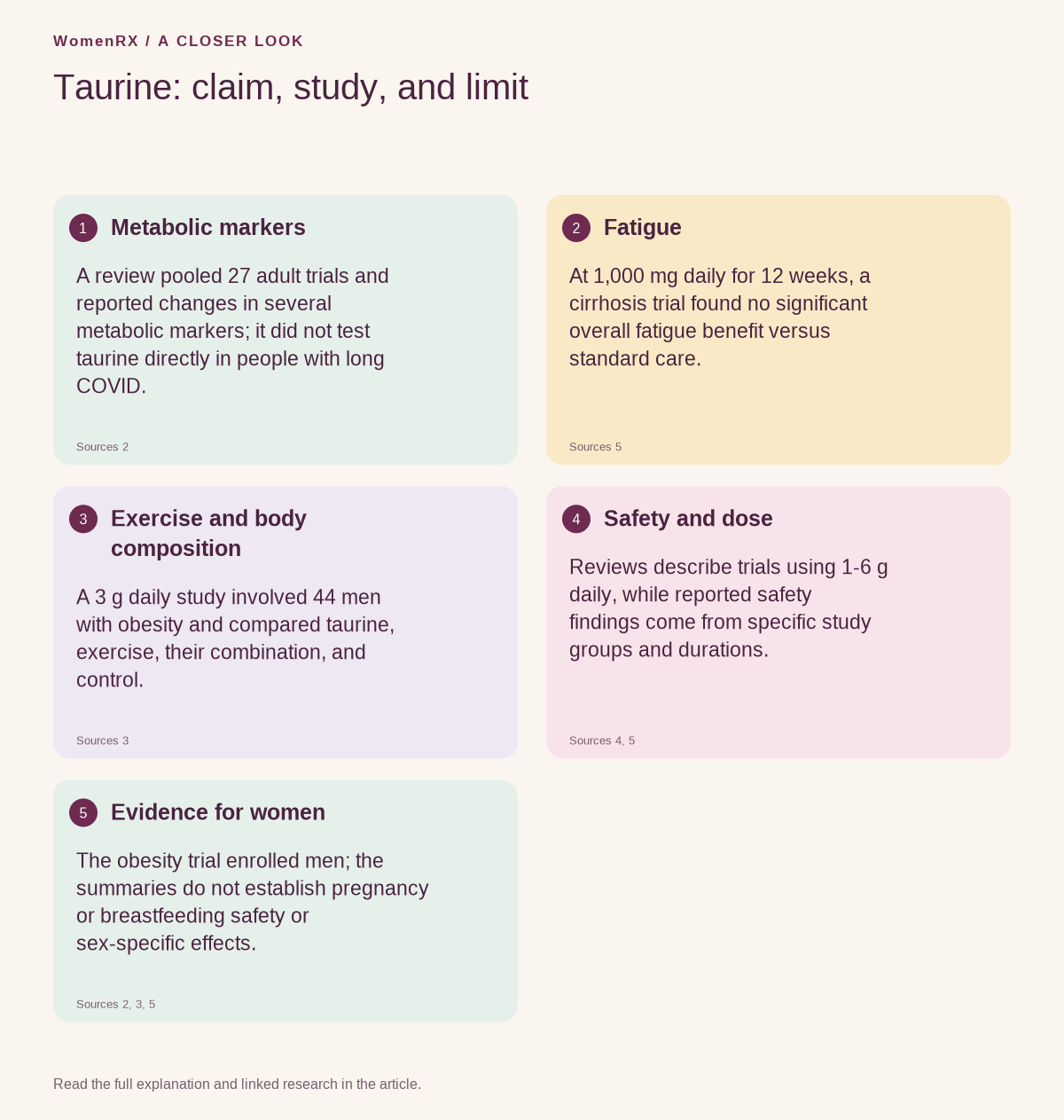
Taurine: claim, study, and limit
Metabolic markers: A review pooled 27 adult trials and reported changes in several metabolic markers; it did not test taurine directly in people with long COVID.2
Fatigue: At 1,000 mg daily for 12 weeks, a cirrhosis trial found no significant overall fatigue benefit versus standard care.5
Exercise and body composition: A 3 g daily study involved 44 men with obesity and compared taurine, exercise, their combination, and control.3
Safety and dose: Reviews describe trials using 1-6 g daily, while reported safety findings come from specific study groups and durations.45
Evidence for women: The obesity trial enrolled men; the summaries do not establish pregnancy or breastfeeding safety or sex-specific effects.235
Read the figure as text
These examples show what human studies measured, who took part, and why a result in one group may not answer the question for another.- Metabolic markers: A review pooled 27 adult trials and reported changes in several metabolic markers; it did not test taurine directly in people with long COVID.2
- Fatigue: At 1,000 mg daily for 12 weeks, a cirrhosis trial found no significant overall fatigue benefit versus standard care.5
- Exercise and body composition: A 3 g daily study involved 44 men with obesity and compared taurine, exercise, their combination, and control.3
- Safety and dose: Reviews describe trials using 1-6 g daily, while reported safety findings come from specific study groups and durations.45
- Evidence for women: The obesity trial enrolled men; the summaries do not establish pregnancy or breastfeeding safety or sex-specific effects.235
Sources you can check
- Taurine supplementation and systemic lupus erythematosus in preclinical studies: a systematic review of clinical outcomes and underlying mechanisms.Malek Mahdavi A, Javadivala Z, Orooji N. · Amino acids · 2026Return to first citation
- Taurine supplementation as a therapeutic strategy for cellular senescence and chronic inflammation in long COVID: a systematic review and meta-analysis.Wang K, Ma CH, Khoramjoo M, Kung JY, Oudit GY. · BMC infectious diseases · 2026Return to first citation
- Combined Aerobic-Resistance Training and Taurine Supplementation Reduce Asprosin and Elevate Spexin in Men with Obesity: A 12-Week Supplement-Blinded, Randomized Controlled Trial.Saedmocheshi S, Dhahbi W, Saeidi A, Rahmani A. · Nutrients · 2026Return to first citation
- Taurine supplementation at the crossroads of metabolism, inflammation and aging: mechanistic and nutritional perspectives.Beine BJ, Castellano M, Fiamoncini J, Hiller K. · Food & function · 2026Return to first citation
- A randomized controlled trial of L-taurine for fatigue in decompensated cirrhosis.Sasidharan S, Philips CA, Philips CA, Tharakan A, Ahamed R, Oommen TT, Menachery J, Varghese R, Augustine P. · Hepatology communications · 2026Return to first citation