Taurine After 40: What Human Studies Actually Show
The clearest clinical findings are tied to cirrhosis, not to being over 40 or going through menopause.
Being over 40, by itself, isn’t a reason to expect a specific benefit from taurine. The human findings described here come from people with cirrhosis: one review notes trials for muscle cramps, while a randomized trial found no meaningful overall improvement in fatigue. Neither finding establishes a benefit for healthy midlife women or a menopause-related concern. 1 2
Age isn’t the condition these studies tested
“Over 40” can describe very different stages of life, from regular menstrual cycles to perimenopause and postmenopause. But the clinical findings discussed here focus on cirrhosis, a serious liver disease, rather than aging or menopause. The studies don’t establish that taurine offsets age-related changes or has a distinct benefit for women in midlife.
That distinction matters: a result in people being treated for a specific disease doesn’t automatically apply to someone who is otherwise healthy and considering a supplement for energy, sleep, or general wellness.
What the cirrhosis research can tell you
A review of cirrhosis care describes clinical trials in which taurine was used to reduce muscle cramps. It identifies cramps as one of several symptoms that can be addressed in people with cirrhosis, but the review summary doesn’t provide the trial details or the size of taurine’s effect. So this is a condition-specific signal, not evidence that taurine generally prevents cramps in women over 40. 2
Fatigue has a clearer trial result. In a randomized study in South India, 202 adults with decompensated cirrhosis completed 12 weeks of taurine plus standard care or standard care alone. Fatigue scores improved in both groups, but the difference between groups was not statistically significant: the average change favored taurine by 1.25 points, with a 95% confidence interval from 3.55 points favoring taurine to 1.05 points favoring standard care. The researchers concluded that taurine did not improve fatigue overall in this group. 1
The trial was open-label, meaning participants knew which care they received. Its possible benefit in a small subgroup without anemia was a post hoc finding, not a confirmed result. It’s a reason for further study in that specific setting, not a basis for expecting taurine to help fatigue in midlife women. 1
What’s missing for a midlife decision
The reported fatigue trial does not give an age breakdown that lets you judge how many participants were over 40, or report a women-only or menopause-specific result. The cirrhosis review’s summary likewise doesn’t identify a menopause subgroup. These findings therefore can’t answer whether taurine helps perimenopausal symptoms, postmenopausal concerns, or common fatigue unrelated to cirrhosis. 1 2
If you’re considering taurine for a particular concern, the useful question is whether a study tested that concern in people like you, and whether it found a meaningful improvement compared with usual care or placebo. A finding for cirrhosis-related cramps is not the same as a finding for ordinary muscle cramps; a fatigue result in advanced liver disease is not a result for menopause-related fatigue.
For now, these studies offer a narrow, condition-specific picture. They don’t provide a reason to take taurine simply because you’re over 40, and they don’t establish a specific benefit for women during or after menopause.
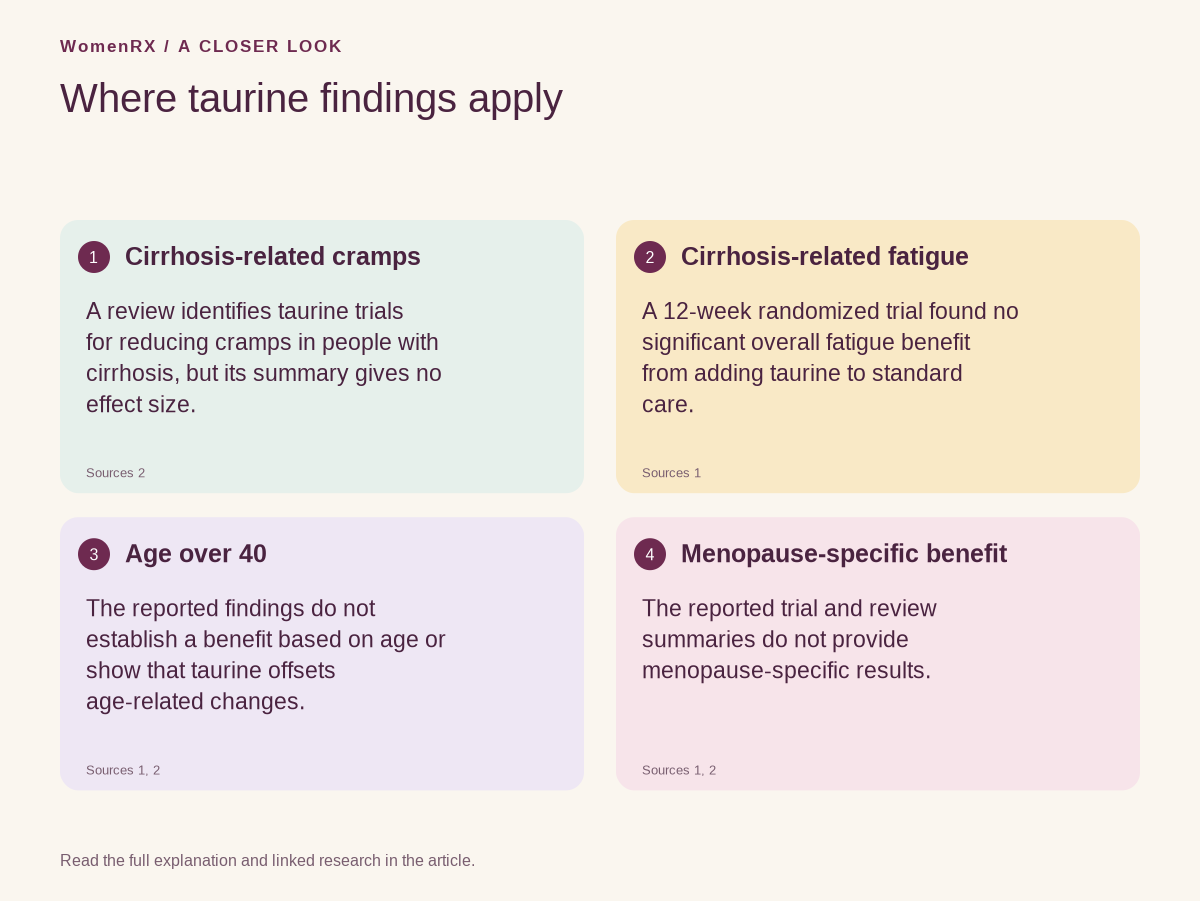
Where taurine findings apply
Cirrhosis-related cramps: A review identifies taurine trials for reducing cramps in people with cirrhosis, but its summary gives no effect size.2
Cirrhosis-related fatigue: A 12-week randomized trial found no significant overall fatigue benefit from adding taurine to standard care.1
Age over 40: The reported findings do not establish a benefit based on age or show that taurine offsets age-related changes.12
Menopause-specific benefit: The reported trial and review summaries do not provide menopause-specific results.12
Read the figure as text
The clinical findings discussed here come from cirrhosis research. They should not be mistaken for evidence about aging or menopause.- Cirrhosis-related cramps: A review identifies taurine trials for reducing cramps in people with cirrhosis, but its summary gives no effect size.2
- Cirrhosis-related fatigue: A 12-week randomized trial found no significant overall fatigue benefit from adding taurine to standard care.1
- Age over 40: The reported findings do not establish a benefit based on age or show that taurine offsets age-related changes.12
- Menopause-specific benefit: The reported trial and review summaries do not provide menopause-specific results.12
Sources you can check
- A randomized controlled trial of L-taurine for fatigue in decompensated cirrhosis.Sasidharan S, Philips CA, Philips CA, Tharakan A, Ahamed R, Oommen TT, Menachery J, Varghese R, Augustine P. · Hepatology communications · 2026Return to first citation
- Diagnosis and Management of Cirrhosis and Its Complications: A Review.Tapper EB, Parikh ND. · JAMA · 2023Return to first citation