What We Know About Taking Taurine Long Term
Short-term human studies offer some reassurance, but they don’t identify a taurine dose shown safe for years of use.
A four-week trial of taurine alone reported no adverse side effects, but its safety finding wasn’t tied to a specific dose. A study lasting about 12 weeks reported infrequent, mild adverse events with a product containing taurine and N-acetylcysteine. Neither establishes a safe dose for years of use. Pregnancy or breastfeeding participation and safety outcomes aren’t specified in the cited findings. 1 2
What the short-term studies can tell you
The clearest taurine-only comparison comes from a randomized trial involving people with chronic liver disease and frequent muscle cramps. Participants received taurine or placebo for four weeks, then switched treatments. The trial tested varying taurine doses and reported no adverse side effects associated with taurine. It did not link that safety finding to any one dose. Of 49 people enrolled, 30 completed the protocol, and 70% of participants were male. Women-specific safety results weren’t reported. 1
You may see 2 grams a day mentioned in connection with this trial. Participants receiving that amount had fewer, shorter and less severe cramps than with placebo. That’s a finding about cramps in this particular group, not a demonstration that 2 grams a day is safe for long-term use. 1
A second study followed adults with stages 1-3 chronic kidney disease for about 12 weeks. It compared standard care with standard care plus a product containing 500 mg taurine and 150 mg N-acetylcysteine. Adverse events in the combination-product group were reported as infrequent and mild, with no serious events. This was a retrospective comparison, not a randomized test of taurine alone, so it cannot tell you which ingredient contributed to the tolerability finding. Women were included, but women-specific safety outcomes weren’t reported. 2
Together, these findings offer limited reassurance within two specific settings: weeks of taurine use in people with liver disease, and weeks of a two-ingredient product in people with kidney disease. They don’t establish what happens when someone takes taurine every day for years. 1 2
Compare your product with what was studied
If you’re deciding whether to continue, look at three details on your label: the amount of taurine, whether it’s paired with other ingredients, and how long you’ve been taking it. A taurine-only capsule and a multi-ingredient blend aren’t interchangeable when you’re weighing the research. The four-week trial’s no-side-effects finding wasn’t dose-specific, while the longer study used taurine alongside N-acetylcysteine. Neither gives you a proven long-term safe dose to match against your label. 1 2
Your health conditions affect how closely either study resembles your situation. Having chronic liver or kidney disease doesn’t automatically make these results more applicable: the liver trial enrolled people with frequent cramps, and the kidney study assessed a combination product alongside standard care. Neither tested whether continuing taurine indefinitely is safe for people with those conditions. 1 2
These studies also don’t establish whether taurine interacts with particular medicines or supplements. That isn’t evidence that interactions occur or that they don’t. If you take prescription medicines or use a blend with several active ingredients, bringing the product label and your medication list to a pharmacist is a practical way to check your particular combination. 1 2
Pregnancy and breastfeeding need their own answer
The cited findings don’t specify whether pregnant or breastfeeding people participated or provide safety outcomes for those stages. Adult findings from these studies therefore can’t answer whether continuing a taurine supplement during pregnancy or breastfeeding is safe. If either applies to you, make that clear when reviewing the specific product and your other medicines with your pregnancy or postpartum care team. 1 2
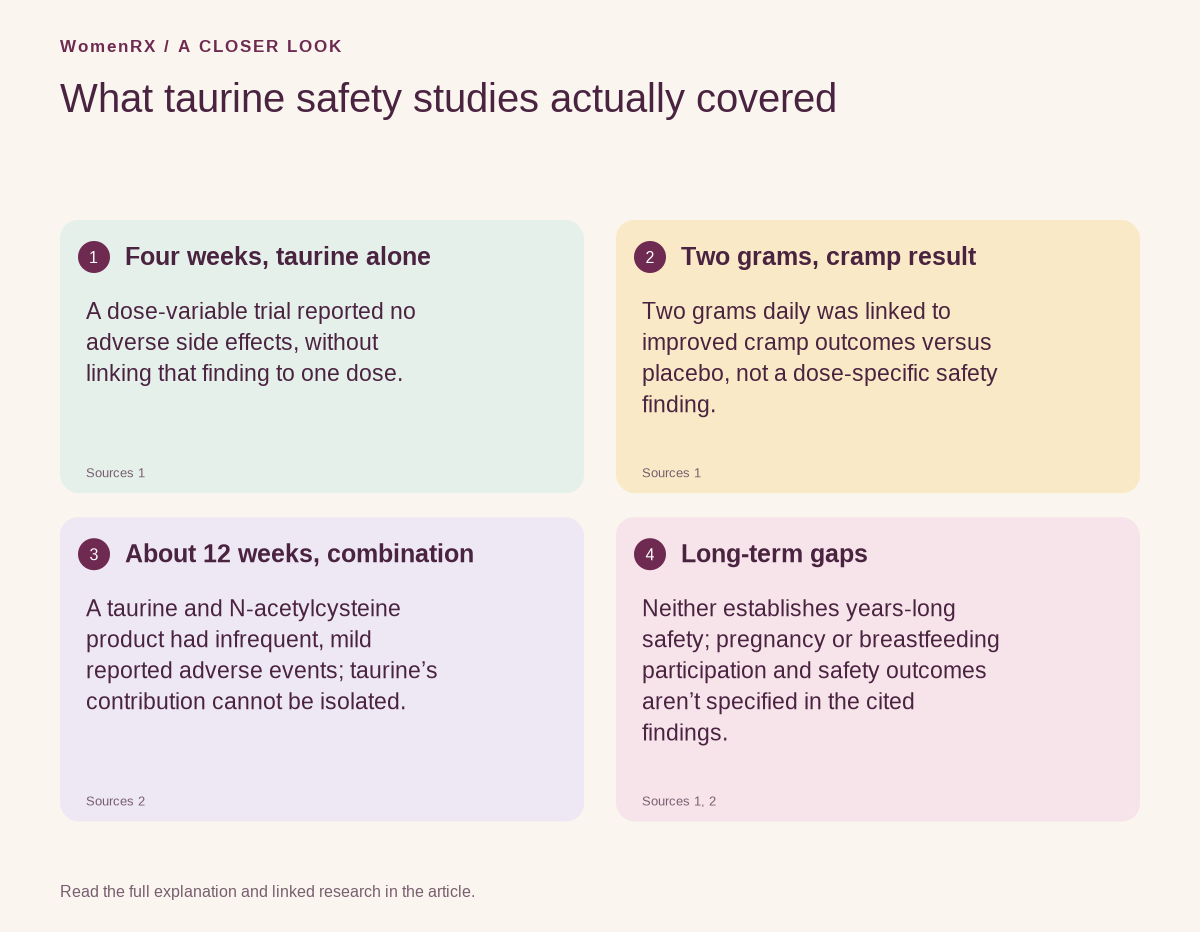
What taurine safety studies actually covered
Four weeks, taurine alone: A dose-variable trial reported no adverse side effects, without linking that finding to one dose.1
Two grams, cramp result: Two grams daily was linked to improved cramp outcomes versus placebo, not a dose-specific safety finding.1
About 12 weeks, combination: A taurine and N-acetylcysteine product had infrequent, mild reported adverse events; taurine’s contribution cannot be isolated.2
Long-term gaps: Neither establishes years-long safety; pregnancy or breastfeeding participation and safety outcomes aren’t specified in the cited findings.12
Read the figure as text
The studied duration, dose information and ingredients differ in ways that matter when considering ongoing use.- Four weeks, taurine alone: A dose-variable trial reported no adverse side effects, without linking that finding to one dose.1
- Two grams, cramp result: Two grams daily was linked to improved cramp outcomes versus placebo, not a dose-specific safety finding.1
- About 12 weeks, combination: A taurine and N-acetylcysteine product had infrequent, mild reported adverse events; taurine’s contribution cannot be isolated.2
- Long-term gaps: Neither establishes years-long safety; pregnancy or breastfeeding participation and safety outcomes aren’t specified in the cited findings.12
Sources you can check
- Randomised clinical trial: oral taurine supplementation versus placebo reduces muscle cramps in patients with chronic liver disease.Vidot H, Cvejic E, Carey S, Strasser SI, McCaughan GW, Allman-Farinelli M, Shackel NA. · Alimentary pharmacology & therapeutics · 2018Return to first citation
- Dual Antioxidant Supplementation With N-Acetylcysteine and Taurine (Nefrosave®) for Cardio-Renal Protection in Chronic Kidney Disease Patients With Diabetes and/or Hypertension: A Real-World, Retrospective, Comparative Study.Kumari R, Jayaraman GV, Dutta SK, Pande A, Vijayakumar M, Bhupal VSR, Jariwala P, Palimkar P, Rungta S, Rajani D, Banerjee G, Kumar S, Kothari DD, Tolchand JL, Panchal P, Nagashank... · Cardiology research · 2026Return to first citation