What We Know About Taking Schisandra Long Term
A few reports describe short-term use, but they don’t establish whether Schisandra supplements are safe to take for months or years.
Long-term safety of Schisandra supplements isn’t established by the human evidence described here. A review mentions two short-term studies with no reported side effects, but their details don’t answer what happens with extended use, prescription medicines, or chronic conditions. If you’re considering continuing, have a pharmacist or prescriber review your exact product and medication list; pregnancy and breastfeeding safety also aren’t established by these reports. 1
What the human reports can tell you
The human safety picture is limited. A 2025 review describes a randomized, placebo-controlled study of 54 older adults that reported no side effects, along with a study of Schisandra for hypertension that also recorded none. The review characterizes these findings as short-term, but the details provided don’t specify how long people took the products or establish safety over months or years. These reports offer some reassurance about the studied use, not a long-term safety record. 1
That distinction matters if you’re deciding whether to keep taking a supplement. A traditional history of use isn’t the same as evidence about a particular modern supplement, its formulation, or prolonged use. Schisandra products can differ, and evidence about one preparation can’t automatically answer questions about another.
Make medicines and health conditions part of the decision
The human reports summarized here don’t answer whether Schisandra affects prescription medicines or is suitable for a particular chronic condition. That’s an evidence gap, not proof that interactions occur, and not proof that they don’t. A 2025 review discusses potential use alongside conventional care but also calls for further clinical trials to validate use in diverse populations. 2
If you take prescription medicine or manage an ongoing condition, ask a pharmacist or prescriber to review the specific product before you continue. Bring the container or a clear photo of its Supplement Facts and ingredients, and mention how long you’ve been taking it. That gives them a chance to consider the actual preparation and your full medication list rather than treating all Schisandra products as interchangeable. Don’t change a prescribed medicine to make room for a supplement.
Pregnancy and breastfeeding are a separate question
The human safety reports described in the review don’t establish safety during pregnancy or breastfeeding. Findings in older adults, or in a study of people with hypertension, can’t answer that question. If you’re pregnant, breastfeeding, or trying to conceive, don’t assume general-adult findings apply to you. 1
Product quality adds another layer
A small 2025 analysis tested 11 adaptogenic supplements sold in Poland, including two Schisandra preparations: dried fruit and a tablet. The researchers reported contamination concerns across the products and said Schisandra preparations showed the highest contamination levels in their sample. This is a warning about those tested products, not a measure of every Schisandra supplement or of products sold in the United States. 3
So duration alone isn’t a reliable safety test. The human evidence doesn’t establish long-term safety, and the product you buy may not be identical to preparations used in research. If continuing Schisandra matters to you, make the decision with the exact product and your medicines and health conditions in view.
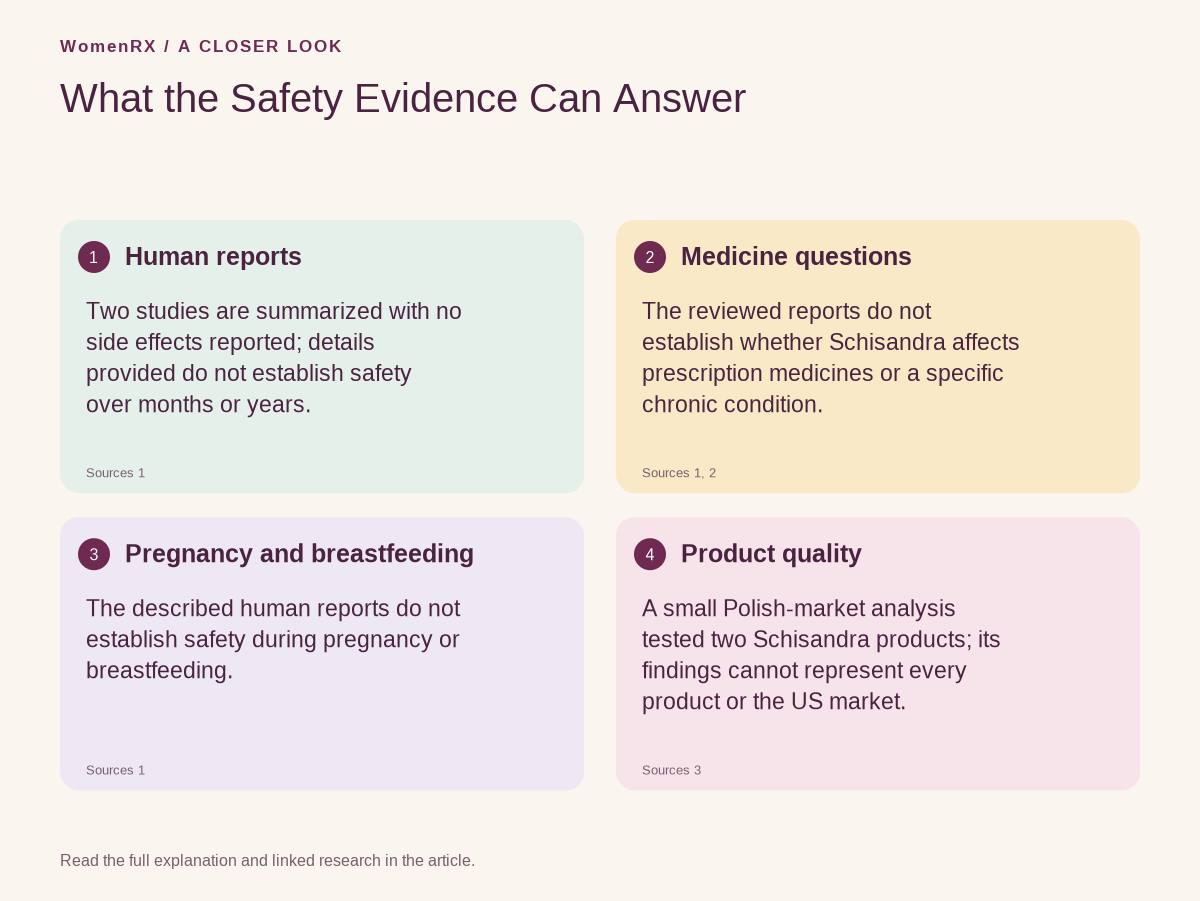
What the Safety Evidence Can Answer
Human reports: Two studies are summarized with no side effects reported; details provided do not establish safety over months or years.1
Medicine questions: The reviewed reports do not establish whether Schisandra affects prescription medicines or a specific chronic condition.12
Pregnancy and breastfeeding: The described human reports do not establish safety during pregnancy or breastfeeding.1
Product quality: A small Polish-market analysis tested two Schisandra products; its findings cannot represent every product or the US market.3
Read the figure as text
Separate the limited human reports from the questions that still matter when deciding whether to continue a supplement.- Human reports: Two studies are summarized with no side effects reported; details provided do not establish safety over months or years.1
- Medicine questions: The reviewed reports do not establish whether Schisandra affects prescription medicines or a specific chronic condition.12
- Pregnancy and breastfeeding: The described human reports do not establish safety during pregnancy or breastfeeding.1
- Product quality: A small Polish-market analysis tested two Schisandra products; its findings cannot represent every product or the US market.3
More questions, answered
Does “no side effects reported” mean Schisandra is proven safe?
No. It means no side effects were recorded in the particular studies described. Those reports don’t establish long-term safety or settle questions about other products and populations. 1
Sources you can check
- Efficacy of Schisandra chinensis in liver injury: a systematic review and preclinical meta-analysis.Huang BH, Lv BH, Wu DJ, Xiong FY, Li YB, Lu YP, Lv WL. · Frontiers in pharmacology · 2025Return to first citation
- Schisandra chinensis in noncommunicable disease management: therapeutic prospects within the PPPM framework.Bao B, Zhang P, Li Y, Tian T, Xie Y. · The EPMA journal · 2025Return to first citation
- Heavy Metal Contamination in Adaptogenic Herbal Dietary Supplements: Experimental, Assessment and Regulatory Safety Perspectives.Jasińska-Balwierz A, Krypel P, Świsłowski P, Rajfur M, Balwierz R, Ochędzan-Siodłak W. · Biology · 2025Return to first citation