Schisandra Safety: Side Effects and Medicine Checks
A few human reports raise specific questions about schisandra and medicines, but they don’t establish how often problems happen or define its usual side effects.
Short-term studies mentioned in a review reported no side effects, but they’re not enough to define schisandra’s usual or long-term safety. A retrospective review described four adverse-event reports involving schisandra and antidepressants; another review reported a change in an inactive clopidogrel metabolite. These are reasons to review your medicines, not proof of harm. If you’re pregnant or breastfeeding, get advice before using it. 3 4 5 2 1
What’s known about side effects
There isn’t enough information to describe a reliable list of common side effects or how often they happen. A 2025 review mentions a placebo-controlled study involving 54 older adults, with no side effects noted, and a separate study in people with hypertension that recorded no side effects. Those limited observations are reassuring for the people studied, but they don’t establish long-term safety or predict how every product or person will respond. 3
The clearest specific human safety signal comes from a retrospective review of adverse-event reports involving adaptogens and antidepressants. It identified four reports involving Schisandra chinensis: joint pain and thrombocytopenia with bupropion, delirium with amitriptyline, and dysuria, or painful or difficult urination, with fluoxetine. These were reports involving combinations, not a controlled study that can establish how often a problem occurs or prove schisandra alone caused it. 4
If you take one of these antidepressants, have a pharmacist or prescriber review the exact schisandra product before you start it. If you already take both and notice a new symptom, share the timing and product details with the person managing your medication. Don’t stop a prescribed medicine on your own.
The clopidogrel finding is a different kind of signal
A review of traditional Chinese medicine and clopidogrel reported that schisandra decreased a measured amount of an inactive clopidogrel metabolite. That’s a finding about a drug-related measurement, not proof that schisandra changes clopidogrel’s antiplatelet effect, causes bleeding, or affects health outcomes. Still, if you take clopidogrel, include schisandra in a medication review rather than assuming the finding is either harmless or a confirmed clinical interaction. 5
These reports don’t establish that schisandra interacts with every antidepressant, blood thinner, birth-control medicine, or menopausal hormone treatment. Nor does a report about one medicine establish what happens with another. A pharmacist can review the specific product and your full medicine list.
Pregnancy and breastfeeding call for a separate check
If you’re pregnant, check with your health care provider before taking herbs or supplements. MedlinePlus also advises discussing medicines before starting or stopping them during pregnancy, since an untreated health condition can carry risks too. 2
Breastfeeding raises a separate question: some medicines and other substances can pass through breast milk, but that general fact doesn’t tell us whether a particular schisandra product does. Ask your clinician or pharmacist to review the exact product and your situation before using it while breastfeeding. 1
If you have a procedure planned
Add schisandra to the supplement list you share with the procedural team and ask whether they want you to make any changes. This is a practical step for coordinating care, not a claim that a specific schisandra-procedure interaction has been demonstrated.
Make the review specific to you
Bring the product label or a clear photo of it, along with a list of your prescription and over-the-counter medicines. Mention whether you’re considering a capsule, extract, or another form, and when you plan to use it. That gives a pharmacist or prescriber something specific to check instead of relying on the herb’s name alone.
Schisandra research also includes substantial animal work. A systematic review of liver-injury research included 54 animal studies, which can’t establish what effects or risks a person will experience. 3 The useful takeaway is to distinguish limited observations of tolerability from the specific interaction reports, and to get advice that fits your medicines and circumstances.
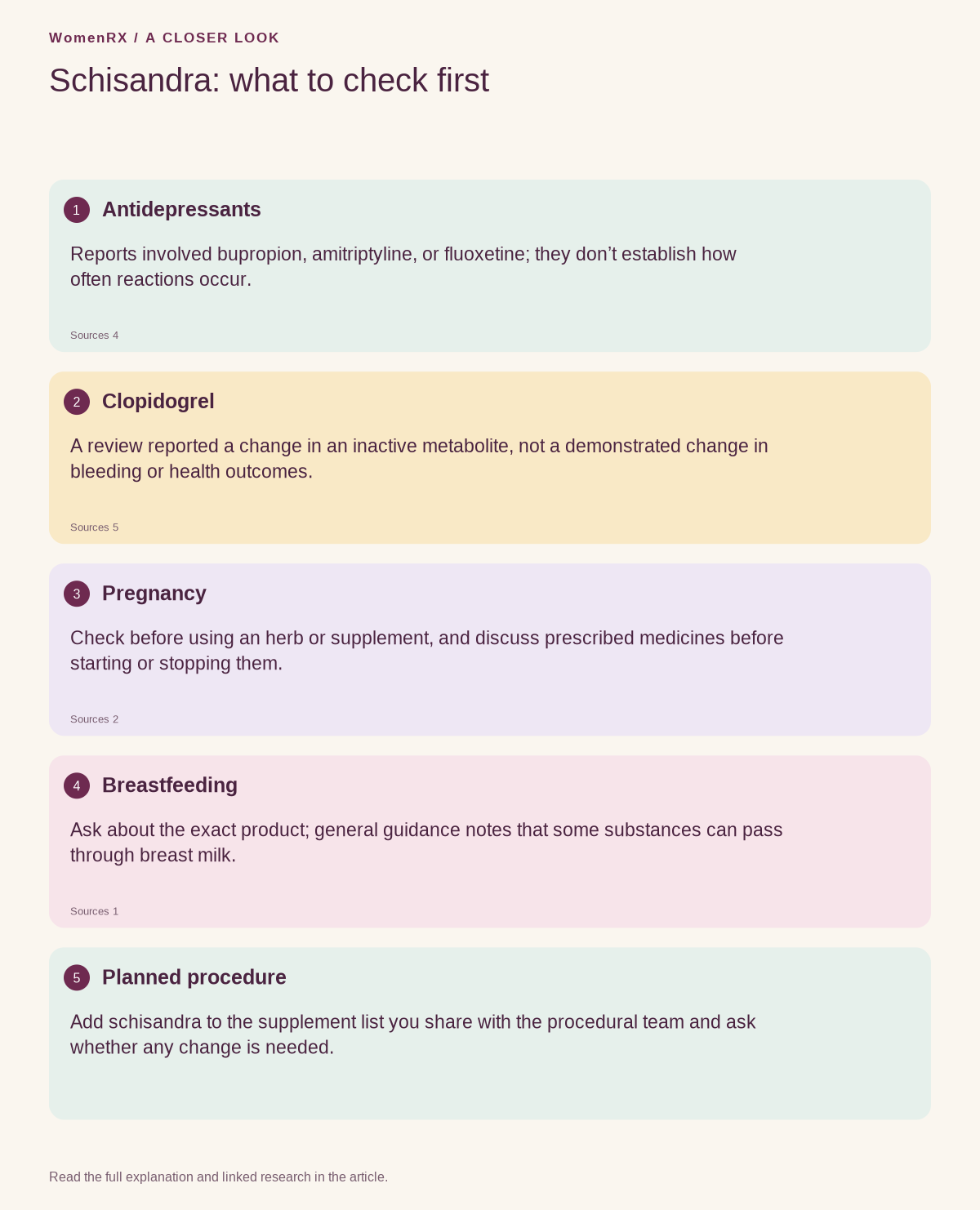
Schisandra: what to check first
Antidepressants: Reports involved bupropion, amitriptyline, or fluoxetine; they don’t establish how often reactions occur.4
Clopidogrel: A review reported a change in an inactive metabolite, not a demonstrated change in bleeding or health outcomes.5
Pregnancy: Check before using an herb or supplement, and discuss prescribed medicines before starting or stopping them.2
Breastfeeding: Ask about the exact product; general guidance notes that some substances can pass through breast milk.1
Planned procedure: Add schisandra to the supplement list you share with the procedural team and ask whether any change is needed.
Read the figure as text
Use these distinctions to decide what to bring to a medication review; reported signals are not the same as proven clinical harms.- Antidepressants: Reports involved bupropion, amitriptyline, or fluoxetine; they don’t establish how often reactions occur.4
- Clopidogrel: A review reported a change in an inactive metabolite, not a demonstrated change in bleeding or health outcomes.5
- Pregnancy: Check before using an herb or supplement, and discuss prescribed medicines before starting or stopping them.2
- Breastfeeding: Ask about the exact product; general guidance notes that some substances can pass through breast milk.1
- Planned procedure: Add schisandra to the supplement list you share with the procedural team and ask whether any change is needed.
More questions, answered
Does the clopidogrel finding prove a bleeding risk?
No. The review reported a change in a measurement of an inactive clopidogrel metabolite. It did not establish a change in bleeding risk, the drug’s clinical effect, or health outcomes. 5
Should I stop a prescribed medicine if I’m considering schisandra?
No. Talk with your prescriber or pharmacist before starting or stopping a medicine. During pregnancy especially, MedlinePlus advises weighing the risks and benefits rather than stopping a needed medicine on your own. 2
Sources you can check
- Breastfeeding | Benefits of Breastfeeding | MedlinePlusAccessed 2026-09-25Return to first citation
- Pregnancy and Medicines | MedlinePlusAccessed 2026-09-25Return to first citation
- Efficacy of Schisandra chinensis in liver injury: a systematic review and preclinical meta-analysis.Huang BH, Lv BH, Wu DJ, Xiong FY, Li YB, Lu YP, Lv WL. · Frontiers in pharmacology · 2025Return to first citation
- Harder, better, faster, stronger? Retrospective chart review of adverse events of interactions between adaptogens and antidepressant drugs.Siwek M, Woroń J, Wrzosek A, Gupało J, Chrobak AA. · Frontiers in pharmacology · 2023Return to first citation
- Interactions between clopidogrel and traditional Chinese medicine.Hu Y, Wang J. · Journal of thrombosis and thrombolysis · 2019Return to first citation