Schisandra Supplements: Weighing Benefits Against Medicine Interactions
Schisandra’s traditional uses are better documented than its benefits in people, while a human study raises a concrete medicine-interaction question.
If you’re considering schisandra for sleep, fatigue, or another health concern, traditional use doesn’t establish that it will help. The clearest human finding here concerns an interaction: in healthy volunteers, chronic use of Schisandra sphenanthera extract reduced clearance of the medicine midazolam by 52%. That result doesn’t predict what a different schisandra product will do with your medicines, but it makes a product-specific medication review worthwhile. 24
Match the evidence to your reason for taking it
Schisandra is often described as a tonic or an “adaptogen.” If you’re hoping it will help you sleep, ease fatigue, or address a health condition, those labels don’t answer the useful question: has that particular benefit been shown in people?
A review describes traditional uses of two related species, Schisandra chinensis and S. sphenanthera, including use for insomnia and as tonics. It also describes a range of proposed pharmacological effects. Traditional use and laboratory findings, though, don’t establish that a supplement treats those concerns in people. 2
The distinction matters if you’re weighing a hoped-for benefit against a possible interaction with a medicine you already need. The specific human result reported in the interaction research is about how the body handled a medicine, not whether schisandra improved someone’s health. 4
The human interaction finding, and its limits
In healthy volunteers, chronic use of an S. sphenanthera extract reduced clearance of midazolam by 52%. Clearance describes how the body removes a medicine. Slower clearance can change exposure to that medicine, but this study does not tell us what would happen with every medicine or schisandra supplement. 4
The species is worth noticing. S. chinensis and S. sphenanthera are closely related, but the amounts of some of their compounds differ. Researchers found effects of extracts from both species on drug-metabolizing activity in human liver cells. That laboratory result supports an interaction concern for S. chinensis; it is not the same as measuring an interaction in people taking a commercial S. chinensis product. 24
One reason interactions are plausible is that schisandra constituents can affect CYP3A enzymes and P-glycoprotein, which help process or transport some medicines. An interaction review identifies schisandra as a botanical of concern for effects on drug-metabolizing enzymes. Neither finding means that every medicine using those pathways will interact, or that all schisandra extracts act alike. 12
Make the medicine discussion specific
Bring the bottle or a clear photo of its label to a pharmacist or prescriber. If the species or type of extract isn’t listed, say that. Then ask: “Could this product change the effect or exposure of any medicine I take?” Include prescription medicines, over-the-counter medicines, and other supplements so the answer is tied to your actual combination.
Some examples make that conversation more focused:
- Antidepressants: A retrospective review of adverse-event reports listed schisandra taken alongside bupropion, amitriptyline, and fluoxetine, with different reported problems for each pairing. Reports flag possible concerns; they cannot tell you how often an interaction occurs or, on their own, prove that schisandra caused an event. 5
- Beta blockers: A review names schisandra among herbs that may interact with beta blockers, but its abstract does not establish an effect for a particular schisandra-and-beta-blocker pairing. Give the reviewer the name of your medicine rather than assuming all beta blockers are handled the same way. 3
- Medicines used after a transplant: S. sphenanthera extract has been used alongside immunosuppressant treatment, a setting in which researchers have examined herb-drug interaction potential. If you take an immunosuppressant, make sure it is part of the product-specific review. The midazolam result does not quantify an effect on your transplant medicine. 4
Include your life stage, without assuming a result
Pregnancy, breastfeeding, postpartum recovery, and the cycling years through postmenopause can change which questions matter to you. The interaction findings above do not establish schisandra’s safety in pregnancy or breastfeeding, its effectiveness for menopause symptoms, or how it behaves alongside hormonal contraception or fertility medicines. If any of those apply, name them when you discuss the product. An unanswered question is a reason to review your circumstances, not evidence that a particular interaction has occurred. 24
You don’t need to master enzyme names to have a useful conversation. Start with the outcome you want, identify the species and extract if you can, and put the exact supplement beside your complete medicine list. That separates a traditional claim about benefit from an interaction question that needs an individual answer.
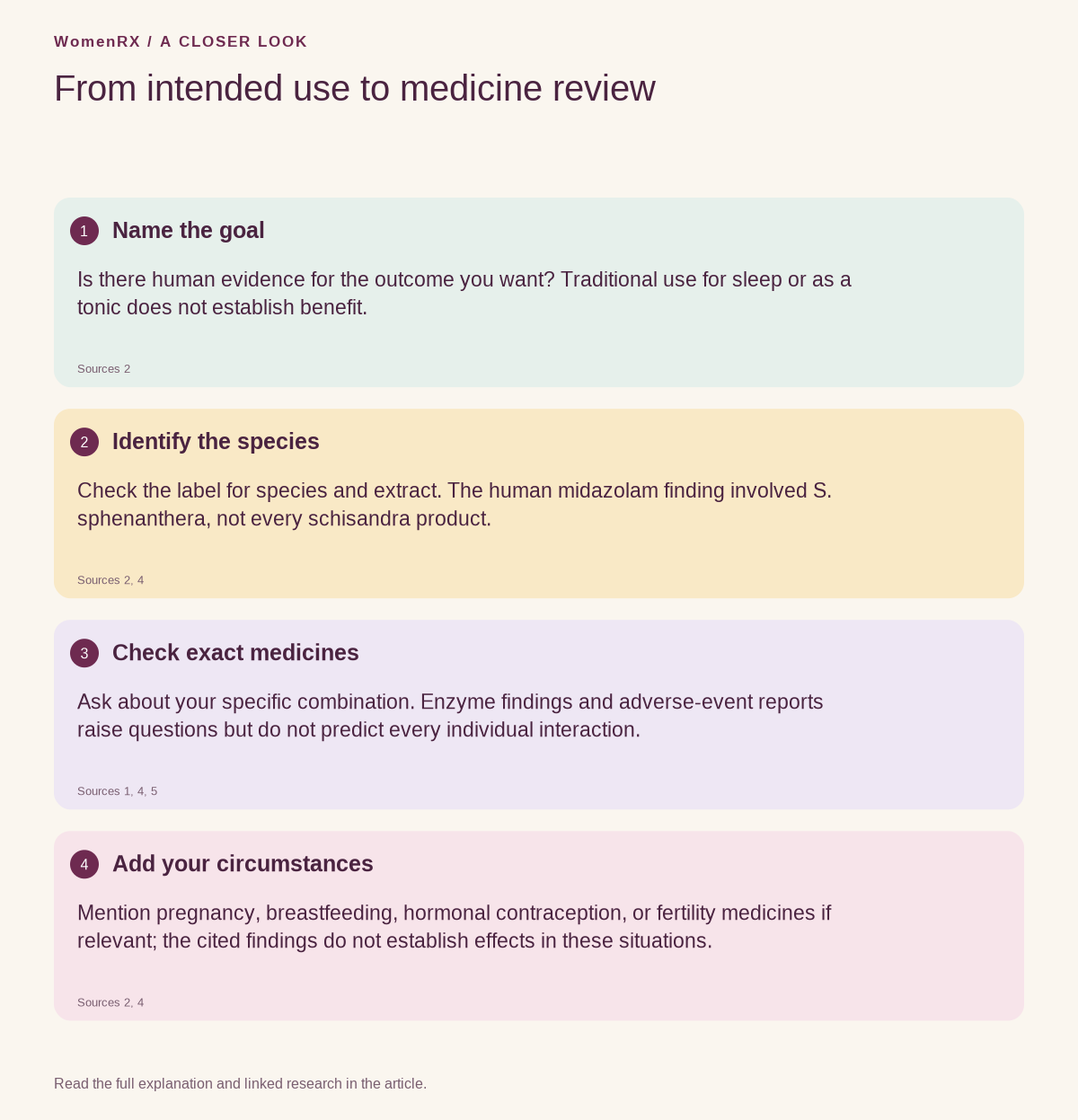
From intended use to medicine review
Name the goal: Is there human evidence for the outcome you want? Traditional use for sleep or as a tonic does not establish benefit.2
Identify the species: Check the label for species and extract. The human midazolam finding involved S. sphenanthera, not every schisandra product.24
Check exact medicines: Ask about your specific combination. Enzyme findings and adverse-event reports raise questions but do not predict every individual interaction.145
Add your circumstances: Mention pregnancy, breastfeeding, hormonal contraception, or fertility medicines if relevant; the cited findings do not establish effects in these situations.24
Read the figure as text
Use these four questions to keep benefit claims, product details, and interaction evidence separate.- Name the goal: Is there human evidence for the outcome you want? Traditional use for sleep or as a tonic does not establish benefit.2
- Identify the species: Check the label for species and extract. The human midazolam finding involved S. sphenanthera, not every schisandra product.24
- Check exact medicines: Ask about your specific combination. Enzyme findings and adverse-event reports raise questions but do not predict every individual interaction.145
- Add your circumstances: Mention pregnancy, breastfeeding, hormonal contraception, or fertility medicines if relevant; the cited findings do not establish effects in these situations.24
More questions, answered
Does the midazolam result apply to every schisandra supplement?
No. The human finding involved an S. sphenanthera extract in healthy volunteers. Related schisandra species differ in the amounts of some compounds, and laboratory findings with S. chinensis do not establish the effect of every finished product in people. 24
Sources you can check
- Pharmacokinetic herb-drug interactions (part 2): drug interactions involving popular botanical dietary supplements and their clinical relevance.Gurley BJ, Fifer EK, Gardner Z. · Planta medica · 2012Return to first citation
- A comprehensive review of ethnopharmacology, phytochemistry, pharmacology, and pharmacokinetics of Schisandra chinensis (Turcz.) Baill. and Schisandra sphenanthera Rehd. et Wils.Yang K, Qiu J, Huang Z, Yu Z, Wang W, Hu H, You Y. · Journal of ethnopharmacology · 2022Return to first citation
- A Review on Pharmacokinetic and Pharmacodynamic Drug Interactions of Adrenergic β-blockers with Clinically Relevant Drugs-An Overview.Maideen NMP, Rajkapoor B, Muthusamy S, Ramanathan S, Thangadurai SA, Sughir AA. · Current drug metabolism · 2021Return to first citation
- Prediction of Clinically Relevant Herb-Drug Clearance Interactions Using Sandwich-Cultured Human Hepatocytes: Schisandra spp. Case Study.Jackson JP, Freeman KM, Friley WW, Herman AG, Black CB, Brouwer KR, Roe AL. · Drug metabolism and disposition: the biological fate of chemicals · 2017Return to first citation
- Harder, better, faster, stronger? Retrospective chart review of adverse events of interactions between adaptogens and antidepressant drugs.Siwek M, Woroń J, Wrzosek A, Gupało J, Chrobak AA. · Frontiers in pharmacology · 2023Return to first citation