Schisandra Supplements: What to Check Before Taking One
There isn’t a daily amount you can reliably borrow from one study: the preparation, purpose, medicines, and reproductive stage all matter.
Don’t assume that a dose studied for one schisandra preparation applies to another. A 12-week trial tested a specific Schisandra chinensis fruit extract mixed with soy, not schisandra products generally, and it does not establish whether outcomes differ for women. 3 Schisandra lignans may affect drug-processing pathways, so have the exact product reviewed alongside your medicines. 4 During pregnancy, check before taking herbs or supplements. General breastfeeding guidance does not establish whether schisandra is suitable while nursing, so ask about the exact product. 2 1
Start with what the product is meant to do
Before comparing milligrams, ask what you want schisandra to help with and what evidence supports that particular use. A label may promise support for energy, liver health, or blood sugar, but evidence for one preparation or outcome doesn’t establish that other products work for the same purpose.
One randomized, placebo-controlled trial followed 80 people with fasting blood glucose in a specified range for 12 weeks. It tested an extract of Schisandra chinensis fruit combined with soybean, not a stand-alone schisandra capsule or every product sold under the name. The study reported some changes in blood-sugar measures and no clinically significant changes in its safety assessments. That finding is specific to the tested mixture and study period; it doesn’t establish a general daily dose or a benefit for other uses. The trial does not establish whether outcomes differ for women. 3
Check the preparation, not just the name
Look for the botanical name and the part of the plant used. “Schisandra” can refer to more than one species: S. chinensis and S. sphenanthera have different lignan profiles, according to a review of their components and potential drug interactions. A product made from one species shouldn’t automatically be treated as equivalent to one made from the other. 4
Also check whether the label describes a fruit powder, an extract, or a blend, and whether it identifies what the extract is standardized to. These details help you compare the product with research, though a matching label still doesn’t prove that the product has the same composition or effects as a study preparation. For example, the blood-sugar trial used dried S. chinensis fruit extracted with 50% ethanol, then combined the extract with soybean in a 5:1 mixture. That is a narrow preparation, not a template for a stand-alone schisandra dose. 3
If the label doesn’t clearly identify the species, preparation, and other ingredients, you may not be able to tell what you’re considering. Don’t use a study dose for a different product as a substitute.
Treat medication interactions as a real question
Schisandra lignans can interfere with CYP enzymes and P-glycoprotein, pathways involved in how some drugs are processed or transported. A review describes reports of changes in blood levels of medicines taken with Wu Wei Zi, a name used for fruit from S. chinensis or S. sphenanthera. This points to a potential interaction, not proof that every schisandra product interacts with every medicine. 4
The review doesn’t establish a simple list of medicines that are safe or unsafe with every product. So bring the exact label, including blends, to a pharmacist or prescriber and ask whether it could affect any of your medicines. Don’t stop or change a prescribed medicine to make room for a supplement.
Pregnancy and breastfeeding need separate consideration
Pregnancy guidance recommends checking before taking herbs or supplements, because some may harm a developing fetus. That general guidance doesn’t determine whether a particular schisandra product is safe during pregnancy. 2
Breastfeeding is a separate question. General breastfeeding guidance notes that some medicines, illegal drugs, and alcohol can pass into breast milk, but it doesn’t establish whether schisandra is suitable while nursing. Ask about the exact product before using it; this is a practical precaution, not a conclusion about its effects in breast milk. 1
A quick label-and-purpose check
Before deciding, make sure you can answer four questions: What is the intended benefit? Which Schisandra species and plant preparation are in the product? Does research match that preparation and purpose? Could it interact with your medicines or be unsuitable for your pregnancy or breastfeeding status?
If those answers aren’t clear, the responsible next step is to pause and get the product reviewed, not to guess at a daily dose.
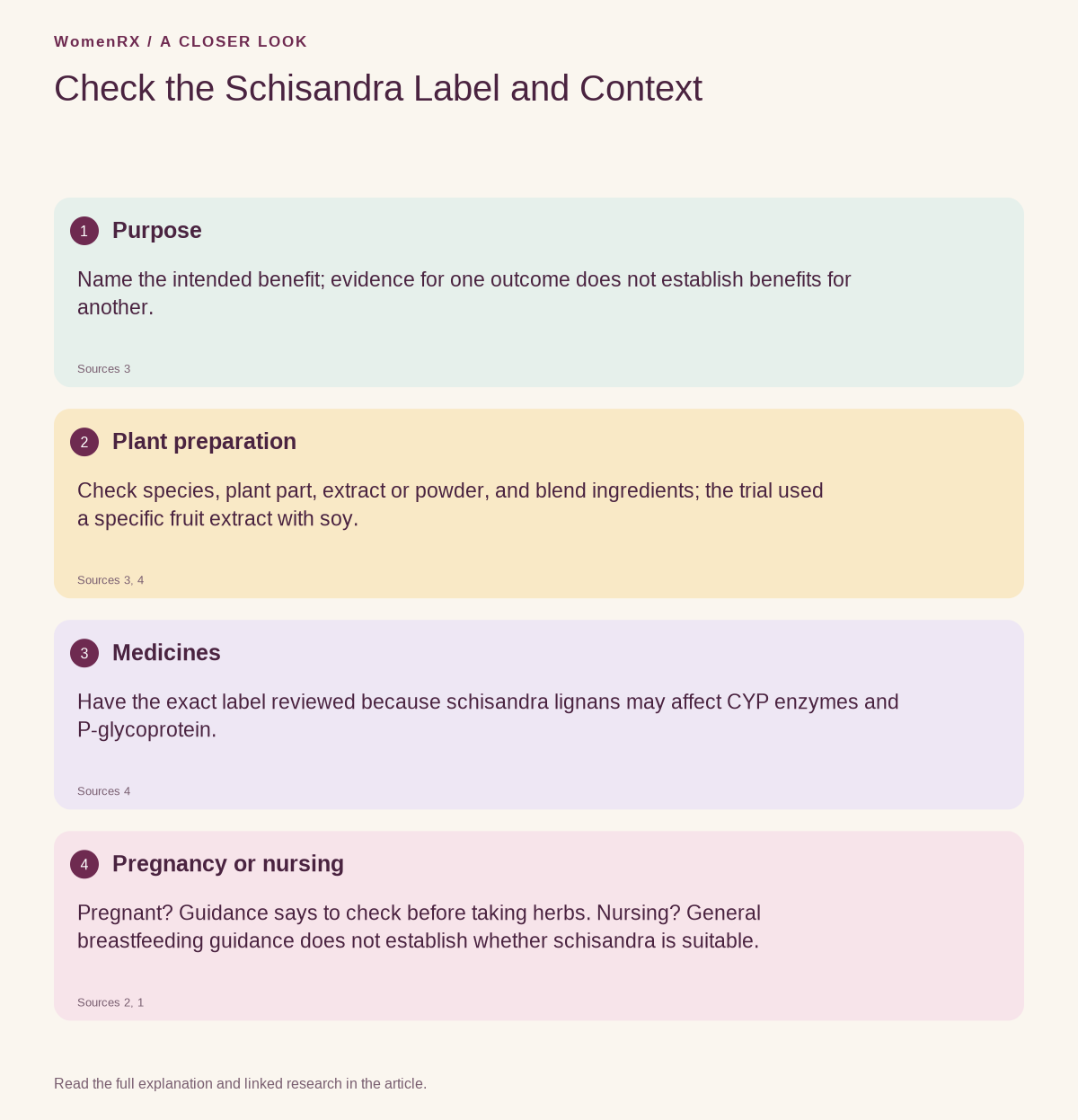
Check the Schisandra Label and Context
Purpose: Name the intended benefit; evidence for one outcome does not establish benefits for another.3
Plant preparation: Check species, plant part, extract or powder, and blend ingredients; the trial used a specific fruit extract with soy.34
Medicines: Have the exact label reviewed because schisandra lignans may affect CYP enzymes and P-glycoprotein.4
Pregnancy or nursing: Pregnant? Guidance says to check before taking herbs. Nursing? General breastfeeding guidance does not establish whether schisandra is suitable.21
Read the figure as text
Use these four checks to see whether a product’s purpose, preparation, interaction questions, and reproductive context are clear.- Purpose: Name the intended benefit; evidence for one outcome does not establish benefits for another.3
- Plant preparation: Check species, plant part, extract or powder, and blend ingredients; the trial used a specific fruit extract with soy.34
- Medicines: Have the exact label reviewed because schisandra lignans may affect CYP enzymes and P-glycoprotein.4
- Pregnancy or nursing: Pregnant? Guidance says to check before taking herbs. Nursing? General breastfeeding guidance does not establish whether schisandra is suitable.21
More questions, answered
Does the blood-sugar study establish a daily schisandra dose?
No. It tested a particular fruit extract mixed with soybean for 12 weeks. Its findings can’t establish a dose for a stand-alone schisandra product or for a different purpose. 3
Does schisandra definitely interact with my medicine?
Not necessarily. The interaction concern comes from evidence that schisandra lignans can affect CYP enzymes and P-glycoprotein, and from reports of changes in drug levels. That doesn’t tell you whether your specific medicine and product will interact; have the exact label reviewed. 4
Sources you can check
- Breastfeeding | Benefits of Breastfeeding | MedlinePlusAccessed 2026-09-25Return to first citation
- Pregnancy and Medicines | MedlinePlusAccessed 2026-09-25Return to first citation
- Efficacy and Safety of Omija (Schisandra chinensis) Extract Mixture on the Improvement of Hyperglycemia: A Randomized, Double-Blind, and Placebo-Controlled Clinical Trial.Kim DS, Baek HI, Ha KC, Cha YS, Park SJ. · Nutrients · 2022Return to first citation
- A Comprehensive Review of the Main Lignan Components of Schisandra chinensis (North Wu Wei Zi) and Schisandra sphenanthera (South Wu Wei Zi) and the Lignan-Induced Drug-Drug Interactions Based on the Inhibition of Cytochrome P450 and P-Glycoprotein Activities.Zhang F, Zhai J, Weng N, Gao J, Yin J, Chen W. · Frontiers in pharmacology · 2022Return to first citation