Schisandra and medications: what to check first
Schisandra may affect how the body handles some medicines, but the size and relevance of that effect depend on the product and the medication.
Schisandra compounds can affect enzymes and transporters involved in medicine absorption and breakdown, so an interaction is possible. A review reports medicine-level fluctuations during some co-use, but that finding and the proposed mechanisms can’t predict what will happen with your specific product and prescription. Bring the product label and your full medication list to a pharmacist or clinician, especially during pregnancy or breastfeeding. 3
The main safety question is how medicines are handled
Schisandra isn’t just a question of whether it causes a noticeable side effect. Its lignans may affect cytochrome P450 enzymes and P-glycoprotein, systems involved in processing, transporting, or absorbing some medicines. If their activity changes, a medicine’s level in the body could change too. The direction and size of any change aren’t predictable from the plant name alone. 3
A 2022 review reports that medicine levels have fluctuated in some people using Wu Wei Zi alongside other treatments. That finding, along with the proposed enzyme and transporter effects, doesn’t predict what will happen with a particular prescription and supplement. Treat it as a reason to check your specific combination, not proof that every combination is dangerous. 3
There is also a preclinical example that shows why one result shouldn’t be generalized: in rats, a Schisandra chinensis extract did not significantly change lamivudine’s measured pharmacokinetic parameters. That animal finding doesn’t establish safety for people taking lamivudine, or for other medicines and schisandra products. 4
Product identity matters
“Schisandra” can refer to more than one species. The review distinguishes Schisandra chinensis, also called North Wu Wei Zi, from Schisandra sphenanthera, or South Wu Wei Zi. Their lignan compositions differ. A supplement’s species, extract, and other ingredients therefore matter when a pharmacist is assessing it. 3
If you have the bottle, bring it or take clear photos of the front and ingredient panel. Note the full product name, listed species, whether it is a single herb or a blend, and how much you take or are considering taking. Don’t assume two products labeled “schisandra” are interchangeable.
Pregnancy and breastfeeding need their own discussion
General pregnancy guidance advises checking with a care provider before taking herbs or supplements, and discussing medicine changes rather than starting or stopping a medicine on your own. This guidance doesn’t answer the schisandra-specific question. 2
During breastfeeding, some medicines and substances can pass into breast milk. MedlinePlus advises checking with a care provider if you have concerns about a substance; that general advice doesn’t establish whether schisandra passes into milk or what effect it might have on a nursing baby. 1
If you’re pregnant, trying to become pregnant, or breastfeeding, make that clear during the review. Don’t stop a prescribed medicine on your own to make room for a supplement. The balance of risks depends on the medicine and the reason you take it. 2
Make the medicine review specific
Bring a complete list of prescriptions, over-the-counter medicines, and other supplements, including products you use only occasionally. Add the schisandra label and tell the pharmacist or clinician whether you already started it, when you started, and what you hope it will help with. Those details help them assess the actual product and combination rather than make a decision from the word “schisandra” alone.
A useful question is: “Does this exact product have a known or plausible interaction with any medicine I take, and what should I do before changing either one?” Ask them to distinguish a demonstrated interaction in people from a possible interaction based on enzyme or transporter effects. Those mechanisms don’t by themselves prove that a particular combination causes harm. 3
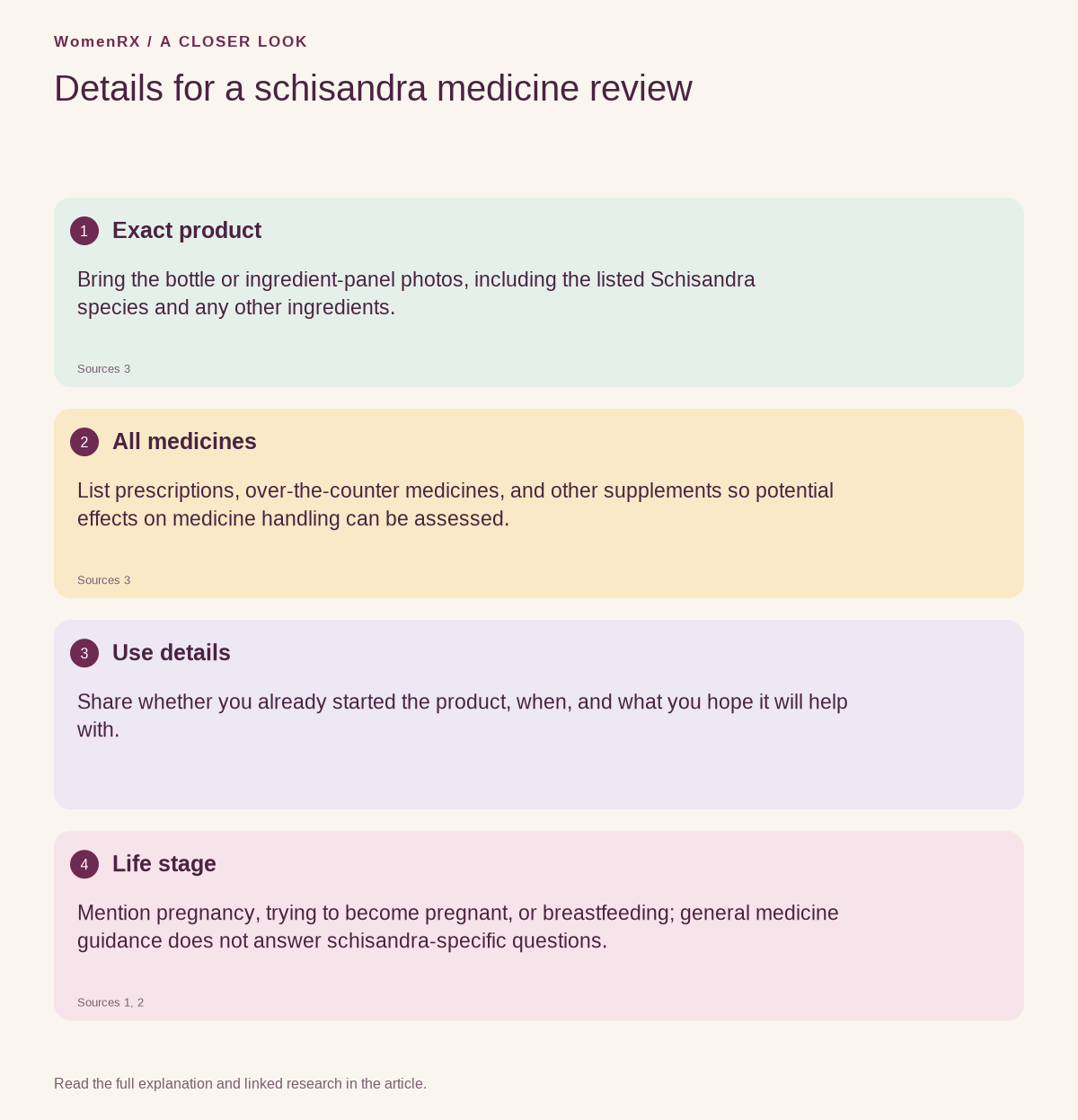
Details for a schisandra medicine review
Exact product: Bring the bottle or ingredient-panel photos, including the listed Schisandra species and any other ingredients.3
All medicines: List prescriptions, over-the-counter medicines, and other supplements so potential effects on medicine handling can be assessed.3
Use details: Share whether you already started the product, when, and what you hope it will help with.
Life stage: Mention pregnancy, trying to become pregnant, or breastfeeding; general medicine guidance does not answer schisandra-specific questions.12
Read the figure as text
These details help focus the discussion on the actual product, medicines, and life stage rather than the supplement name alone.- Exact product: Bring the bottle or ingredient-panel photos, including the listed Schisandra species and any other ingredients.3
- All medicines: List prescriptions, over-the-counter medicines, and other supplements so potential effects on medicine handling can be assessed.3
- Use details: Share whether you already started the product, when, and what you hope it will help with.
- Life stage: Mention pregnancy, trying to become pregnant, or breastfeeding; general medicine guidance does not answer schisandra-specific questions.12
More questions, answered
Does a rat study show schisandra is safe with lamivudine?
No. One rat study found no significant change in measured lamivudine pharmacokinetic parameters with the tested Schisandra chinensis extract. That result doesn’t establish what happens in people or with other products and medicines. 4
Are Schisandra chinensis and Schisandra sphenanthera the same?
They’re different Schisandra species, described in the review as North and South Wu Wei Zi, with differences in their major lignan components. Check the species on the product label rather than assuming the names refer to identical preparations. 3
Sources you can check
- Breastfeeding | Benefits of Breastfeeding | MedlinePlusAccessed 2026-09-25Return to first citation
- Pregnancy and Medicines | MedlinePlusAccessed 2026-09-25Return to first citation
- A Comprehensive Review of the Main Lignan Components of Schisandra chinensis (North Wu Wei Zi) and Schisandra sphenanthera (South Wu Wei Zi) and the Lignan-Induced Drug-Drug Interactions Based on the Inhibition of Cytochrome P450 and P-Glycoprotein Activities.Zhang F, Zhai J, Weng N, Gao J, Yin J, Chen W. · Frontiers in pharmacology · 2022Return to first citation
- Preclinical Pharmacokinetics of Lamivudine and Its Interaction with Schisandra chinensis Extract in Rats.Li CL, Hsieh CH, Tsai TH. · ACS omega · 2020Return to first citation