Schisandra Timing: What Matters More Than the Clock
A small human study doesn’t identify a best time to take schisandra, while research on medicine interactions gives you a more useful question to ask first.
The human study discussed here doesn’t tell you whether schisandra works better in the morning, at night, or with food. It tested a schisandra-and-sesamin combination without comparing schedules. Before considering schisandra, check whether the exact product could affect your medicines: laboratory findings raise that possibility, and a published paper describes increased tacrolimus levels in transplant patients taking a Schisandra extract. 1 2
What would “best time” mean for your goal?
If you’re thinking about schisandra for energy, sleep, or another health goal, a timing rule is only useful if there’s evidence that changing the time improves that outcome. In a small, open-label study, 10 people took a product containing both schisandra extract and sesamin for two weeks. Researchers measured a laboratory indicator of blood fluidity. They didn’t compare morning with evening use, test taking it with food, or isolate the effect of schisandra from the other ingredients. That study can’t tell you which schedule works best for a health goal. 2
Human use doesn’t by itself settle the question of benefit, either. A review of natural products studied for hepatitis C included a schisandra-containing preparation and concluded that the research on the treatments it covered was inconclusive. That is not evidence for using schisandra to treat hepatitis C, and it offers no timing guidance. 3
Why your medication list matters more
Your body uses enzymes to process many medicines. In a laboratory study using human liver microsomes, researchers found that certain compounds from Schisandra chinensis, called lignans, inhibited the activity of several CYP enzymes. A result in liver microsomes helps identify a possible interaction; it doesn’t predict what will happen with every supplement and medicine combination in a person. 1
There is also a more concrete reason to pay attention. The enzyme-study paper describes a clinical report in which Schisandra extract increased blood concentrations of tacrolimus in liver transplant patients. Tacrolimus is a medicine for which a change in exposure can matter. The paper doesn’t establish that all schisandra products interact with all medicines, but it does make “it’s herbal, so it won’t affect my prescription” a poor assumption. 1
Think of the decision in four parts: which schisandra product, which of its compounds have been studied, which medicine you take, and whether evidence connects that combination to a change in medicine exposure. The laboratory study answers part of the mechanism question, not all four parts for your particular product. 1
Before buying or taking schisandra, a useful question for a pharmacist or prescriber is: “Could this exact product affect any of my medicines, including ones whose levels need careful monitoring?” Bring the product label and your medication and supplement list. Ask what plant species and ingredients the label identifies, and whether the maker provides verification of the product’s identity and contents. Those details help make the interaction question specific; a suggested time of day doesn’t answer it.
What if you’re pregnant, breastfeeding, or considering it for menopause?
The 10-person combination study doesn’t report a women-specific analysis, and it doesn’t establish safety during pregnancy or breastfeeding. The hepatitis C review doesn’t answer those questions either. Neither provides evidence that schisandra treats menstrual or menopause symptoms. If pregnancy or breastfeeding is part of your decision, don’t treat a history of traditional use as a substitute for safety evidence. 2 3
The next useful move is to start with your goal and your medicines, not the clock: identify what you hope schisandra will change, then check the particular product against anything you already take.
Where an interaction question comes from
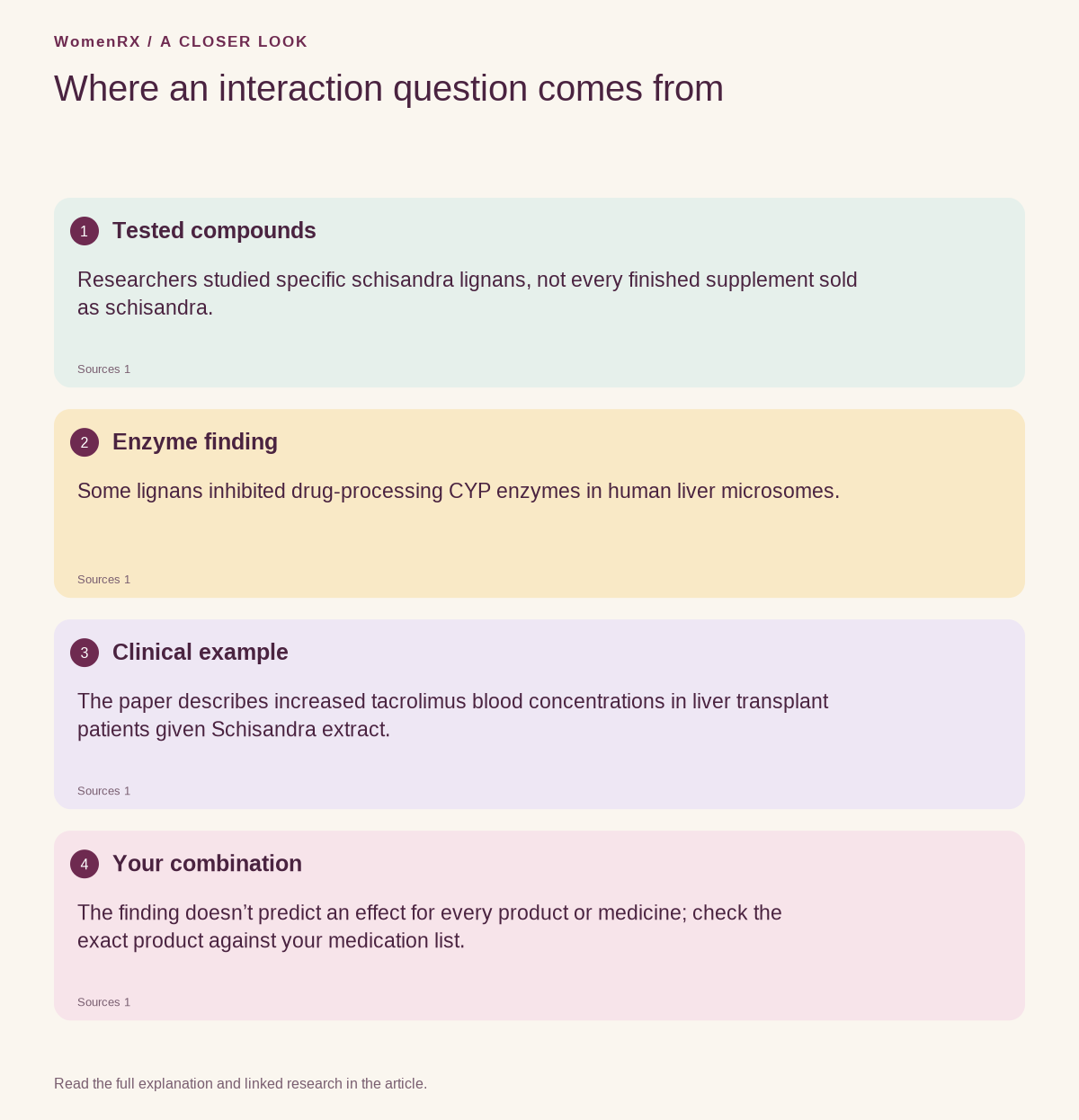
Tested compounds: Researchers studied specific schisandra lignans, not every finished supplement sold as schisandra.1
Enzyme finding: Some lignans inhibited drug-processing CYP enzymes in human liver microsomes.1
Clinical example: The paper describes increased tacrolimus blood concentrations in liver transplant patients given Schisandra extract.1
Your combination: The finding doesn’t predict an effect for every product or medicine; check the exact product against your medication list.1
Read the figure as text
Follow the difference between a laboratory signal and a finding involving a particular medicine.- Tested compounds: Researchers studied specific schisandra lignans, not every finished supplement sold as schisandra.1
- Enzyme finding: Some lignans inhibited drug-processing CYP enzymes in human liver microsomes.1
- Clinical example: The paper describes increased tacrolimus blood concentrations in liver transplant patients given Schisandra extract.1
- Your combination: The finding doesn’t predict an effect for every product or medicine; check the exact product against your medication list.1
More questions, answered
Can I avoid an interaction by taking schisandra and my medicine at different times?
The small human study didn’t test whether spacing schisandra from a medicine prevents an interaction. Laboratory enzyme effects and the reported tacrolimus interaction are reasons to check the specific combination rather than rely on a timing rule. 1 2
Sources you can check
- Inhibitory Effects of Schisandra Lignans on Cytochrome P450s and Uridine 5'-Diphospho-Glucuronosyl Transferases in Human Liver Microsomes.Seo HJ, Ji SB, Kim SE, Lee GM, Park SY, Wu Z, Jang DS, Liu KH. · Pharmaceutics · 2021Return to first citation
- Evaluation on the combined effect of Sesamin and Schisandra extract on blood fluidity.Tsi D, Tan A. · Bioinformation · 2008Return to first citation
- Natural products and chronic hepatitis C virus.Azzam HS, Goertz C, Fritts M, Jonas WB. · Liver international : official journal of the International Association for the Study of the Liver · 2007Return to first citation