Schisandra: What Human Studies Say About Timing
Human studies have tested a few specific schisandra products, but they don’t establish a dependable time to benefit from schisandra alone.
There isn’t a reliable, general timeline for schisandra supplements. A small trial in women with menopausal symptoms tested a specific schisandra extract for six weeks, but measured its primary outcome at week 12. Other studies tested schisandra in blends or combinations, so their results and timing can’t show when schisandra by itself works. 2 3 4
The clearest single-herb trial was small
One randomized, placebo-controlled trial studied women ages 40 to 70 who reported menopausal symptoms. The researchers tested a particular Schisandra chinensis extract, BMO-30. Participants took it for six weeks and were followed for 12 weeks; the main comparison was change in the Kupperman Index, a measure of menopausal symptoms, from the start of the trial to week 12. 2
Thirty-six women completed the study, with 18 in each group. The researchers reported a difference in total symptom scores between groups over time. That is a human signal worth distinguishing from lab or animal research, but it is not a precise “you’ll feel it by” estimate. The primary outcome was measured at week 12, not reported as a clear onset time, and the result applies to this extract and study population, not automatically to every schisandra capsule or powder. 2
Combination studies can’t give schisandra its own clock
Some human studies include schisandra alongside other ingredients. In a 60-day stress study, one product combined schisandra berry with rhodiola, holy basil, milky oat seed, and ashwagandha root. The study also tested a separate ashwagandha product. Although the researchers reported improvement in stress scores versus placebo at day 60 for both products, the blend’s result can’t show what schisandra contributed or how quickly it would work alone. 3
A smaller pilot study tested a single dose of ADAPT-232, a combination of schisandra, rhodiola, and eleuthero, in 40 women. Attention testing took place two hours after the dose, and the study reported a difference between the combination and placebo. That is a result for the combination on a specific test, not evidence that schisandra alone improves attention within two hours. 4
A 12-week trial in people with elevated blood sugar tested Omija extract mixed with soybean, not schisandra alone. Its findings on glucose-related measures therefore don’t establish a schisandra-only effect or a general time to benefit. 1
Match the study to the goal and the product
Before using a study to set expectations, check three things: the health goal it tested, the exact product, and when the outcome was measured. A trial of a named extract for menopausal symptoms is more directly relevant to that question than a study of a multi-ingredient stress blend. Neither necessarily matches a product with a different preparation or combination of ingredients.
Also separate the study’s schedule from when a person might notice a change. In the menopausal-symptom trial, six weeks was the treatment period and week 12 was the primary measurement point. In the combination studies, tests were scheduled at two hours or at later study visits. Those are measurement times, not a dependable promise about when you’ll feel an effect. 2 3 4
A practical way to assess a product’s claim is to ask: “Was this exact preparation tested for my goal, on its own, and at the time the claim describes?” If the evidence is from a blend, a different health goal, or a lab study, it doesn’t answer that question directly.
What the studies tell women about safety
The menopausal-symptom study enrolled women, but the trials described here do not report pregnancy or breastfeeding safety outcomes. Their results shouldn’t be taken as evidence that schisandra is suitable during pregnancy or while breastfeeding. 2 3 4
The useful bottom line is modest: a small trial gives one specific extract a preliminary human signal for menopausal symptoms, while combination-product studies offer no reliable timeline for schisandra alone. The evidence does not support one general wait time that applies to every goal and product.
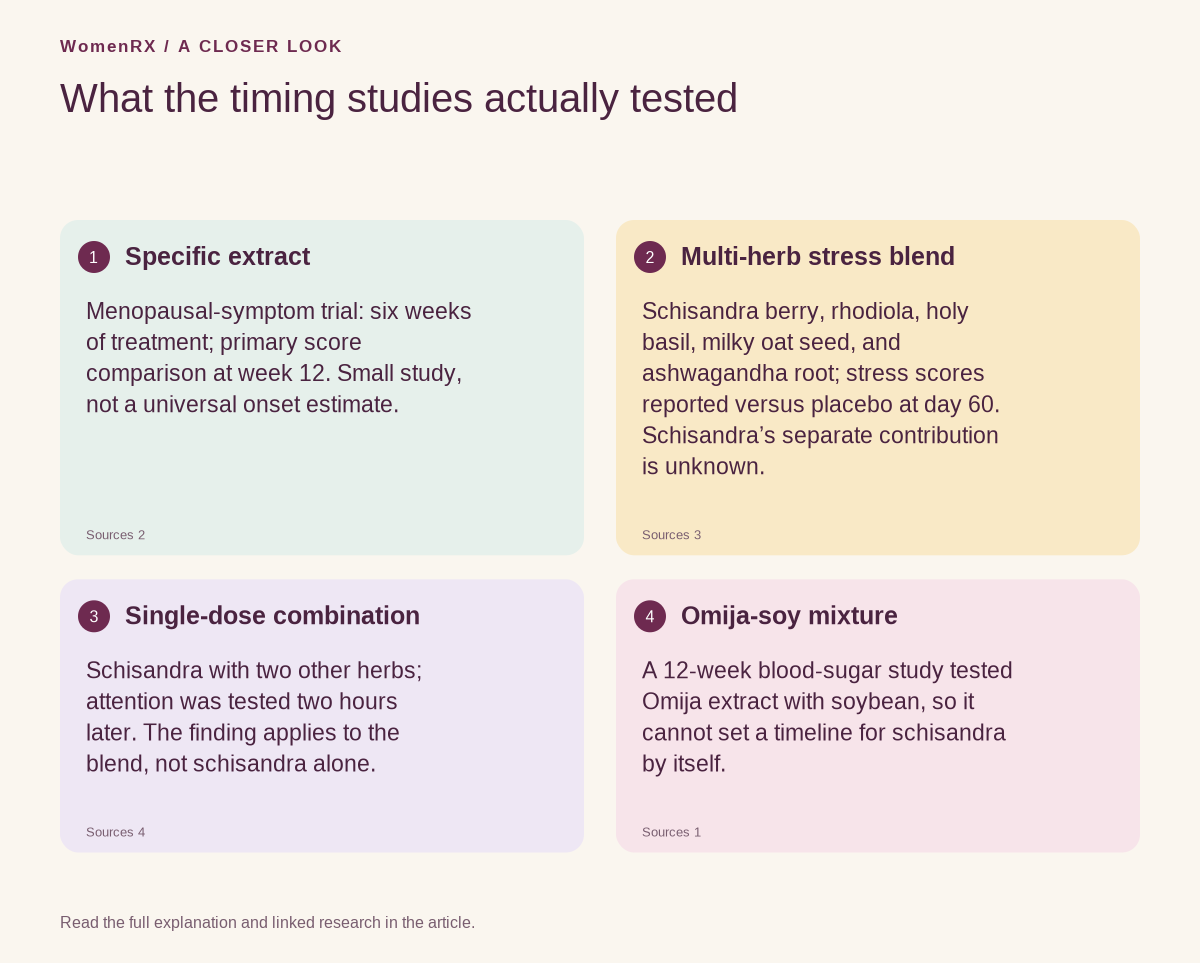
What the timing studies actually tested
Specific extract: Menopausal-symptom trial: six weeks of treatment; primary score comparison at week 12. Small study, not a universal onset estimate.2
Multi-herb stress blend: Schisandra berry, rhodiola, holy basil, milky oat seed, and ashwagandha root; stress scores reported versus placebo at day 60. Schisandra’s separate contribution is unknown.3
Single-dose combination: Schisandra with two other herbs; attention was tested two hours later. The finding applies to the blend, not schisandra alone.4
Omija-soy mixture: A 12-week blood-sugar study tested Omija extract with soybean, so it cannot set a timeline for schisandra by itself.1
Read the figure as text
These examples separate a trial of a specific schisandra extract from combination-product results and show why test timing is not a promise of onset.- Specific extract: Menopausal-symptom trial: six weeks of treatment; primary score comparison at week 12. Small study, not a universal onset estimate.2
- Multi-herb stress blend: Schisandra berry, rhodiola, holy basil, milky oat seed, and ashwagandha root; stress scores reported versus placebo at day 60. Schisandra’s separate contribution is unknown.3
- Single-dose combination: Schisandra with two other herbs; attention was tested two hours later. The finding applies to the blend, not schisandra alone.4
- Omija-soy mixture: A 12-week blood-sugar study tested Omija extract with soybean, so it cannot set a timeline for schisandra by itself.1
More questions, answered
Does the menopause study mean I should wait 12 weeks?
No. Week 12 was the study’s primary measurement point after a six-week treatment period. It doesn’t establish a recommended waiting period or predict when an individual will notice a change. 2
Do combination studies show that schisandra works within hours?
No. The two-hour attention result came from a pilot study of ADAPT-232, which combined schisandra with rhodiola and eleuthero. It cannot identify schisandra’s individual effect. 4
Sources you can check
- Efficacy and Safety of Omija (Schisandra chinensis) Extract Mixture on the Improvement of Hyperglycemia: A Randomized, Double-Blind, and Placebo-Controlled Clinical Trial.Kim DS, Baek HI, Ha KC, Cha YS, Park SJ. · Nutrients · 2022Return to first citation
- A randomized, double-blind, placebo-controlled trial of Schisandra chinensis for menopausal symptoms.Park JY, Kim KH. · Climacteric : the journal of the International Menopause Society · 2016Return to first citation
- Effects of multi-herb and ashwagandha root formulas on stress modulation: a randomized, double-blind, placebo-controlled clinical study.McKinney E, Stewart J, Kewalramani R, Singh S. · Trials · 2026Return to first citation
- Double-blind, placebo-controlled, randomised study of single dose effects of ADAPT-232 on cognitive functions.Aslanyan G, Amroyan E, Gabrielyan E, Nylander M, Wikman G, Panossian A. · Phytomedicine : international journal of phytotherapy and phytopharmacology · 2010Return to first citation