Schisandra in Human Studies: What Has Actually Been Tested
A few small trials have tested specific schisandra extracts, but their findings don’t establish benefits across health goals or products.
Human trials have looked at menopausal symptoms, muscle strength, blood sugar measures, and a multi-herb stress formula. The clearest women-specific studies are small trials in menopausal or postmenopausal women; other results come from older adults or a combined schisandra-and-soy product. Different preparations and short study periods make it hard to apply one result to another supplement or health goal. 1 2 3 4 5
Schisandra has been tested in people for a handful of outcomes, not as one standardized treatment. The findings vary by goal and preparation: a trial of one extract for menopausal symptoms doesn’t establish that a berry tea or a different supplement will have the same effect. Overall, the studies offer preliminary signals, not dependable proof for broad health claims.
Menopausal symptoms: a small women-only trial
One randomized, placebo-controlled trial enrolled women ages 40 to 70 who reported menopausal symptoms. Thirty-six women completed it, split evenly between the schisandra-extract group and placebo. Participants took the study treatment for six weeks and were followed for 12 weeks. The schisandra group had lower total Kupperman Index symptom scores than the placebo group in the reported group-and-time analysis. The authors highlighted hot flashes, sweating, and palpitations, but the abstract doesn’t give the size of the difference for those individual symptoms. 4
This is directly relevant to women experiencing menopausal symptoms, but the small number of participants and a single trial leave open how reliable the result is and which symptoms might respond. It doesn’t tell us whether findings apply to women in the cycling years, during pregnancy or postpartum, or after menopause without symptoms.
Muscle strength: two different study populations
A randomized trial in 45 healthy postmenopausal women compared a schisandra extract with placebo for 12 weeks. The study reported a significant group-by-time difference in quadriceps strength and resting lactate. Other measured outcomes, including muscle mass and physical function, did not show significant group-by-time differences. This is an encouraging signal for strength, but it is not evidence that schisandra builds muscle or improves everyday mobility. 3
A separate 12-week trial enrolled 54 adults over age 50 with relatively low muscle mass. Everyone was asked to do regular low-intensity walking. Compared with placebo, the extract group had a greater increase in knee-extension strength: 10.2 Nm for the right leg (95% CI 3.7 to 16.8) and 6.7 Nm for the left (95% CI 0.3 to 13.1). The trial found no between-group difference in muscle mass. The abstract doesn’t report a women-specific analysis, so these results can’t establish an effect specifically in women. 2
These studies tested extracts alongside particular study conditions, not schisandra as a replacement for exercise or other approaches to maintaining strength. Their findings also don’t show that other products containing schisandra will perform similarly.
Blood sugar: a blend, not schisandra alone
A 12-week randomized trial studied 80 people with fasting blood glucose between 100 and 140 mg/dL. The test product combined Omija, another name for schisandra in Korea, with soybean. Compared with placebo, the blend produced statistically lower fasting and some post-meal glucose measures, as well as differences in several other markers. Because the product contained soybean too, the study can’t show that schisandra alone caused the changes. The summary also doesn’t report results by sex. 1
This is an early finding about one combination product in people with elevated fasting glucose. It doesn’t establish that schisandra treats diabetes or that a different extract, tea, or supplement would have the same effect.
Stress claims: results from a multi-herb formula
A 60-day trial tested a formula containing schisandra, Rhodiola, and holy basil; a separate study group received an ashwagandha product. The multi-herb formula was associated with improvements in reported stress and some sleep and mood measures compared with placebo. Since several ingredients were combined, the results can’t identify schisandra’s individual contribution. The summary doesn’t provide a women-specific analysis. 5
What the evidence means when choosing a product
The studies don’t test one interchangeable “schisandra” intervention. They use distinct extracts or blends, and the outcomes range from symptom scores to strength tests and blood markers. A result for one preparation and population is not a guarantee for another. This research is also short-term, and several trials are small. That makes the findings worth distinguishing from traditional uses or proposed benefits, but not a basis for assuming schisandra will help with a particular goal.
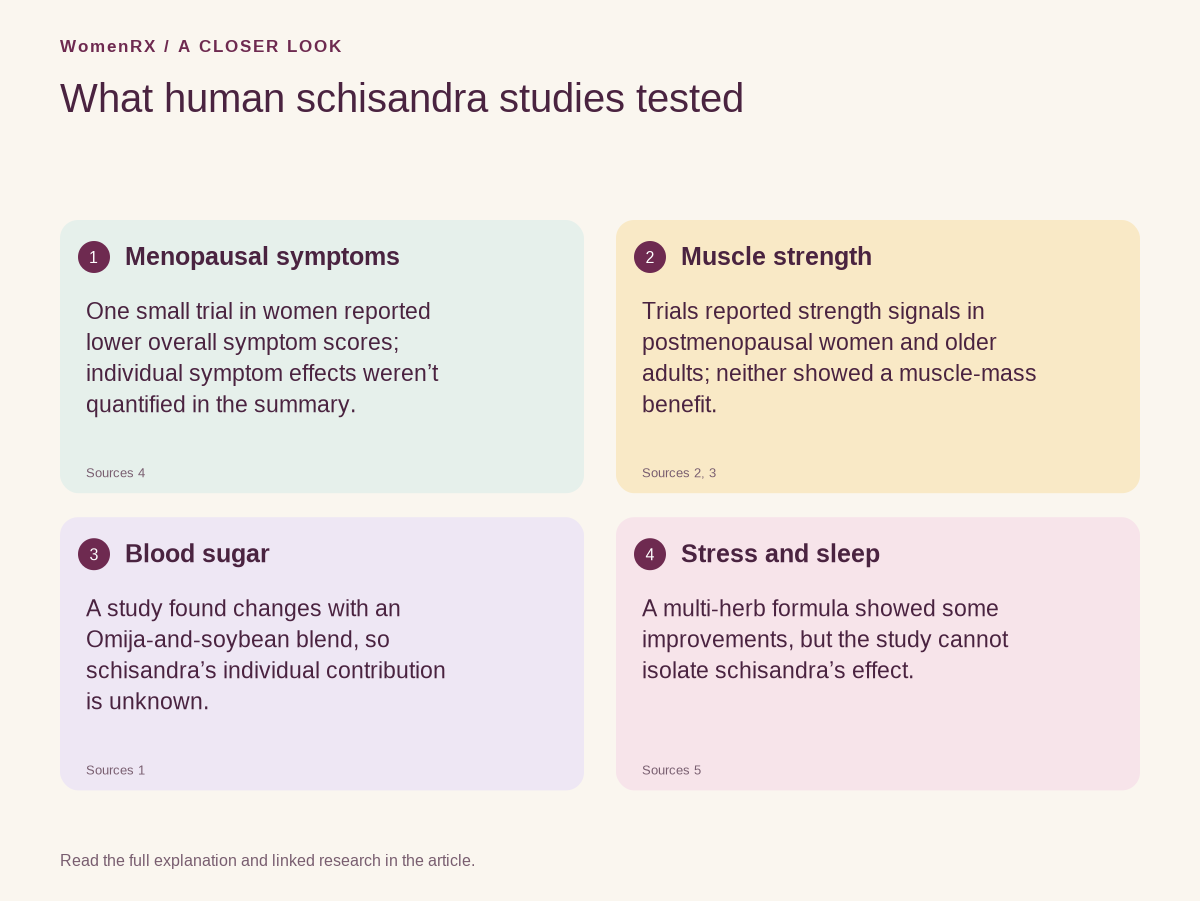
What human schisandra studies tested
Menopausal symptoms: One small trial in women reported lower overall symptom scores; individual symptom effects weren’t quantified in the summary.4
Muscle strength: Trials reported strength signals in postmenopausal women and older adults; neither showed a muscle-mass benefit.23
Blood sugar: A study found changes with an Omija-and-soybean blend, so schisandra’s individual contribution is unknown.1
Stress and sleep: A multi-herb formula showed some improvements, but the study cannot isolate schisandra’s effect.5
Read the figure as text
These study snapshots show which outcomes were tested, who took part, and where the results cannot be attributed to schisandra alone.- Menopausal symptoms: One small trial in women reported lower overall symptom scores; individual symptom effects weren’t quantified in the summary.4
- Muscle strength: Trials reported strength signals in postmenopausal women and older adults; neither showed a muscle-mass benefit.23
- Blood sugar: A study found changes with an Omija-and-soybean blend, so schisandra’s individual contribution is unknown.1
- Stress and sleep: A multi-herb formula showed some improvements, but the study cannot isolate schisandra’s effect.5
More questions, answered
Can I apply these findings to schisandra tea or another supplement?
Not confidently. The trials used particular extracts or blends, and their results don’t establish that a tea, a different extract, or a product with other ingredients has the same effects. 1 2 3 4
Sources you can check
- Efficacy and Safety of Omija (Schisandra chinensis) Extract Mixture on the Improvement of Hyperglycemia: A Randomized, Double-Blind, and Placebo-Controlled Clinical Trial.Kim DS, Baek HI, Ha KC, Cha YS, Park SJ. · Nutrients · 2022Return to first citation
- Effect of Schisandra chinensis Baillon extracts and regular low-intensity exercise on muscle strength and mass in older adults: a randomized, double-blind, placebo-controlled trial.Cho YH, Lee SY, Lee CH, Park JH, So YS. · The American journal of clinical nutrition · 2021Return to first citation
- Effect of Schisandra Chinensis Extract Supplementation on Quadriceps Muscle Strength and Fatigue in Adult Women: A Randomized, Double-Blind, Placebo-Controlled Trial.Park J, Han S, Park H. · International journal of environmental research and public health · 2020Return to first citation
- A randomized, double-blind, placebo-controlled trial of Schisandra chinensis for menopausal symptoms.Park JY, Kim KH. · Climacteric : the journal of the International Menopause Society · 2016Return to first citation
- Effects of multi-herb and ashwagandha root formulas on stress modulation: a randomized, double-blind, placebo-controlled clinical study.McKinney E, Stewart J, Kewalramani R, Singh S. · Trials · 2026Return to first citation