Schisandra After 40: One Small Trial, Open Questions
A small menopause-symptom trial offers an early signal, but it doesn’t establish that schisandra is useful simply because you’re over 40.
One small randomized trial tested a specific Schisandra chinensis extract in women ages 40 to 70 who had menopausal symptoms. The results suggest a possible benefit for symptoms, but only 36 women completed the study, and it doesn’t show whether age or menopausal stage matters. Being over 40, by itself, isn’t evidence that you need schisandra. 2
What the menopause trial can tell you
The most directly relevant human study tested BMO-30, a particular Schisandra chinensis extract, against placebo in women ages 40 to 70 who reported menopausal symptoms. It was randomized and double-blind. Thirty-six women completed the trial, with 18 in each group. The extract was taken for six weeks, and participants were followed for 12 weeks. 2
The study’s primary outcome was change in the Kupperman Index, a measure of menopausal symptoms. The researchers reported a statistically significant difference in total scores between groups over time (p=0.042). They highlighted hot flushes, sweating, and heart palpitations in their conclusion. But the abstract doesn’t provide the score changes needed to judge how large or noticeable the benefit was. A statistical difference alone doesn’t tell you how much relief an individual might feel. 2
This is a signal worth distinguishing from proof. Clinical trials are designed around specific questions and protocols; this one asked about menopausal symptoms, not broad claims about energy, “hormone balance,” or healthy aging. 12
Age alone doesn’t make it a match
The trial included women from 40 to 70, but the reported results don’t break down outcomes by age or menopausal stage. They also don’t tell us how many participants were perimenopausal or postmenopausal. So the study offers limited evidence about a specific extract in women with symptoms, not evidence that schisandra benefits all women after 40 or that turning 40 creates a special need for it. 2
The product matters, too. The study tested BMO-30, so its findings can’t automatically be applied to every supplement labeled schisandra. The available report doesn’t establish that other products have the same composition or effects. 2
A goal-first decision check
Before considering a supplement, match the evidence to the reason you’re interested:
- For menopausal symptoms: There’s one small placebo-controlled trial to weigh, but it doesn’t establish a dependable effect or how much relief to expect.
- For another goal: This trial doesn’t answer that question. Menopause findings shouldn’t be treated as evidence for unrelated benefits.
- For a specific supplement: Compare its label with the study’s named extract. The trial doesn’t establish that different formulations are equivalent.
- If you take medicines: Bring the exact product label and your medication list to a clinician or pharmacist. The study report doesn’t describe an assessment of interactions, so it can’t answer whether a particular combination is suitable. 2
The study authors described BMO-30 as safe, but 36 completers followed for a short period can’t settle questions about longer-term use or uncommon problems. That’s a limit of what this study can establish, not proof that schisandra is unsafe. 2
The useful takeaway
Schisandra may be relevant to a discussion about menopausal symptoms, because one small trial tested it for that purpose. It isn’t established as a general after-40 supplement. A practical next step is to name the symptom or health goal you want to address, then ask whether evidence for this specific extract applies to that goal and whether your medications have been considered.
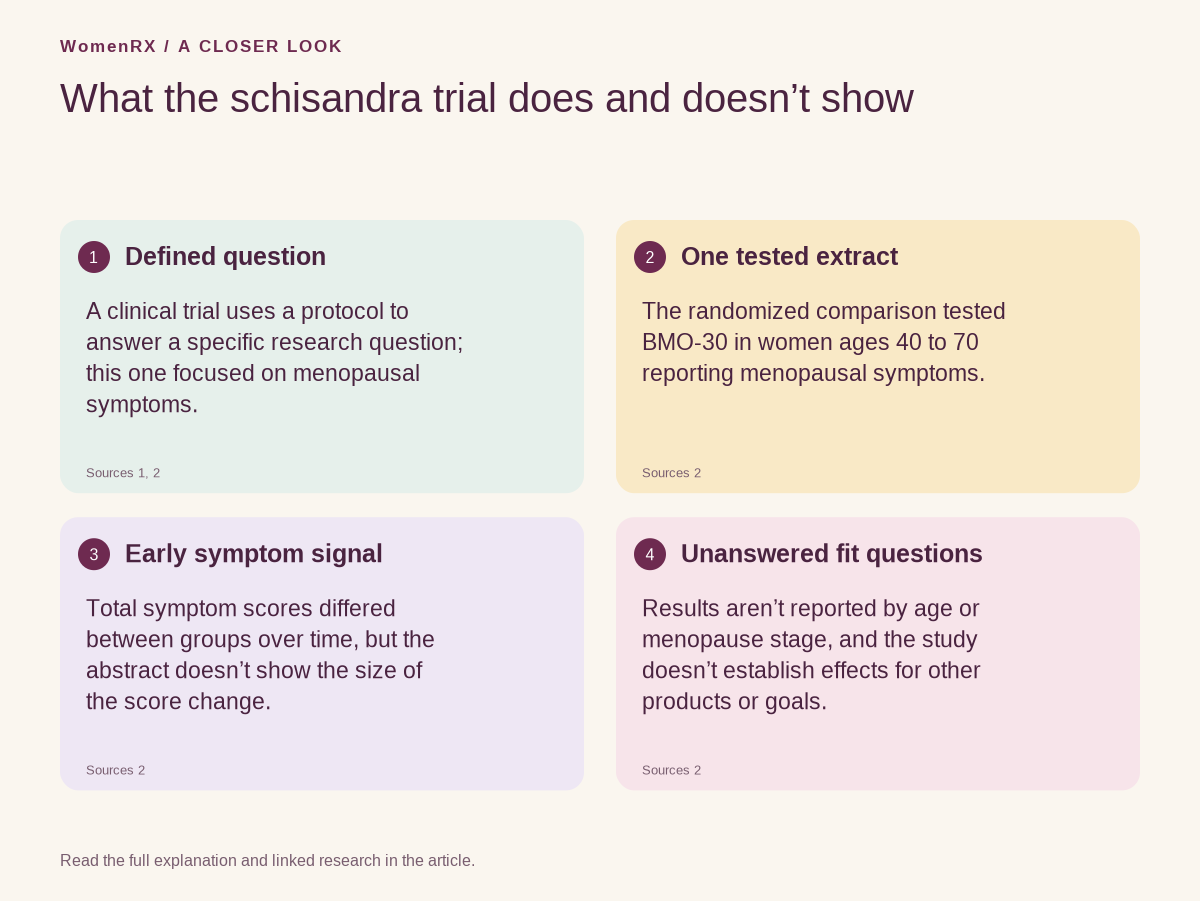
What the schisandra trial does and doesn’t show
Defined question: A clinical trial uses a protocol to answer a specific research question; this one focused on menopausal symptoms.12
One tested extract: The randomized comparison tested BMO-30 in women ages 40 to 70 reporting menopausal symptoms.2
Early symptom signal: Total symptom scores differed between groups over time, but the abstract doesn’t show the size of the score change.2
Unanswered fit questions: Results aren’t reported by age or menopause stage, and the study doesn’t establish effects for other products or goals.2
Read the figure as text
Follow the evidence from the question studied to the limits that matter when deciding whether it fits your goal.- Defined question: A clinical trial uses a protocol to answer a specific research question; this one focused on menopausal symptoms.12
- One tested extract: The randomized comparison tested BMO-30 in women ages 40 to 70 reporting menopausal symptoms.2
- Early symptom signal: Total symptom scores differed between groups over time, but the abstract doesn’t show the size of the score change.2
- Unanswered fit questions: Results aren’t reported by age or menopause stage, and the study doesn’t establish effects for other products or goals.2
More questions, answered
Does the trial prove schisandra is safe with my medicines?
No. The study abstract doesn’t report an assessment of medication interactions, so it can’t establish whether a particular supplement and medicine are suitable together. Bring the product label and your medication list to a clinician or pharmacist. 2
Sources you can check
- Clinical Trials: MedlinePlusAccessed 2026-09-25Return to first citation
- A randomized, double-blind, placebo-controlled trial of Schisandra chinensis for menopausal symptoms.Park JY, Kim KH. · Climacteric : the journal of the International Menopause Society · 2016Return to first citation