Does Schisandra Need to Be Taken With Food?
Studies of Schisandra bee-pollen extracts in cells and mice don’t establish whether taking a supplement with food changes its effects.
There isn’t a food-timing rule established by these findings: researchers tested Schisandra bee-pollen extracts in cells and mice, not supplements taken with meals versus on an empty stomach by people. Follow your product’s directions, but don’t fast to try to improve its effects or assume food prevents a medicine interaction. 1 3 2 4
What a food instruction can tell you
If your Schisandra product says “take with food” or “take on an empty stomach,” that’s a direction for that product. It isn’t proof that the same timing works best for every Schisandra supplement.
The distinction matters because Schisandra research covers different preparations and questions. One study tested a Schisandra chinensis bee-pollen extract in heart cells; another tested a bee-pollen extract in mice with colitis. Neither compared meals with fasting in people. Their findings can’t tell you whether food changes a supplement’s effects or makes it easier on your stomach. 1 3
There’s no supported reason from those experiments to skip a meal in hopes of getting more from Schisandra. If your label’s timing instruction is unclear, ask a pharmacist about that exact product rather than applying directions from a different one.
If it seems to upset your stomach
A stomach symptom that starts after you take a supplement is worth paying attention to, but it doesn’t tell you which ingredient caused it. Check the full ingredient list, especially if the product combines Schisandra with other ingredients. Note whether the symptom happens repeatedly and what the label says about taking it with food. Those details are more useful than assuming a meal will solve the problem.
The cell and mouse experiments don’t establish how often people have stomach symptoms with Schisandra or whether taking it with food prevents them. If symptoms keep recurring, bring the product details to a pharmacist or prescriber before trying to work around the problem by changing meal timing. 1 3
Food won’t settle the tacrolimus question
Tacrolimus, a medicine used after organ transplantation, deserves a separate check. A review describes the possibility that Schisandra could increase tacrolimus exposure. Another calls the use of Schisandra sphenanthera with tacrolimus controversial. Neither finding means every Schisandra product has the same effect, but this is a consequential combination to review. 2 4
If you take tacrolimus, tell your transplant team or pharmacist the exact Schisandra product and its ingredients before using it. These reviews do not show that taking Schisandra with food, or separating it from tacrolimus by timing, prevents this possible interaction. 2 4
These reviews don’t provide a reliable interaction list for every other medicine. If you take a prescription drug, a pharmacist can check the particular product and medicine together.
Pregnancy and breastfeeding are different questions
Neither the cell study nor the mouse study establishes whether a Schisandra supplement is safe during pregnancy or breastfeeding. A food-timing direction doesn’t answer either safety question. If you’re pregnant or breastfeeding, check the specific product with your care team before using it. 1 3
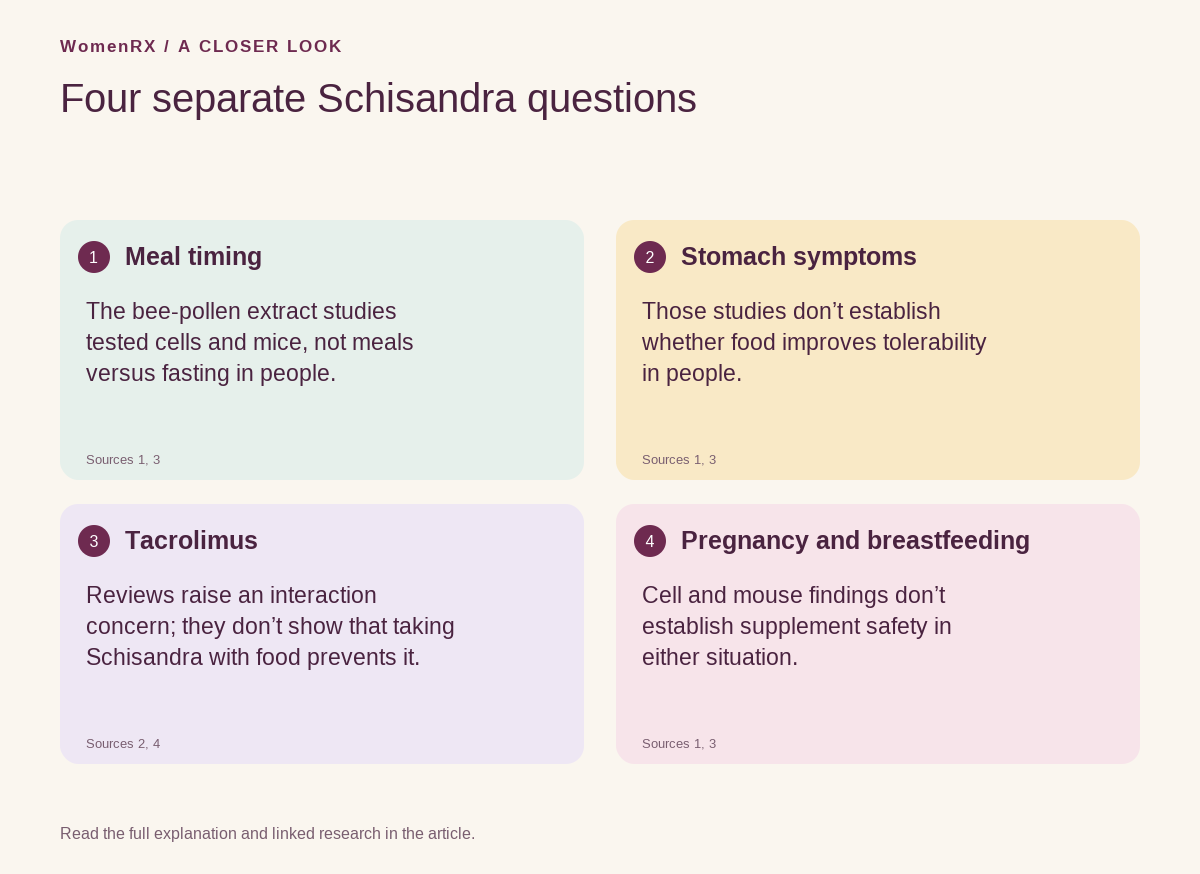
Four separate Schisandra questions
Meal timing: The bee-pollen extract studies tested cells and mice, not meals versus fasting in people.13
Stomach symptoms: Those studies don’t establish whether food improves tolerability in people.13
Tacrolimus: Reviews raise an interaction concern; they don’t show that taking Schisandra with food prevents it.24
Pregnancy and breastfeeding: Cell and mouse findings don’t establish supplement safety in either situation.13
Read the figure as text
A meal instruction does not answer every question about using a Schisandra product.- Meal timing: The bee-pollen extract studies tested cells and mice, not meals versus fasting in people.13
- Stomach symptoms: Those studies don’t establish whether food improves tolerability in people.13
- Tacrolimus: Reviews raise an interaction concern; they don’t show that taking Schisandra with food prevents it.24
- Pregnancy and breastfeeding: Cell and mouse findings don’t establish supplement safety in either situation.13
Sources you can check
- Schisandra chinensis bee pollen's chemical profiles and protective effect against H2O2-induced apoptosis in H9c2 cardiomyocytes.Shi P, Geng Q, Chen L, Du T, Lin Y, Lai R, Meng F, Wu Z, Miao X, Yao H, Yao H. · BMC complementary medicine and therapies · 2020Return to first citation
- Tacrolimus, Cytochrome P450, Interactions with Food Variables in Organ Transplant Recipients; A Current and Comprehensive Review.Tolou-Ghamari Z. · Current drug metabolism · 2025Return to first citation
- Schisandra chinensis Bee Pollen Ameliorates Colitis in Mice by Modulating Gut Microbiota and Regulating Treg/Th17 Balance.Cheng N, Wang X, Zhou Y, Zhao X, Chen M, Zhao H, Cao W. · Foods (Basel, Switzerland) · 2024Return to first citation
- Controversial Interactions of Tacrolimus with Dietary Supplements, Herbs and Food.Miedziaszczyk M, Bajon A, Jakielska E, Primke M, Sikora J, Skowrońska D, Idasiak-Piechocka I. · Pharmaceutics · 2022Return to first citation