Glycine for Sleep: What Amount Has Been Tested?
Small human sleep studies have used 3 grams of glycine, but that amount isn’t an established daily requirement or insomnia treatment.
Earlier human studies reported that 3 grams of glycine improved perceived sleep quality or shortened measured time to fall asleep, while a separate three-night trial found some next-day benefits in seven men whose sleep was restricted. The latter trial used 3 grams 30 minutes before bed. These findings don’t establish a best daily amount, an insomnia treatment, or a women-specific result.5
What the 3-gram study actually tested
The most detailed reported protocol comes from a small study of next-day effects after short sleep, not a treatment trial for insomnia. Researchers enrolled 10 healthy men without sleep disorders and analyzed results from seven. In a randomized, single-blind crossover study, each man took either 3 grams of glycine or a flavored placebo 30 minutes before bedtime for three consecutive nights. Their time in bed was restricted to about 25% less than usual. After a recovery period, they repeated the experiment with the other substance.5
Compared with placebo, glycine reduced reported fatigue on the first day of restricted sleep, but not the third. Reaction time on a computer-based attention test improved on both days tested. The study did not find a statistically significant difference in its visual-analog measure of sleepiness. Sleep duration was monitored with logs; the main question was how participants felt and performed the next day, not whether glycine could resolve ongoing trouble falling or staying asleep.5
That distinction matters if you’re looking at a supplement label. Three grams, taken shortly before bed, is what these researchers chose for this particular experiment. It isn’t a finding that every adult needs 3 grams daily, that the amount is best for sleep, or that the result applies to women. All seven participants whose results were analyzed were men.5
What about studies of sleep itself?
The researchers behind the restricted-sleep trial also described earlier human studies in which 3 grams of glycine improved participants’ ratings of sleep quality or shortened the time it took to fall asleep as measured in a sleep study. Those are more directly relevant if your concern is falling asleep, but the account does not establish those studies’ dosing time, duration, participant sex, or whether the effects apply to ongoing insomnia.5
A 2026 scoping review identified three trials of supplemental glycine with sleep-related outcomes. Each reported a benefit on at least one such outcome. That doesn’t mean every sleep measure improved, and the review does not establish a best regimen or a women-specific result.3
There is also a 28-day randomized study in children aged six or younger that used glycine as the comparison treatment for a homeopathic product. It was open-label, involved 90 children in the glycine group, and did not include an untreated or placebo group. Sleep-related complaint scores improved in both groups, but that design cannot show how much of the change was due to glycine. A children’s comparison study is not a basis for choosing an adult bedtime amount.4
Taken together, the sleep findings explain why 3 grams appears in discussions of glycine. They do not turn a study amount into a daily requirement or a proven treatment for insomnia.53
Safety and the kind of sleep trouble you’re having
One acute safety study tested 9 grams of glycine at bedtime, three times the amount used in the earlier sleep study. Investigators reported digestive symptoms they considered possibly adverse but not serious, and observed no serious acute adverse events or next-day sleepiness carryover. Those short-term observations do not establish the safety of long-term use, or make 9 grams a recommended sleep amount.6
A supplement decision also starts with the kind of sleep problem you’re having. For example, regularly struggling to fall asleep or waking and being unable to return to sleep can fit insomnia. Loud snoring with gasping or pauses in breathing, or an evening urge to move your legs, can point to different sleep disorders. Those differences matter because treatment depends on the cause.12
If you’re taking a medicine and your sleep has changed, it’s worth checking whether the medicine itself could be contributing before adding glycine. Medicines can be one cause of ongoing insomnia, and the small glycine trial excluded people taking medicines that might affect natural sleep. It therefore cannot tell you whether glycine helps, or how it behaves alongside your particular medicines.25 If you’re considering glycine alongside medicines, check with your health care provider before taking a supplement. That precaution doesn’t mean a particular glycine-medicine interaction has been established.1
The short human studies cannot answer questions about long-term use or safety during pregnancy or breastfeeding. If either applies to you, don’t use a study amount as evidence of safety.56 For ongoing insomnia, MedlinePlus describes cognitive-behavioral therapy as an option and says an underlying cause should be addressed when one is present.2
What the glycine sleep evidence tested
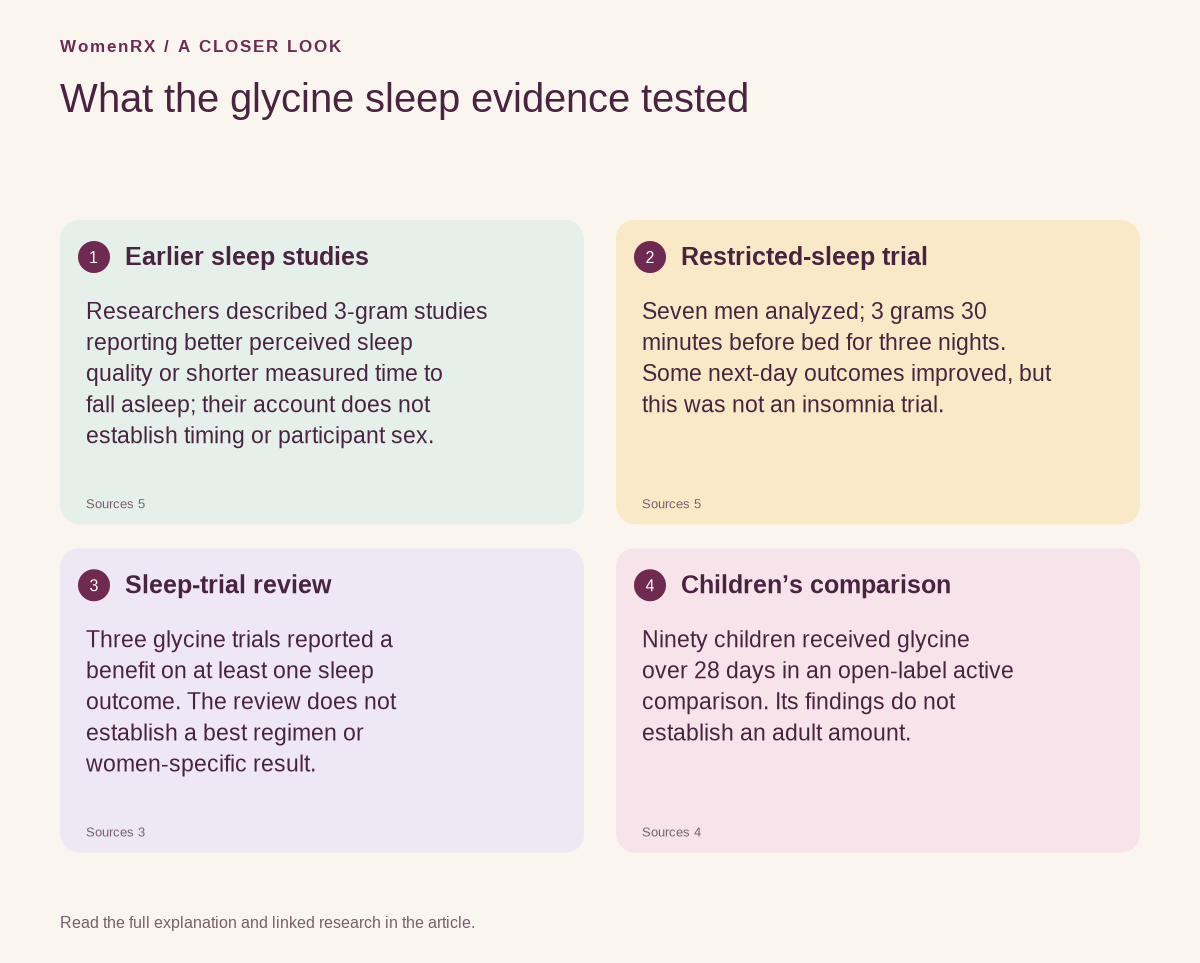
Earlier sleep studies: Researchers described 3-gram studies reporting better perceived sleep quality or shorter measured time to fall asleep; their account does not establish timing or participant sex.5
Restricted-sleep trial: Seven men analyzed; 3 grams 30 minutes before bed for three nights. Some next-day outcomes improved, but this was not an insomnia trial.5
Sleep-trial review: Three glycine trials reported a benefit on at least one sleep outcome. The review does not establish a best regimen or women-specific result.3
Children’s comparison: Ninety children received glycine over 28 days in an open-label active comparison. Its findings do not establish an adult amount.4
Read the figure as text
The people studied and the outcomes measured matter as much as the amount.- Earlier sleep studies: Researchers described 3-gram studies reporting better perceived sleep quality or shorter measured time to fall asleep; their account does not establish timing or participant sex.5
- Restricted-sleep trial: Seven men analyzed; 3 grams 30 minutes before bed for three nights. Some next-day outcomes improved, but this was not an insomnia trial.5
- Sleep-trial review: Three glycine trials reported a benefit on at least one sleep outcome. The review does not establish a best regimen or women-specific result.3
- Children’s comparison: Ninety children received glycine over 28 days in an open-label active comparison. Its findings do not establish an adult amount.4
More questions, answered
Can a collagen supplement stand in for the glycine used in sleep studies?
Not based on the sleep evidence alone. Collagen contains glycine, but a scoping review assessed collagen-related trials separately from trials of supplemental glycine. It found that glycine’s proposed role in any collagen-related sleep effect had not been directly tested.3
Sources you can check
- Sleep Disorders | MedlinePlusAccessed 2026-09-25Return to first citation
- Insomnia | MedlinePlusAccessed 2026-09-25Return to first citation
- Glycine Bioavailability and Sleep-Related Outcomes Following Oral Glycine and Collagen Supplementation-A Scoping Review.Fan Z, Nelson JM, Wallace TC. · Journal of dietary supplements · 2026Return to first citation
- A Comparative Randomized Controlled Clinical Trial on the Effectiveness, Safety, and Tolerability of a Homeopathic Medicinal Product in Children with Sleep Disorders and Restlessness.Jong MC, Ilyenko L, Kholodova I, Verwer C, Burkart J, Weber S, Keller T, Klement P. · Evidence-based complementary and alternative medicine : eCAM · 2016Return to first citation
- The Effects of Glycine on Subjective Daytime Performance in Partially Sleep-Restricted Healthy VolunteersAccessed 2026-09-26Return to first citation
- Assessment of Acute Adverse Events of Glycine Ingestion at a High Dose in Human Volunteers (2006)Accessed 2026-09-26Return to first citation