Perimenopause Sleep Supplements: What Has Actually Been Tested?
Melatonin has been studied for sleep quality in menopausal women, but the results don’t establish that it helps perimenopausal sleep.
Melatonin has been tested for sleep quality in menopausal women, with no clear benefit in a review of randomized trials; a perimenopause-only result wasn’t reported. Black cohosh has been studied mainly for menopausal symptoms, with limited evidence on insomnia as a separate outcome. This evidence can’t establish whether magnesium improves perimenopausal sleep, or whether any of these supplements increases sleep duration. 42
First, what does “better sleep” mean to you?
If you’re waking up hot, that’s a different problem from lying awake for hours at the start of the night. And neither is quite the same as sleeping through the night but feeling exhausted the next day. Those differences matter when you read supplement claims: a study that asks women to rate their sleep quality hasn’t necessarily shown that they fell asleep faster, slept longer, or had less insomnia.
They also matter in perimenopause. A study of “menopausal women” may include people at different stages, and an overall finding doesn’t tell you what happened specifically among participants who were still having periods. The most useful question isn’t simply Was this supplement studied? It’s Who was studied, and what changed?
Melatonin: a sleep-quality test, not a perimenopause answer
A 2021 review brought together eight melatonin study cohorts involving 812 menopausal women. Four randomized trials contributed to its sleep-quality analysis, which found no statistically clear benefit. The review also found no clear improvement in vasomotor symptoms, anxiety, or depression. Its reported results do not separate out a perimenopausal subgroup. That makes the finding more informative than a general claim that melatonin “helps menopause sleep,” but less specific than a woman in perimenopause might hope. 4
Sleep quality was the outcome reported in that analysis. It shouldn’t be translated into a promise about hours slept or treatment of insomnia. Nor does an inconclusive overall result prove that no individual could find melatonin helpful. It means this review doesn’t establish a reliable sleep-quality benefit for this population. 4
Black cohosh: hot-flash research isn’t sleep treatment research
Black cohosh is often marketed for menopausal symptoms, including night sweats and sleep disturbance. One randomized trial described by the NIH enrolled 88 perimenopausal and postmenopausal women who had frequent hot flashes and night sweats. Insomnia was among its secondary outcomes, but the NIH summary reports no significant differences between treatment groups for most secondary outcomes. It does not give a separate perimenopause-only insomnia result. In that trial, black cohosh also did not outperform placebo on the number of hot flashes and night sweats over the reported assessments. 2
The broader picture depends on which question a review asks. A more recent systematic review rated evidence for black cohosh’s effect on vasomotor or overall menopausal symptoms as moderate-certainty, while the NIH fact sheet describes earlier trials and reviews that did not consistently find a hot-flash benefit. Neither finding establishes that black cohosh treats insomnia or increases sleep duration in perimenopause. Products studied have also differed considerably in composition, making results hard to apply to any particular bottle. 52
There’s a practical safety distinction here, too. Liver injury has been reported in people using black cohosh, although a causal link hasn’t been established. If you’re taking it and develop dark urine, jaundice, or abdominal pain, stop taking it and contact a clinician. 2
Where does magnesium fit?
Magnesium is a common suggestion for sleep, but a suggestion isn’t the same as a result from a trial in perimenopausal women. There isn’t a magnesium sleep outcome in the studies compared above, so there’s no sound basis here to rank it against melatonin or black cohosh for sleep quality, insomnia symptoms, or hours slept. That’s a limit on this comparison, not proof that magnesium has no effect.
Be especially wary of a comparison that gives all three a single “sleep score.” Melatonin’s review assessed sleep quality, the black cohosh trial included insomnia among secondary outcomes, and neither gives a clear perimenopause-specific sleep-duration finding. Those aren’t interchangeable measures. 42
Look at what happens when you wake
A supplement choice can distract from a clue that points elsewhere. For example, a strong urge to move your legs when resting at night can be a sign of restless legs syndrome. It may be linked to low iron, and some medicines can make symptoms worse. If it’s keeping you from sleeping, that pattern is worth bringing up rather than treating it as ordinary menopause-related wakefulness. 1
Loud snoring with snorting or choking sounds, particularly alongside daytime drowsiness, raises a different question: could sleep apnea be interrupting your breathing? A clinician can assess that possibility and determine whether a sleep study is needed. Not everyone who snores has sleep apnea, but a supplement won’t answer what’s causing those awakenings. 3
You don’t need to diagnose your sleep from a symptom list. Start with the most recognizable pattern: waking hot, feeling an urge to move your legs, noticing breathing-related sounds, or lying awake without an obvious trigger. That distinction gives you a more useful next question than “Which supplement is best?” It also keeps a mixed-stage supplement finding from being mistaken for a solution to your particular nights. 134
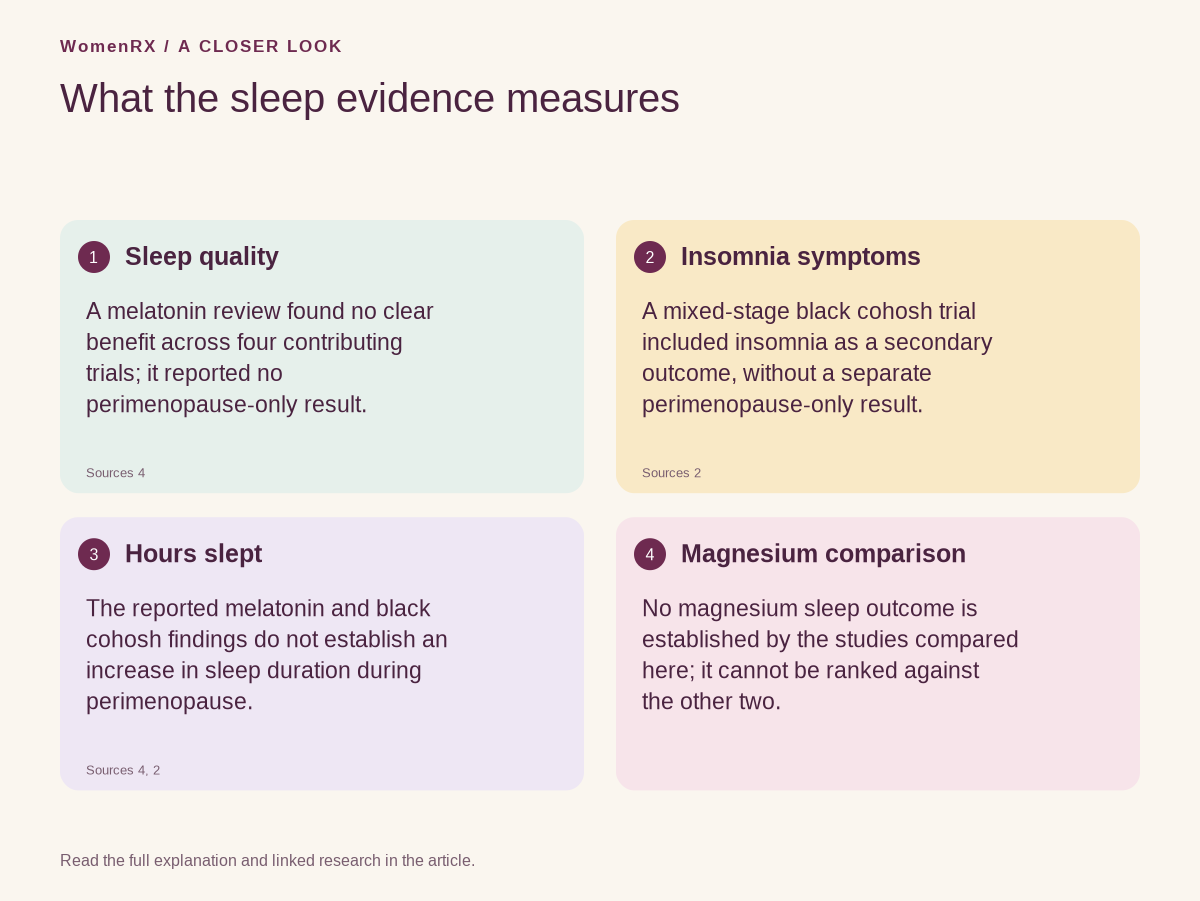
What the sleep evidence measures
Sleep quality: A melatonin review found no clear benefit across four contributing trials; it reported no perimenopause-only result.4
Insomnia symptoms: A mixed-stage black cohosh trial included insomnia as a secondary outcome, without a separate perimenopause-only result.2
Hours slept: The reported melatonin and black cohosh findings do not establish an increase in sleep duration during perimenopause.42
Magnesium comparison: No magnesium sleep outcome is established by the studies compared here; it cannot be ranked against the other two.
Read the figure as text
These outcomes answer different questions; none should be silently substituted for another.- Sleep quality: A melatonin review found no clear benefit across four contributing trials; it reported no perimenopause-only result.4
- Insomnia symptoms: A mixed-stage black cohosh trial included insomnia as a secondary outcome, without a separate perimenopause-only result.2
- Hours slept: The reported melatonin and black cohosh findings do not establish an increase in sleep duration during perimenopause.42
- Magnesium comparison: No magnesium sleep outcome is established by the studies compared here; it cannot be ranked against the other two.
Sources you can check
- Restless legs syndrome - NHSAccessed 2026-09-25Return to first citation
- Black Cohosh - Health Professional Fact SheetAccessed 2026-09-25Return to first citation
- Sleep Apnea | MedlinePlusAccessed 2026-09-25Return to first citation
- Effects of exogenous melatonin on sleep quality and menopausal symptoms in menopausal women: a systematic review and meta-analysis of randomized controlled trials.Yi M, Wang S, Wu T, Zhang X, Jiang L, Fang X. · Menopause (New York, N.Y.) · 2021Return to first citation
- Complementary therapies for management of menopausal symptoms: a systematic review to inform the update of the International Menopause Society recommendations on women's midlife health.Maunder A, Mardon AK, Rao V, Torkel S, Metri NJ, Liu J, Yang G, Giese N, Mantzioris E, Abdul Jafar NK, Rodrigues de Souza GE, Al-Kanini I, Romero L, Panay N, Pedder H, Ee C. · Climacteric : the journal of the International Menopause Society · 2026Return to first citation