Melatonin for Sleep: When Timing Matters
Melatonin has a clearer role in shifting a mistimed body clock than in treating insomnia as a catch-all sleep problem.
Melatonin may be worth discussing when your sleep schedule is out of sync with your internal clock, such as with a delayed sleep schedule or jet lag. It is less predictable for insomnia, which can have many causes and is commonly treated with cognitive behavioral therapy for insomnia (CBT-I). Timing depends on the sleep problem; taking it automatically at bedtime is not a universal approach. 3 4
Melatonin is often treated like a general sleep aid, but the reason you’re not sleeping matters. It can act as a signal that helps shift sleep timing. That is different from treating the many thoughts, habits, health conditions, or other sleep disorders that can contribute to insomnia. 3 4
First ask: is your sleep time shifted, or is sleep itself difficult?
A circadian timing problem means your internal sleep-wake rhythm doesn’t line up well with the hours you need or want to sleep. For example, you may feel alert late at night and struggle to wake for work or school, even when you’ve allowed enough time for sleep. In delayed sleep-wake phase disorder, melatonin may help move sleep earlier when it is timed for that purpose. The timing depends on the circadian goal, so simply taking it at bedtime may not address the mismatch. 3 4
Insomnia is different: you have trouble falling asleep, staying asleep, or waking too early, even when you have the chance to sleep. Stress, medicines, health conditions, caffeine, alcohol, and other sleep disorders can contribute. CBT-I is a well-established treatment approach for ongoing insomnia; melatonin’s benefits for insomnia are described as smaller and less predictable than its role in circadian rhythm disorders. 1 3 4
That distinction matters in practice. If you’re lying awake because your sleep window is consistently shifted later, the question may be about circadian timing. If you’re waking repeatedly or feeling keyed up despite a suitable sleep schedule, a general “sleep aid” may miss the problem. Persistent insomnia deserves attention to its causes and treatment options, not just repeated trials of supplements. 1 3
Jet lag is a timing problem, too
After crossing time zones, your body clock may still be set to the time at home. Melatonin may help with circadian realignment and jet lag, but evidence reviews describe uncertainty about the best timing and formulation, and note that some of the underlying evidence is dated. The goal is not simply to feel sedated; it is to help your body adjust to a new schedule. 2 4
Shift work also disrupts sleep timing, but it isn’t interchangeable with jet lag or a delayed sleep schedule. Research reviews describe melatonin as a possible part of a broader circadian strategy, rather than a stand-alone fix. 2 4
Timing and product questions to raise
Before considering melatonin, identify the problem you’re trying to address: a shifted sleep schedule, travel-related jet lag, or insomnia. Ask whether the goal is to change your body-clock timing or to address trouble sleeping despite an appropriate sleep window. If timing is part of the plan, ask how it should relate to your intended sleep schedule and whether light exposure or a consistent sleep-wake routine also matters. The right timing can vary with the goal; there isn’t one schedule that fits every sleep complaint. 3 4
Also ask what is known about the particular product and its formulation. A clinical review notes variability among over-the-counter preparations, which can make results less predictable. For delayed sleep-wake phase disorder, guidance does not give one standardized dose regimen. 4 Questions about long-term safety remain. 2
What women’s insomnia rates do and don’t tell you
Insomnia is reported more often in women than men. That difference in how often insomnia occurs doesn’t, by itself, tell you whether melatonin works differently by sex. 1
For pregnancy and breastfeeding, or if sleep changes around your menstrual cycle or menopause, general adult sleep findings don’t establish whether melatonin is appropriate, safe, or more effective in those contexts. Don’t infer a life-stage-specific benefit or safety from general adult sleep findings. Before considering it, raise that specific context with the clinician who knows your health.
A useful route through the decision
If your sleep timing is persistently out of step with your needs, ask whether a circadian rhythm problem could explain it and whether melatonin timing is relevant. If you have ongoing difficulty sleeping despite a suitable schedule, ask about insomnia treatments such as CBT-I and whether another condition, medicine, or sleep disorder could be involved. If the problem followed travel, discuss jet-lag timing and the limits of the evidence. These are different questions, and melatonin is not a proven answer to all of them. 1 3 4
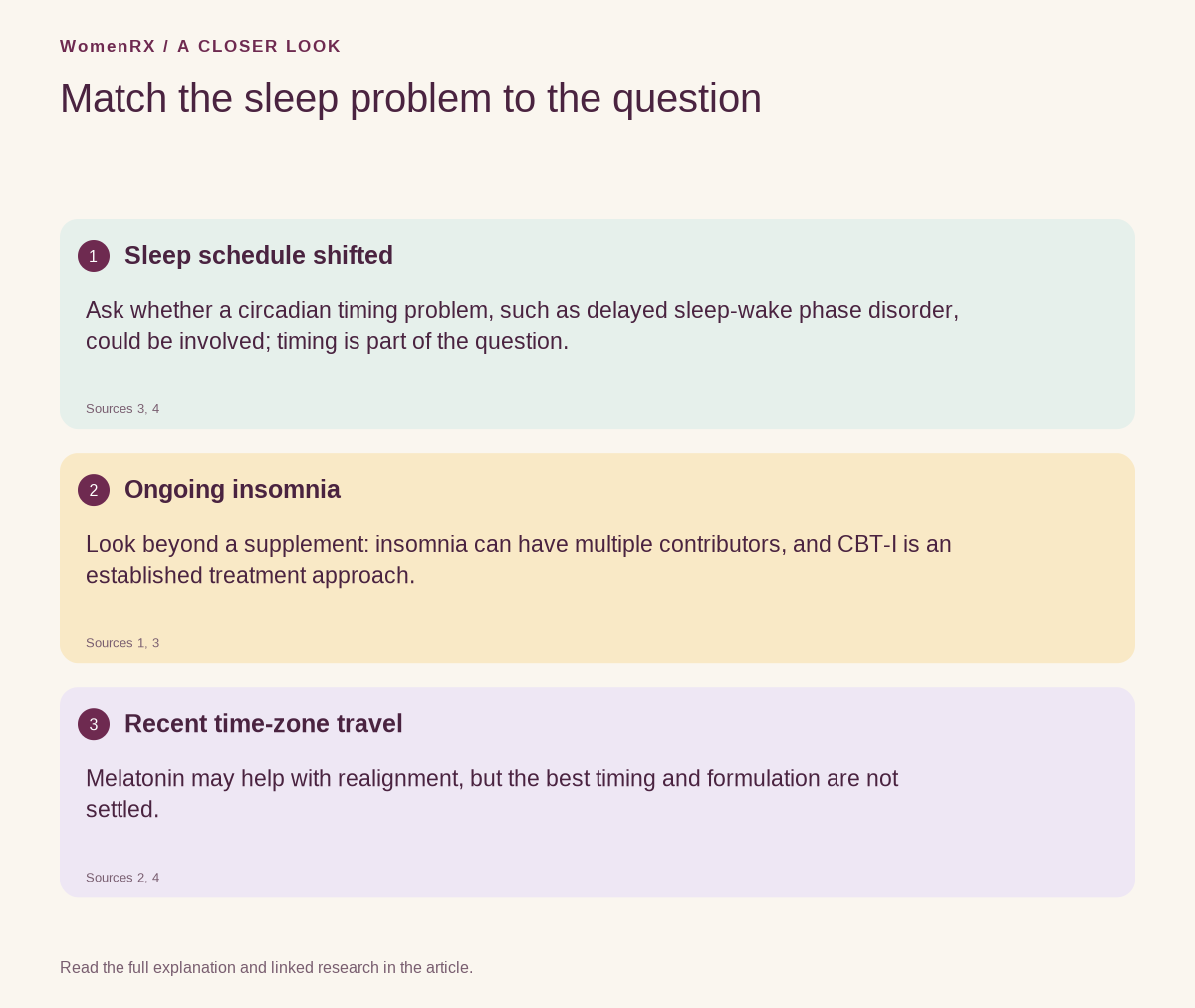
Match the sleep problem to the question
Sleep schedule shifted: Ask whether a circadian timing problem, such as delayed sleep-wake phase disorder, could be involved; timing is part of the question.34
Ongoing insomnia: Look beyond a supplement: insomnia can have multiple contributors, and CBT-I is an established treatment approach.13
Recent time-zone travel: Melatonin may help with realignment, but the best timing and formulation are not settled.24
Read the figure as text
Melatonin is not one answer for every sleep complaint. Start with the pattern you’re trying to change, then focus on the relevant evidence and timing question.- Sleep schedule shifted: Ask whether a circadian timing problem, such as delayed sleep-wake phase disorder, could be involved; timing is part of the question.34
- Ongoing insomnia: Look beyond a supplement: insomnia can have multiple contributors, and CBT-I is an established treatment approach.13
- Recent time-zone travel: Melatonin may help with realignment, but the best timing and formulation are not settled.24
More questions, answered
Does melatonin work like a sleeping pill?
It can have sleep-related effects, but it acts primarily as a signal that can shift circadian timing. Treating it as a general sedative can miss the distinction between a mistimed body clock and insomnia. 3 4
Sources you can check
- Insomnia | MedlinePlusAccessed 2026-09-25Return to first citation
- Melatonin and sleep: Exploring its role in regulating the circadian rhythm and sleep-wake cycle.Wani PD. · Journal of family medicine and primary care · 2026Return to first citation
- Circadian dimensions in insomnia disorder: mechanistic evidence, candidate phenotypes, and a phenotype-stratified research framework.Zhang S, Liu Y, Tan J, Si W, Liu H, Huang Y, Li Y, Xiao J. · Frontiers in psychiatry · 2026Return to first citation
- Melatonin in Clinical Practice: Grey Zones Between Chronobiology, Insomnia and Consumer Supplementation.Kalkanis A, Karkala A, Pataka A. · Clocks & sleep · 2026Return to first citation