Melatonin Timing: What to Expect and What It Means
Melatonin may take about one to two hours to work, but that estimate can’t tell you why your sleep is difficult or when you’ll fall asleep.
If melatonin hasn’t helped, first name the problem you hoped it would solve: taking a long time to fall asleep, waking overnight, or keeping a later schedule than you want. Melatonin helps regulate sleep timing, but those outcomes aren’t interchangeable. For adult short-term insomnia, NHS guidance gives one example: a slow-release tablet taken 1 to 2 hours before bedtime. That schedule does not apply to every product or purpose. 1 2
First, decide what “working” would mean
Melatonin is a hormone that rises at night and helps regulate the timing of sleep. Taking a synthetic version adds to the body’s supply, but the effect isn’t the same as switching off wakefulness on demand. NHS guidance estimates that melatonin takes around one to two hours to work. That’s a general estimate, not a countdown to the moment you’ll fall asleep. 2
It helps to separate three outcomes: falling asleep sooner, waking less during the night, and shifting a sleep schedule that feels too late. If your main problem is waking repeatedly, for example, a timing estimate doesn’t tell you what’s causing those awakenings. If you fall asleep easily but later than you want, the question is less about how quickly you feel sleepy and more about whether your sleep schedule shifts.
Sleep timing and sleepiness are related, not identical
Your internal body clock helps set when your body is ready for sleep. In earlier research on adults with ADHD and delayed sleep phase syndrome, melatonin shifted an internal body-clock marker earlier. But in a separate analysis of sleep outcomes from a randomized trial of 49 adults with those conditions, melatonin, with or without bright light therapy, did not move actual sleep times earlier or improve sleep overall. A shift in the body-clock marker did not, by itself, translate into earlier sleep for this group. The findings don’t show that melatonin never helps with sleep timing. 3
For everyday use, the distinction matters: a change in a body-clock marker doesn’t automatically mean you’ll fall asleep earlier.
Immediate or prolonged release?
Melatonin comes in standard and slow-release forms. That describes the formulation, not a proven ranking of which form is best for every sleep problem. The general estimate of one to two hours to work is not a comparison showing that one form makes you fall asleep faster than the other. 2
For adult short-term insomnia, NHS guidance gives a more specific example: one 2 mg slow-release tablet taken 1 to 2 hours before bedtime. The before-bed instruction applies to that use and formulation; it isn’t a schedule to borrow for a standard-release product. Check the instructions for the product you have rather than treating “melatonin” as one interchangeable option. 1
When the usual timing hasn’t helped
Ask what has and hasn’t changed. If you’re still taking a long time to fall asleep, check whether the timing advice you followed was meant for your formulation and reason for use. If you’re waking during the night, moving the dose earlier or later doesn’t establish why that’s happening. And if bedtime itself keeps drifting later, remember that moving a body-clock marker earlier did not move sleep times earlier in the trial of adults with ADHD and delayed sleep phase syndrome. None of those patterns, on its own, is a reason to assume you need more melatonin. 1 3
Pregnancy and breastfeeding raise a different question from when melatonin works. A bedtime instruction or a sleep trial in adults cannot establish whether taking it is safe during pregnancy or breastfeeding. The adult trial’s reported findings also don’t show whether melatonin’s effects differ by sex. 1 3
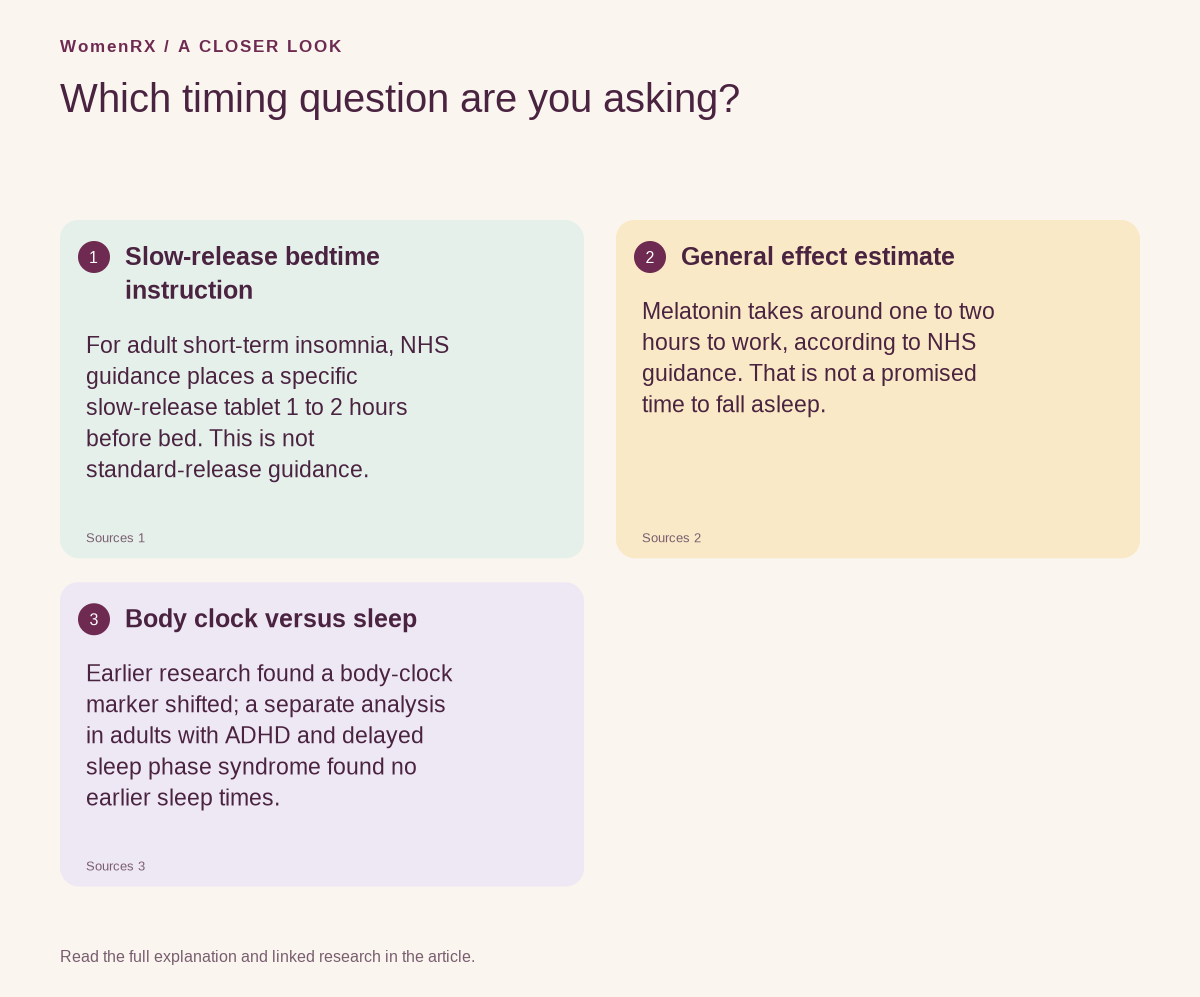
Which timing question are you asking?
Slow-release bedtime instruction: For adult short-term insomnia, NHS guidance places a specific slow-release tablet 1 to 2 hours before bed. This is not standard-release guidance.1
General effect estimate: Melatonin takes around one to two hours to work, according to NHS guidance. That is not a promised time to fall asleep.2
Body clock versus sleep: Earlier research found a body-clock marker shifted; a separate analysis in adults with ADHD and delayed sleep phase syndrome found no earlier sleep times.3
Read the figure as text
A bedtime instruction, an estimate of effect, and a shift in sleep schedule describe different things.- Slow-release bedtime instruction: For adult short-term insomnia, NHS guidance places a specific slow-release tablet 1 to 2 hours before bed. This is not standard-release guidance.1
- General effect estimate: Melatonin takes around one to two hours to work, according to NHS guidance. That is not a promised time to fall asleep.2
- Body clock versus sleep: Earlier research found a body-clock marker shifted; a separate analysis in adults with ADHD and delayed sleep phase syndrome found no earlier sleep times.3
Sources you can check
- How and when to take melatonin - NHSAccessed 2026-09-25Return to first citation
- About melatonin - NHSAccessed 2026-09-25Return to first citation
- Attention-Deficit/Hyperactivity Disorder and Delayed Sleep Phase Syndrome in Adults: A Randomized Clinical Trial on the Effects of Chronotherapy on Sleep.van Andel E, Bijlenga D, Vogel SWN, Beekman ATF, Kooij JJS. · Journal of biological rhythms · 2022Return to first citation