Melatonin for Sleep: What the Dose Evidence Really Says
The sleep problem and the formulation matter more than finding a single melatonin dose that supposedly works for everyone.
Melatonin may be worth considering for a short-term sleep concern, but there’s no one dose in this evidence that fits every adult or every kind of insomnia. A trial of one sustained-release product does not establish a dose for other products.6 For ongoing insomnia, cognitive behavioral therapy for insomnia has stronger guideline support than fast-release melatonin.5
Start with the sleep problem, not the bottle
Melatonin is a hormone whose levels normally rise at night and fall during the day. That makes it relevant to when you sleep, but it doesn’t mean every sleepless night calls for more melatonin.3
Think about what’s happening. If your sleep changed during travel, that’s a different question from lying awake for weeks or repeatedly waking during the night. Stress, shift work, medicines, other health conditions and menopause can all contribute to insomnia. If one of those is driving the problem, a supplement alone may leave the cause untouched.12 For ongoing insomnia, a 2023 European clinical guideline recommends cognitive behavioral therapy for insomnia (CBT-I) as the first treatment for adults. It does not recommend fast-release melatonin as an insomnia treatment.5
Why a study dose isn’t your dose
One placebo-controlled trial tested a 2 mg sustained-release capsule taken at night for 28 days in healthy adults ages 30 to 60 who reported poor sleep quality. Fifty-nine people completed it: 28 in the melatonin group and 31 in the placebo group. At day 28, several measured sleep outcomes improved more in the melatonin group. That is evidence about that formulation, population and timeframe, not proof that any product labeled “2 mg” will have the same effect or that the dose treats chronic insomnia.6
Formulation matters because products release melatonin differently. The European guideline allows prolonged-release melatonin for up to three months in patients 55 or older, while recommending against fast-release melatonin for insomnia. Those are distinct conclusions, not a general endorsement of melatonin at any age or dose.5 The trial studied healthy adults ages 30 to 60; its findings do not establish a dose or safety profile for pregnancy, breastfeeding or specific women’s life stages.6
Timing needs the same care. UK medicine guidance says melatonin takes around one to two hours to work, but that estimate should not be treated as a precise schedule for every US supplement or formulation.3 If you’re comparing a product with a study, check whether its label says fast-release or sustained-release as well as how much melatonin it lists. A matching number of milligrams, by itself, is not a match to the studied product.56
Check safety before making it a nightly habit
Melatonin can leave some people tired, dizzy, headachy, nauseated or irritable the next day. If you feel sleepy or dizzy, don’t drive or do something else that needs your full attention.34 UK medicine guidance also cautions that combining melatonin with sleep-affecting herbal remedies can make you very drowsy, and that alcohol can affect how melatonin works.34 These are specific cautions, not a complete list of medicine interactions. If you take other medicines or sleep aids, have someone review the actual combination rather than guessing from a general melatonin dose chart.
Pregnant or breastfeeding? Bring the specific product to your prenatal or postpartum care team before using it. The adult trial above does not establish safety or a dose for pregnancy, breastfeeding or an infant exposed through breast milk.6 Menopause can be a reason sleep has changed, but it does not turn that trial into evidence for a menopause-specific supplement dose.26
Finally, decide what would count as a useful result and when you’ll reassess. The sustained-release trial followed people for 28 days, while the guideline’s limited recommendation for adults 55 or older extends to three months. Neither answers whether taking a US supplement indefinitely helps or is safe for you.56 If sleep trouble keeps returning or affects your daytime functioning, look beyond the bottle: insomnia can be linked to another sleep disorder, a medicine or a health condition that needs a different approach.1
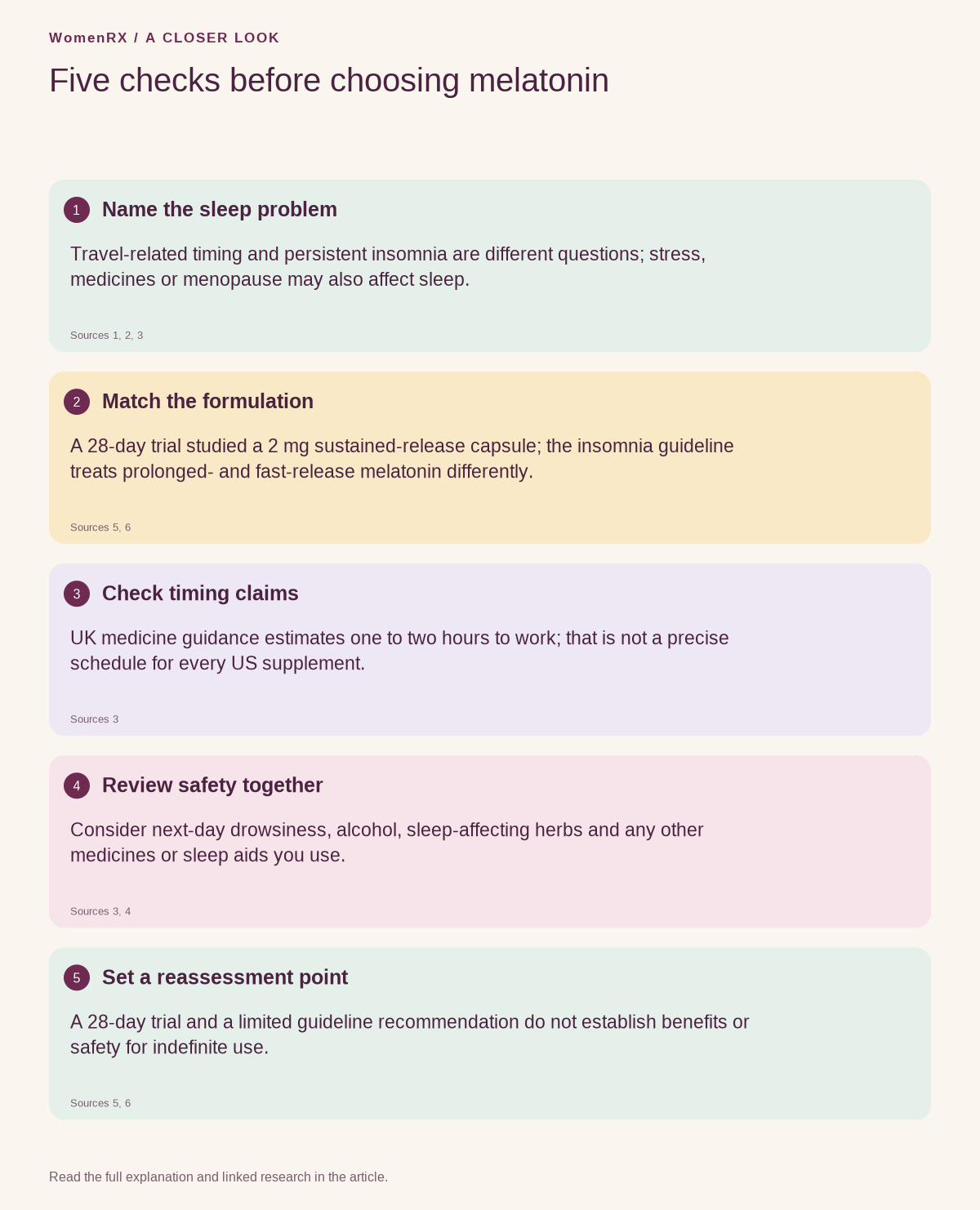
Five checks before choosing melatonin
Name the sleep problem: Travel-related timing and persistent insomnia are different questions; stress, medicines or menopause may also affect sleep.123
Match the formulation: A 28-day trial studied a 2 mg sustained-release capsule; the insomnia guideline treats prolonged- and fast-release melatonin differently.56
Check timing claims: UK medicine guidance estimates one to two hours to work; that is not a precise schedule for every US supplement.3
Review safety together: Consider next-day drowsiness, alcohol, sleep-affecting herbs and any other medicines or sleep aids you use.34
Set a reassessment point: A 28-day trial and a limited guideline recommendation do not establish benefits or safety for indefinite use.56
Read the figure as text
Use these questions to keep a studied dose from becoming a one-size-fits-all recommendation.- Name the sleep problem: Travel-related timing and persistent insomnia are different questions; stress, medicines or menopause may also affect sleep.123
- Match the formulation: A 28-day trial studied a 2 mg sustained-release capsule; the insomnia guideline treats prolonged- and fast-release melatonin differently.56
- Check timing claims: UK medicine guidance estimates one to two hours to work; that is not a precise schedule for every US supplement.3
- Review safety together: Consider next-day drowsiness, alcohol, sleep-affecting herbs and any other medicines or sleep aids you use.34
- Set a reassessment point: A 28-day trial and a limited guideline recommendation do not establish benefits or safety for indefinite use.56
More questions, answered
Is melatonin a treatment for chronic insomnia?
It isn’t the guideline’s first choice. The 2023 European insomnia guideline recommends CBT-I first for adults with chronic insomnia, advises against fast-release melatonin for insomnia, and makes a narrower allowance for prolonged-release melatonin in adults 55 or older.5
Does a 2 mg label mean a product matches the trial?
No. The 28-day trial studied a particular sustained-release capsule in healthy adults ages 30 to 60 with poor sleep quality. Its findings cannot establish the effect of a different formulation simply because the listed dose is also 2 mg.6
Sources you can check
- Insomnia | MedlinePlusAccessed 2026-09-25Return to first citation
- Insomnia - NHSAccessed 2026-09-25Return to first citation
- About melatonin - NHSAccessed 2026-09-25Return to first citation
- Side effects of melatonin - NHSAccessed 2026-09-25Return to first citation
- The European Insomnia Guideline: An update on the diagnosis and treatment of insomnia 2023.Riemann D, Espie CA, Altena E, Arnardottir ES, Baglioni C, Bassetti CLA, Bastien C, Berzina N, Bjorvatn B, Dikeos D, Dolenc Groselj L, Ellis JG, Garcia-Borreguero D, Geoffroy PA, G... · Journal of sleep research · 2023Return to first citation
- Efficacy and Safety of Sustained-Release Melatonin Capsules (2 mg) in Healthy Adults with Poor Sleep Quality: A Randomized, Double-Blind, Placebo-Controlled Trial.Thanawala S, Shah R, Lopes A, Kulkarni M, Jain B, Andhalkar N. · Clocks & sleep · 2026Return to first citation