Where Does Melatonin Have Evidence for Sleep?
The answer depends on the sleep problem: findings in children, older adults, and menopausal women don’t tell the same story.
Melatonin isn’t one treatment with one proven benefit across every kind of sleep trouble. Trials in children with certain chronic sleep problems show modest reductions in time to fall asleep and increases in total sleep time, but those results don’t establish a benefit for adults. Evidence in older adults is harder to interpret because a review pooled melatonin with a different drug, and its summary does not show whether results were analyzed separately for women. Trials in menopausal women haven’t shown a clear improvement in sleep quality. 548
First, name the sleep problem
If you can’t fall asleep until very late, wake repeatedly, or feel out of step after a flight, those experiences may sound alike at bedtime. They aren’t necessarily the same problem. Insomnia can involve difficulty falling asleep, staying asleep, or both; a circadian rhythm disorder involves trouble sleeping and waking at the intended times. The cause affects which evidence is relevant to you. 23
That distinction matters when someone says melatonin “helps sleep.” A study measuring how long it takes to fall asleep in one group doesn’t prove that melatonin fixes repeated waking, jet lag, or sleep disrupted by hot flashes. Here’s what the available human findings can and can’t answer.
Chronic insomnia in adults: separate melatonin from its relative
A review of studies in older adults with chronic insomnia reported modest improvements in measures including time to fall asleep, total sleep time, and sleep quality. But it combined studies of melatonin with studies of ramelteon, a different melatonin-receptor agonist. Its pooled result therefore can’t tell you how much of the improvement came from melatonin itself. Sleep efficiency, the proportion of time in bed spent asleep, did not improve significantly in the pooled analysis. The reported results do not indicate whether outcomes were analyzed separately for women, so the pooled findings are not women-specific estimates. 4
This is especially relevant if your main complaint is lying awake for hours or waking through the night. The review gives a reason to keep studying these treatments, not a dependable estimate of what a melatonin supplement will do for either complaint. And ramelteon is not interchangeable with melatonin when you’re reading a study or considering an option. 4
For ongoing insomnia, it’s also worth looking beyond the supplement aisle. Stress, other health conditions, medicines, and other sleep disorders can contribute; treatment may include behavioral approaches and addressing an underlying cause. 3
Menopause-related sleep trouble: a direct test with a limited result
A review of randomized trials in menopausal women offers a more direct answer than a mixed-treatment review. Across four trials that measured sleep quality, the pooled result did not show a clear benefit from melatonin. The same review did not find clear improvements in overall menopausal symptoms or vasomotor symptoms, such as hot flashes. It did report improvement in a combined measure of physical symptoms, which is a different outcome from better sleep. 8
So if hot flashes are waking you, a finding about physical symptoms isn’t evidence that melatonin will keep you asleep. A menopause society evidence review does not recommend supplements or herbal remedies as treatments for vasomotor symptoms; it identifies other evidence-based nonhormonal options. 6 That distinction gives you a more useful starting point: is the problem falling asleep, or being awakened by a symptom that needs attention in its own right?
Jet lag and shift work: the clock question remains separate
Jet lag follows travel across time zones and usually eases as your body adjusts. Rest before travel and sleep timed to the destination are among the practical measures described in clinical guidance. The NHS does not recommend melatonin tablets for jet lag in its care system, citing insufficient evidence of effectiveness. That guidance isn’t a trial estimate of melatonin’s benefit, and it shouldn’t be read as proof that melatonin never helps a traveler. 1
Shift work can also put sleep and waking times at odds with your schedule. 2 The cited sources do not provide a comparable trial-based estimate of melatonin’s effect on shift-work sleep. Neither a jet-lag recommendation nor an insomnia finding settles that question.
A positive finding in children doesn’t transfer to adults
A review of 13 randomized trials included 403 children and adolescents whose chronic insomnia was associated with a range of underlying conditions. Melatonin was associated with an average of about 15 minutes less time to fall asleep and 19 minutes more total sleep time in the pooled analyses. The authors rated the evidence low certainty, found no other clinical benefits, and noted that safety data were scarce. 5
Those numbers describe a specific pediatric population, not an expected result for an adult woman with insomnia or jet lag. They illustrate why an apparently encouraging melatonin result needs its population and outcome attached.
What changes if you’re pregnant or breastfeeding?
The adult sleep findings above don’t establish a pregnancy-specific benefit or safety profile. Little is known about melatonin’s effects on babies during pregnancy. During breastfeeding, it isn’t known how much manufactured melatonin passes into breast milk; prolonged use might make a baby sleepy. If either situation applies to you, that uncertainty is worth raising before using it for sleep. 7
The useful next question isn’t simply “Does melatonin work?” It’s “For my particular sleep problem, what outcome has actually been tested in people like me?” For menopausal sleep quality, there are direct trials without a clear benefit. For older adults, a promising pooled finding can’t isolate melatonin. For jet lag and shift-work sleep, this evidence doesn’t provide a comparable trial-based estimate. Those differences matter more than a general list of melatonin benefits. 841
Match the finding to the sleep problem
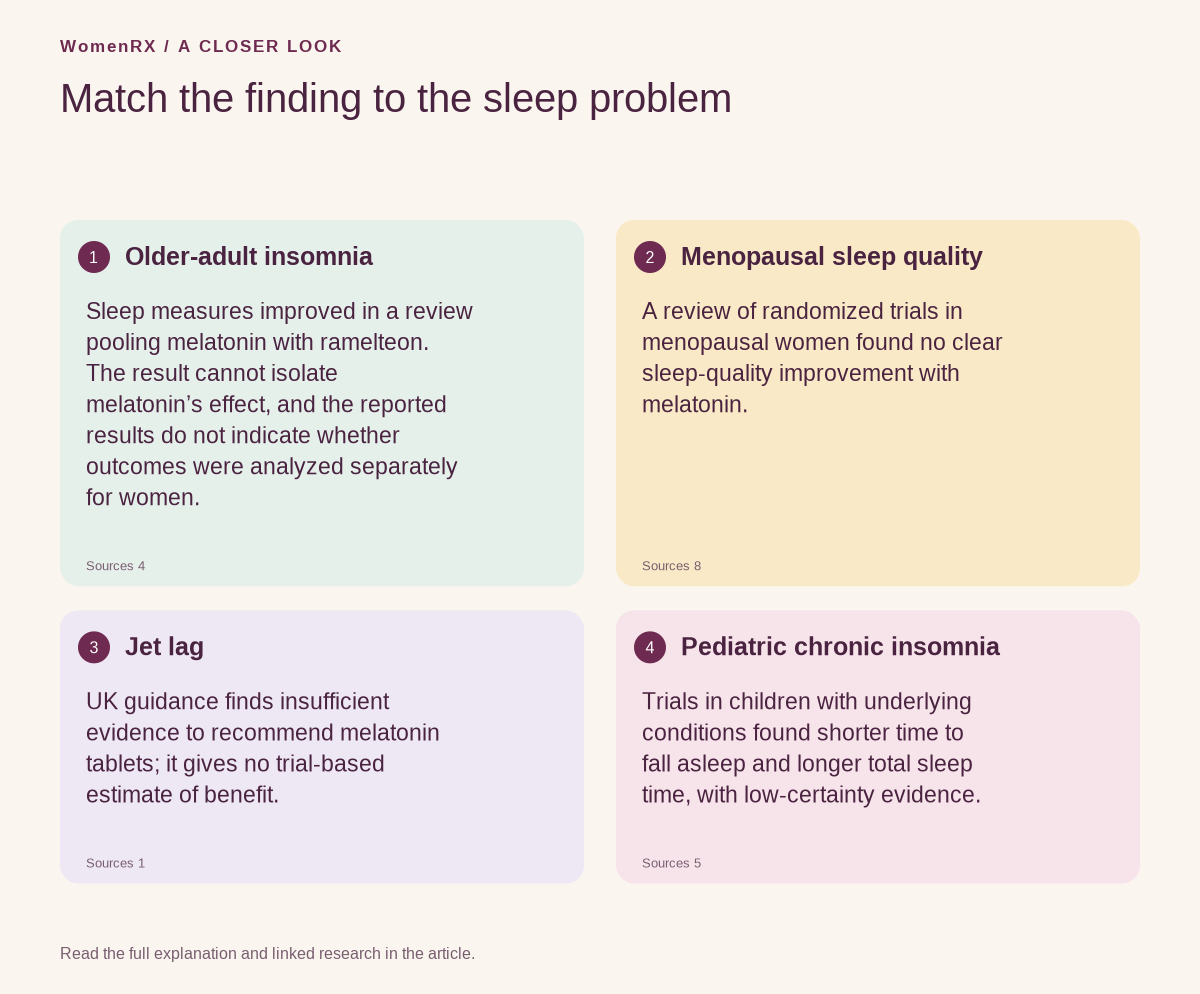
Older-adult insomnia: Sleep measures improved in a review pooling melatonin with ramelteon. The result cannot isolate melatonin’s effect, and the reported results do not indicate whether outcomes were analyzed separately for women.4
Menopausal sleep quality: A review of randomized trials in menopausal women found no clear sleep-quality improvement with melatonin.8
Jet lag: UK guidance finds insufficient evidence to recommend melatonin tablets; it gives no trial-based estimate of benefit.1
Pediatric chronic insomnia: Trials in children with underlying conditions found shorter time to fall asleep and longer total sleep time, with low-certainty evidence.5
Read the figure as text
These findings answer different questions; they cannot be combined into one estimate of melatonin’s benefit.- Older-adult insomnia: Sleep measures improved in a review pooling melatonin with ramelteon. The result cannot isolate melatonin’s effect, and the reported results do not indicate whether outcomes were analyzed separately for women.4
- Menopausal sleep quality: A review of randomized trials in menopausal women found no clear sleep-quality improvement with melatonin.8
- Jet lag: UK guidance finds insufficient evidence to recommend melatonin tablets; it gives no trial-based estimate of benefit.1
- Pediatric chronic insomnia: Trials in children with underlying conditions found shorter time to fall asleep and longer total sleep time, with low-certainty evidence.5
Sources you can check
- Jet lag - NHSAccessed 2026-09-25Return to first citation
- Sleep Disorders | MedlinePlusAccessed 2026-09-25Return to first citation
- Insomnia | MedlinePlusAccessed 2026-09-25Return to first citation
- Use of Melatonin and/on Ramelteon for the Treatment of Insomnia in Older Adults: A Systematic Review and Meta-Analysis.Marupuru S, Arku D, Campbell AM, Slack MK, Lee JK. · Journal of clinical medicine · 2022Return to first citation
- Use of melatonin for children and adolescents with chronic insomnia attributable to disorders beyond indication: a systematic review, meta-analysis and clinical recommendation.Edemann-Callesen H, Andersen HK, Ussing A, Virring A, Jennum P, Debes NM, Laursen T, Baandrup L, Gade C, Dettmann J, Holm J, Krogh C, Birkefoss K, Tarp S, Händel MN. · EClinicalMedicine · 2023Return to first citation
- The 2023 nonhormone therapy position statement of The North American Menopause Society.Menopause (New York, N.Y.) · 2023Return to first citation
- Pregnancy, breastfeeding and fertility while taking melatonin - NHSAccessed 2026-09-25Return to first citation
- Effects of exogenous melatonin on sleep quality and menopausal symptoms in menopausal women: a systematic review and meta-analysis of randomized controlled trials.Yi M, Wang S, Wu T, Zhang X, Jiang L, Fang X. · Menopause (New York, N.Y.) · 2021Return to first citation