Melatonin: Match the Sleep Problem Before Choosing a Product
Melatonin may be worth considering for a short-term sleep problem, but a shifting sleep schedule and repeated nighttime waking call for different questions.
Start with what’s happening to your sleep. Trouble sleeping at the times your schedule requires may point to a circadian timing problem; trouble falling or staying asleep can have other causes. Melatonin is used for some sleep problems, but its dose and timing depend on why it’s being used. Before trying it, read the product directions and check pregnancy, breastfeeding, and medication considerations. 12567
First, is your sleep late or interrupted?
Imagine two evenings. On one, you don’t feel ready to sleep until well after the bedtime your schedule requires, but you can sleep when your schedule allows it. On the other, you’re tired at bedtime yet lie awake, or you fall asleep and wake repeatedly. Those patterns aren’t a diagnosis, but they’re a useful first distinction: circadian rhythm disorders involve difficulty sleeping or waking at the right times, while insomnia can involve trouble falling asleep, staying asleep, or both. 12
Melatonin is involved in the body’s circadian rhythms, and it’s used for sleep problems, including short-term insomnia and jet lag in some clinical settings. That doesn’t make it a fix for every kind of poor sleep. If you wake because of pain, for example, or your bed partner notices loud snoring, gasping, or pauses in breathing, the cause deserves attention rather than another attempt to make yourself sleepy. Medicines, caffeine, alcohol, stress, and other sleep disorders can also contribute to insomnia. 12345
This distinction matters during perimenopause or after menopause, too. If nighttime waking is the main problem, don’t assume a product aimed at sleep onset addresses what’s waking you. And if you use estrogen in contraception or hormone therapy, include it when you check for melatonin interactions. 26
Read the label as a set of questions
There isn’t one dose or clock time that fits every reason for taking melatonin. Clinical guidance says the dose depends on why it’s being used and directs people to follow the instructions for their particular medicine. It describes different courses for short-term sleep problems and jet lag, rather than treating melatonin as an open-ended nightly habit. That guidance concerns medicines in the UK, not directions for every supplement sold in the US. 5
For a US product, start with what the package actually says:
- How much melatonin is in a serving, and what counts as one serving? Read the stated amount alongside the directions, rather than assuming one tablet or gummy is the intended serving.
- What timing do the directions give? A bedtime direction on a package is not, by itself, a plan for shifting your body clock. If the aim is to change a persistently late or otherwise mismatched sleep schedule, get help working out the timing instead of guessing. Melatonin guidance makes clear that how it’s taken depends on the reason for use. 15
- Does the package name a release type? Note whether it says slow-release or uses another release description. The fact that slow-release melatonin is used in some clinical settings does not establish which formulation fits your particular sleep problem. 5
- When will you reassess? If you keep needing a sleep aid or your sleep is affecting daily life, look for the cause. Treatment for insomnia can include changes to sleep habits and cognitive behavioral therapy; treating an underlying problem matters when insomnia is its symptom. 23
These questions help you avoid a common mismatch: choosing a product because its label says “sleep,” when the real issue is when you can sleep, why you wake, or both.
Check what else you take
Melatonin can interact with medicines or add to their sedating effects. A medication check is especially worthwhile if you take warfarin, an antidepressant such as fluvoxamine, a benzodiazepine or another medicine for sleep, an opioid pain medicine, a medicine that lowers blood pressure, or estrogen in contraception or hormone therapy. The interaction guidance also flags other medicines, so this is not a complete list. Herbs that make you sleepy may increase drowsiness as well. Bring the names of the products you actually use to a pharmacist or clinician before adding melatonin. 6
Pregnancy and breastfeeding change the decision. Melatonin is not usually recommended during pregnancy because its effects on the baby are not well known. During breastfeeding, it’s unclear how much manufactured melatonin passes into milk; the guidance raises concern that longer use might make a baby sleepy. If you’re pregnant, planning a pregnancy, or breastfeeding, discuss the sleep problem and melatonin before using it rather than treating an over-the-counter label as an answer to that uncertainty. 7
If your sleep trouble has lasted for months, is making daily life hard, or comes with witnessed gasping or breathing pauses, a product comparison is no longer the most useful next step. Those details can point toward a problem that needs a different approach. 13
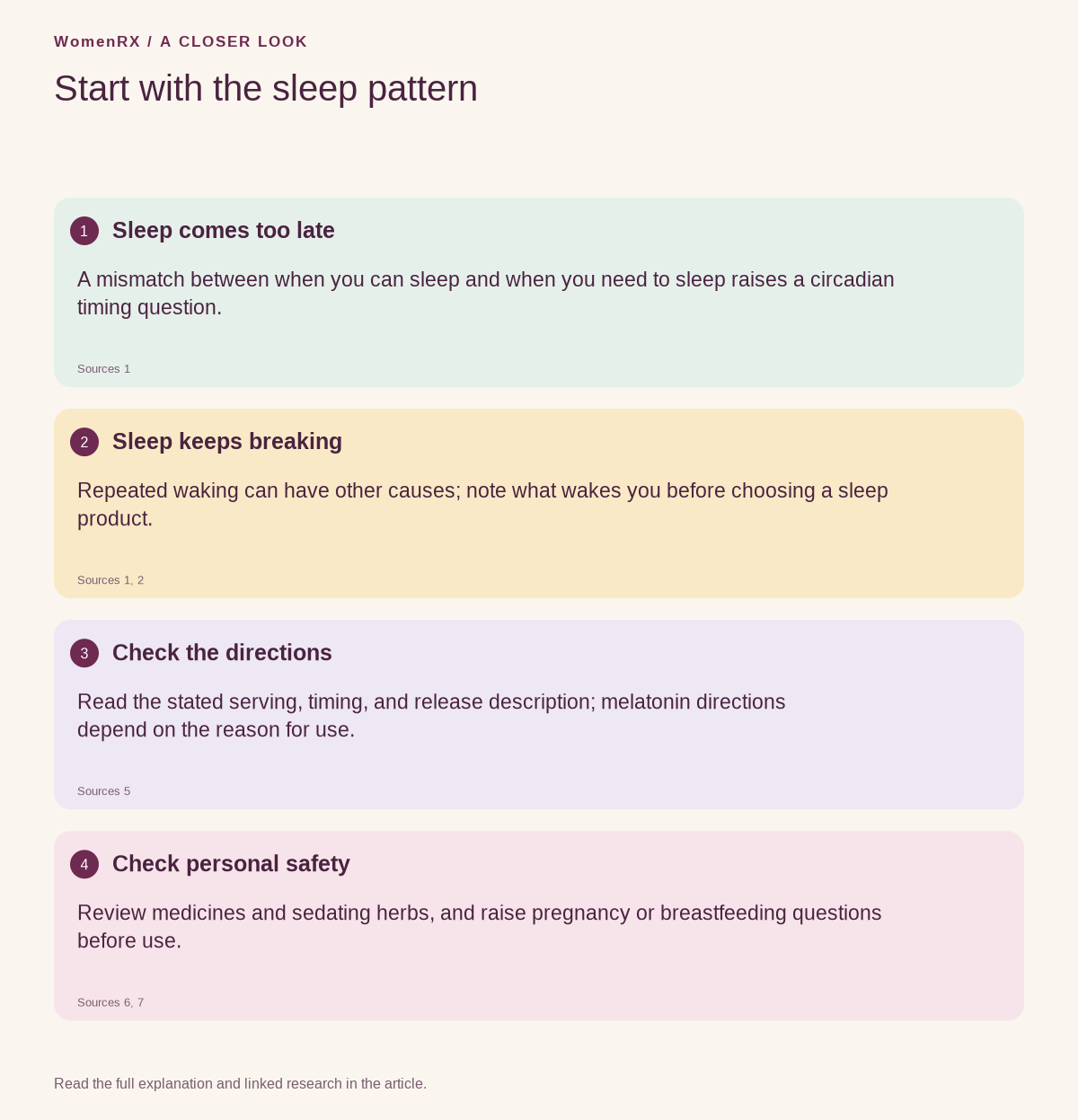
Start with the sleep pattern
Sleep comes too late: A mismatch between when you can sleep and when you need to sleep raises a circadian timing question.1
Sleep keeps breaking: Repeated waking can have other causes; note what wakes you before choosing a sleep product.12
Check the directions: Read the stated serving, timing, and release description; melatonin directions depend on the reason for use.5
Check personal safety: Review medicines and sedating herbs, and raise pregnancy or breastfeeding questions before use.67
Read the figure as text
Use the pattern of your sleep difficulty to decide which question to answer before choosing melatonin.- Sleep comes too late: A mismatch between when you can sleep and when you need to sleep raises a circadian timing question.1
- Sleep keeps breaking: Repeated waking can have other causes; note what wakes you before choosing a sleep product.12
- Check the directions: Read the stated serving, timing, and release description; melatonin directions depend on the reason for use.5
- Check personal safety: Review medicines and sedating herbs, and raise pregnancy or breastfeeding questions before use.67
More questions, answered
Is melatonin a good choice if I keep waking up during the night?
Not automatically. Repeated waking can have causes that melatonin won’t address, including another sleep disorder or an underlying health problem. What wakes you, and whether you can get back to sleep, are more useful starting questions than the word “insomnia” alone. 12
Sources you can check
- Sleep Disorders | MedlinePlusAccessed 2026-09-25Return to first citation
- Insomnia | MedlinePlusAccessed 2026-09-25Return to first citation
- Insomnia - NHSAccessed 2026-09-25Return to first citation
- Melatonin in Pregnancy-Related Disorders: A Review of Protective Mechanisms and Therapeutic Potential.Waseem S, Zhan J, Yu L, Xiao X. · Reproductive sciences (Thousand Oaks, Calif.) · 2026Return to first citation
- How and when to take melatonin - NHSAccessed 2026-09-25Return to first citation
- Taking melatonin with other medicines and herbal supplements - NHSAccessed 2026-09-25Return to first citation
- Pregnancy, breastfeeding and fertility while taking melatonin - NHSAccessed 2026-09-25Return to first citation