Melatonin After 40: Start With the Sleep Problem
Age alone isn’t a reason to take melatonin; the kind of sleep disruption you’re having matters more.
Melatonin may be worth discussing when the problem involves sleep timing or a short-term sleep difficulty, not simply because you’re over 40. Menopause-specific trial evidence hasn’t shown a clear improvement in sleep quality, and melatonin didn’t significantly improve hot flashes in the trials reviewed. If night sweats, breathing problems, or another issue is waking you, the cause deserves attention too. 1 2 4
First, name the sleep problem
Melatonin is a hormone involved in the body’s sleep-wake timing. That makes the question more useful than “Am I old enough to need it?”: Is my sleep timing off, am I having a short-term difficulty falling asleep, or am I waking because something else is disrupting sleep? Melatonin is used for short-term sleep problems and may help with jet lag, but that doesn’t mean it’s a general fix for every kind of insomnia. 1
For example, a schedule that has shifted later, or sleep disruption during travel, raises a different question from waking repeatedly with hot flashes. The first is about sleep timing; the second may be linked to a menopause symptom that melatonin hasn’t been shown to resolve. These examples help identify the problem to discuss, not diagnose it.
What menopause-specific studies found
A 2021 systematic review and meta-analysis included eight cohorts, with 812 participants, evaluating melatonin in menopausal women. Across four randomized trials, the analysis did not find a statistically significant improvement in sleep quality. It also found no significant improvement in overall menopause symptoms or vasomotor symptoms such as hot flashes. 2
That isn’t proof melatonin can never help an individual woman. It does mean the menopausal evidence doesn’t establish it as a reliable answer to sleep disruption after 40, or as a treatment for menopause itself. The sleep-quality estimate was uncertain: its confidence interval included no effect. The review also combined studies that used different amounts of melatonin and lasted different lengths of time, so it doesn’t identify a dependable approach for a particular woman. 2
The reported results don’t give separate treatment effects for women over 40 as an age group, or for perimenopause versus postmenopause. So the evidence doesn’t support a special age-based recommendation. 2
Menopause can disturb sleep in more than one way
Sleep changes around menopause aren’t automatically evidence of low melatonin. Hormonal changes and vasomotor symptoms can contribute, and sleep disruption can also involve conditions such as sleep apnea, restless legs, depression, or anxiety. 4 A small observational study of 17 perimenopausal and 18 postmenopausal women found different associations between natural nighttime melatonin and sleep patterns in the two groups. It did not test melatonin supplements, and its findings do not show that adding melatonin improves sleep. 3
That distinction matters: a biological association can be interesting without showing that a supplement treats the problem. If hot flashes or night sweats are repeatedly waking you, ask about those symptoms directly rather than assuming melatonin will address them. If sleep is persistently poor, or there are signs of another sleep problem, it’s worth discussing the pattern and possible causes. Menopause is one possible part of the picture, not the only one. 2 4
A more useful question than “Should I take it?”
When you raise melatonin, start with what your nights look like: trouble falling asleep at your usual bedtime, waking often, waking with heat or sweating, or feeling that your sleep schedule has shifted. Then ask whether the pattern sounds timing-related, whether a different cause needs attention, and what benefits and downsides are realistic for your situation.
Melatonin can cause headache or tiredness the next day, so how you feel in the morning matters too. 1 A clear description of the problem gives you and your clinician a better basis for deciding whether it’s worth considering than age or menopause status alone.
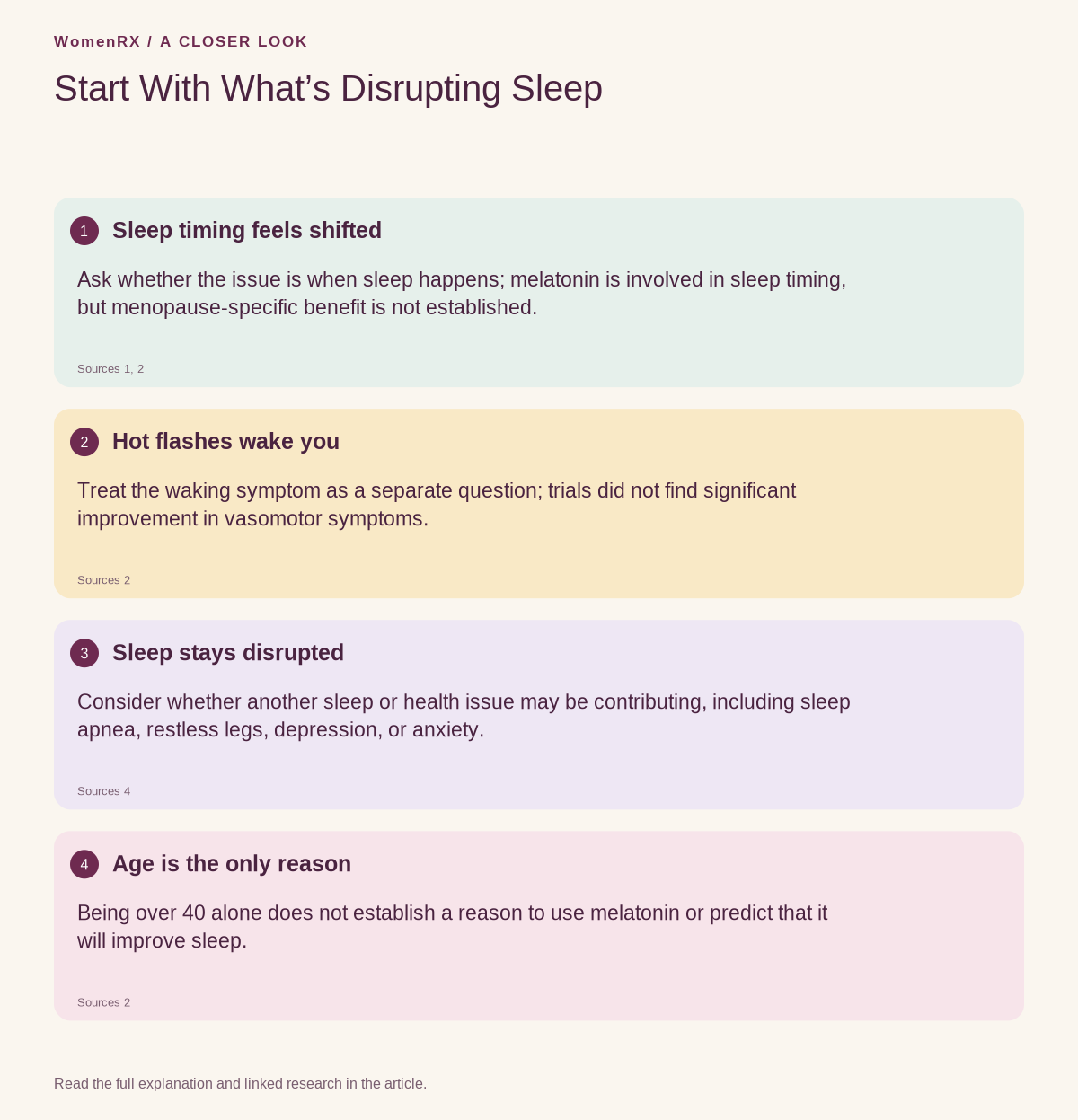
Start With What’s Disrupting Sleep
Sleep timing feels shifted: Ask whether the issue is when sleep happens; melatonin is involved in sleep timing, but menopause-specific benefit is not established.12
Hot flashes wake you: Treat the waking symptom as a separate question; trials did not find significant improvement in vasomotor symptoms.2
Sleep stays disrupted: Consider whether another sleep or health issue may be contributing, including sleep apnea, restless legs, depression, or anxiety.4
Age is the only reason: Being over 40 alone does not establish a reason to use melatonin or predict that it will improve sleep.2
Read the figure as text
A problem-first route to a more useful melatonin discussion; it does not diagnose a sleep condition or promise a treatment effect.- Sleep timing feels shifted: Ask whether the issue is when sleep happens; melatonin is involved in sleep timing, but menopause-specific benefit is not established.12
- Hot flashes wake you: Treat the waking symptom as a separate question; trials did not find significant improvement in vasomotor symptoms.2
- Sleep stays disrupted: Consider whether another sleep or health issue may be contributing, including sleep apnea, restless legs, depression, or anxiety.4
- Age is the only reason: Being over 40 alone does not establish a reason to use melatonin or predict that it will improve sleep.2
More questions, answered
Does lower natural melatonin after menopause mean I should take a supplement?
No. Differences in natural melatonin levels or their association with sleep do not establish that a supplement will improve sleep. The menopause-specific randomized-trial review did not find a significant improvement in sleep quality. 2 3
Does melatonin treat hot flashes that wake me up?
The menopause-specific review did not find a significant improvement in vasomotor symptoms, which include hot flashes. If those symptoms are interrupting sleep, discuss them as their own problem rather than assuming melatonin will treat them. 2
Sources you can check
- About melatonin - NHSAccessed 2026-09-25Return to first citation
- Effects of exogenous melatonin on sleep quality and menopausal symptoms in menopausal women: a systematic review and meta-analysis of randomized controlled trials.Yi M, Wang S, Wu T, Zhang X, Jiang L, Fang X. · Menopause (New York, N.Y.) · 2021Return to first citation
- Nighttime melatonin secretion and sleep architecture: different associations in perimenopausal and postmenopausal women.Toffol E, Kalleinen N, Himanen SL, Partonen T, Haukka J, Polo-Kantola P. · Sleep medicine · 2021Return to first citation
- Chronotype and Sleep Quality in Obesity: How Do They Change After Menopause?Verde L, Barrea L, Vetrani C, Frias-Toral E, Chapela SP, Jayawardena R, de Alteriis G, Docimo A, Savastano S, Colao A, Muscogiuri G. · Current obesity reports · 2022Return to first citation