Melatonin or Magnesium for Sleep: Which Fits the Problem?
Melatonin has a clearer role for a persistently delayed sleep schedule; magnesium matters most when intake or magnesium status needs attention.
If you consistently can’t fall asleep until late and sleep better on a later schedule, melatonin has a more specific evidence-based role than magnesium. An American Academy of Sleep Medicine guideline supports strategically timed melatonin for delayed sleep-wake phase disorder, not for every kind of insomnia.4 Magnesium is an essential nutrient, but treating low magnesium intake is a different goal from treating sleeplessness.3 Neither supplement is a universal winner.
First, name the sleep problem
“Can’t sleep” can describe several different experiences. Maybe you feel alert at the bedtime you need to keep but can sleep well on a later schedule. Maybe you fall asleep without trouble and wake repeatedly. Or maybe uncomfortable sensations in your legs make it hard to settle. Those patterns don’t necessarily call for the same response: sleep disorders include insomnia, circadian rhythm problems, sleep apnea, and restless legs syndrome.2
That distinction makes the melatonin-versus-magnesium question more useful. Melatonin is a hormone your body releases in the evening as a signal that it’s time to sleep.1 Magnesium is a mineral needed for normal muscle and nerve function, among other roles.3 Those facts explain why each comes up in sleep conversations, but they don’t prove that either supplement will fix a particular night’s sleep.
When bedtime and your body clock disagree
Consider a schedule that runs consistently late: you have trouble falling asleep at the bedtime you need, but sleep comes more easily when you’re free to go to bed and wake later. That pattern is different from lying awake at all hours regardless of schedule. An American Academy of Sleep Medicine guideline gives a qualified recommendation for strategically timed melatonin in delayed sleep-wake phase disorder. The timing is part of the treatment studied; the recommendation isn’t a blanket endorsement of taking melatonin whenever sleep is difficult.4
Travel across time zones can also disrupt sleep timing. Daylight after arrival helps your body clock adjust, and jet lag usually improves as your body adapts. NHS guidance does not recommend melatonin tablets for jet lag on the evidence it reviewed.1 That may sound at odds with the circadian guideline, but the two address different problems. Evidence for a defined delayed sleep-wake phase disorder shouldn’t be stretched into a promise for jet lag or ordinary insomnia.
If you fall asleep at your usual time but keep waking, the body-clock rationale offers less of a reason to choose melatonin. Repeated waking may warrant a look at what’s interrupting sleep rather than a switch between supplements. For example, sleep apnea and restless legs syndrome are distinct sleep disorders, not magnesium-versus-melatonin decisions.2
Where magnesium fits, and where it doesn’t
Magnesium adequacy matters for health. Foods that provide it include beans, nuts, seeds, whole grains, and leafy greens. Symptomatic deficiency from low dietary intake alone is uncommon in otherwise healthy people, although gastrointestinal conditions, type 2 diabetes, older age, and some medicines can increase the chance of inadequate magnesium status.3
Addressing inadequate intake or a suspected deficiency is worthwhile on its own terms. It does not establish that a magnesium supplement treats insomnia. A normal-looking diet doesn’t diagnose magnesium status, either: blood magnesium is commonly measured, but it doesn’t fully reflect the magnesium stored elsewhere in the body.3 If you have ongoing diarrhea or take a medicine that can affect magnesium, that context is more informative than assuming nighttime wakefulness means you’re deficient.3
What about a product containing both? In one small randomized crossover trial, 35 otherwise healthy people with poor sleep quality received a melatonin-magnesium combination and placebo in separate four-week periods. Several sleep measures favored the combination, but average questionnaire scores still indicated poor sleep quality after both periods. Because the trial tested the ingredients together, it cannot tell you whether melatonin, magnesium, or their combination made the difference, or which ingredient would suit you better.6
The trial’s reported findings don’t establish a sleep benefit specifically for women, including those in perimenopause or postmenopause. The circadian guideline addresses a defined sleep-timing disorder, not menopause-related sleep complaints. Neither establishes that one supplement works better for women.46
Check the cautions before treating them as interchangeable
Magnesium supplements can cause diarrhea, nausea, and abdominal cramping. Excess magnesium is a greater concern when kidney function is impaired. Magnesium can also reduce absorption of certain oral medicines, including bisphosphonates used for osteoporosis and tetracycline or quinolone antibiotics. Diuretics and long-term proton pump inhibitors can affect magnesium status, which is another reason your medicine list matters if you’re considering a supplement.3
That circadian recommendation does not establish a general safety profile for women taking melatonin for sleep.4 Pregnancy deserves particular care with that uncertainty: a review of melatonin research in preeclampsia found only one human trial among nine studies and judged evidence about fetal safety insufficient. That research was not a trial of melatonin for pregnancy-related insomnia.5 Magnesium needs also change during pregnancy, but a higher nutritional requirement is not evidence that a magnesium sleep supplement will help. The upper limit for magnesium from supplements and medicines applies during pregnancy as well; it does not count magnesium naturally present in food.3
The practical choice is to match the next step to the pattern. A persistently late body clock has a specific melatonin-related evidence base. A concern about low magnesium intake calls for attention to nutrition and possible causes of magnesium loss. Frequent awakenings, breathing interruptions, or an urge to move your legs call for a closer look at the sleep problem itself. Choosing a bottle before making that distinction can miss the reason you’re awake.234
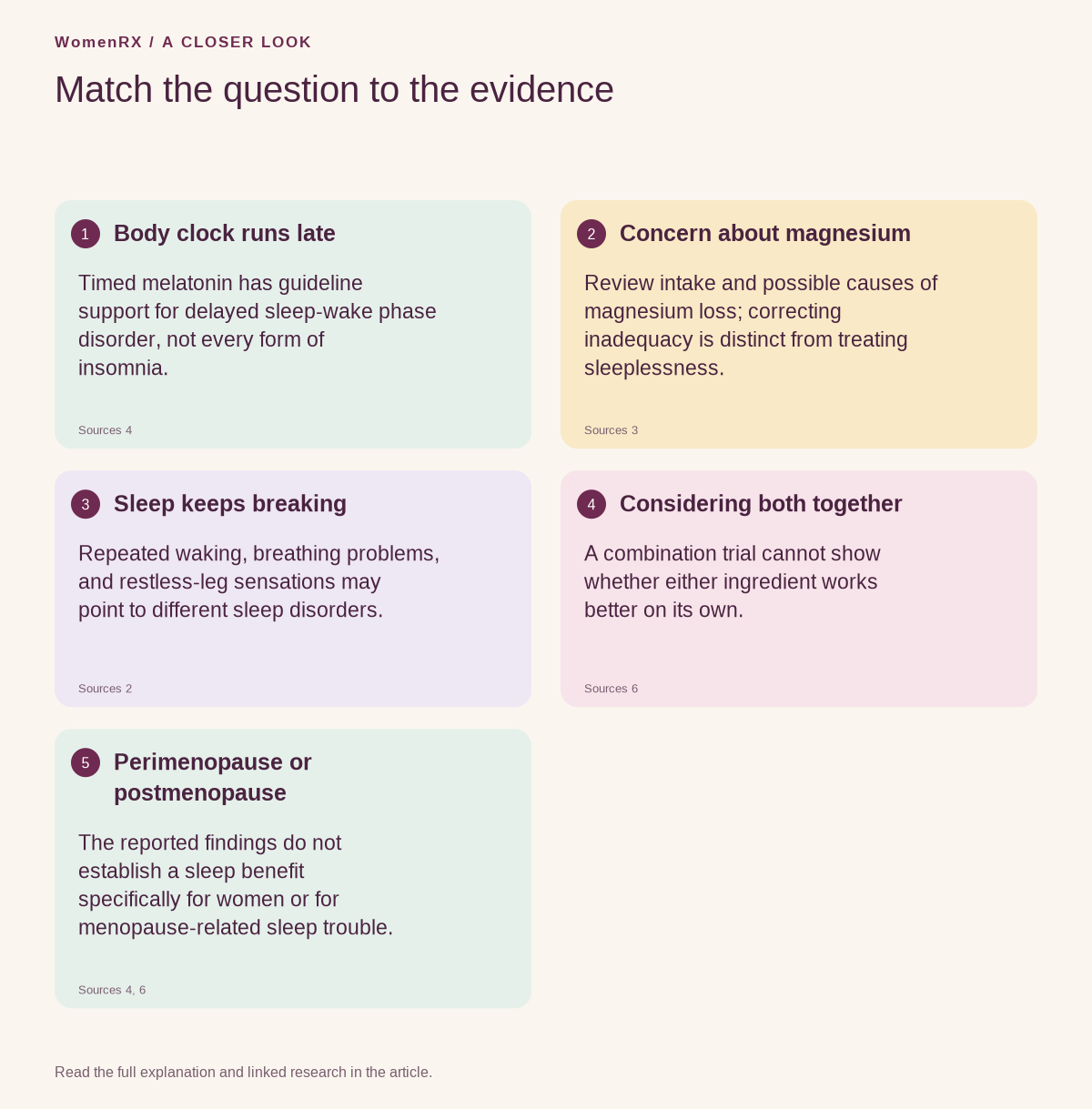
Match the question to the evidence
Body clock runs late: Timed melatonin has guideline support for delayed sleep-wake phase disorder, not every form of insomnia.4
Concern about magnesium: Review intake and possible causes of magnesium loss; correcting inadequacy is distinct from treating sleeplessness.3
Sleep keeps breaking: Repeated waking, breathing problems, and restless-leg sensations may point to different sleep disorders.2
Considering both together: A combination trial cannot show whether either ingredient works better on its own.6
Perimenopause or postmenopause: The reported findings do not establish a sleep benefit specifically for women or for menopause-related sleep trouble.46
Read the figure as text
These sleep situations point to different questions, not a single winning supplement.- Body clock runs late: Timed melatonin has guideline support for delayed sleep-wake phase disorder, not every form of insomnia.4
- Concern about magnesium: Review intake and possible causes of magnesium loss; correcting inadequacy is distinct from treating sleeplessness.3
- Sleep keeps breaking: Repeated waking, breathing problems, and restless-leg sensations may point to different sleep disorders.2
- Considering both together: A combination trial cannot show whether either ingredient works better on its own.6
- Perimenopause or postmenopause: The reported findings do not establish a sleep benefit specifically for women or for menopause-related sleep trouble.46
More questions, answered
Does a melatonin-magnesium combination work better than either ingredient alone?
The combination trial compared both ingredients together with placebo, not with melatonin alone or magnesium alone. Its results can’t answer which ingredient contributed to the sleep changes or whether combining them is better.6
Does waking during the night mean I’m low in magnesium?
No. Waking during the night has multiple possible explanations, and magnesium deficiency can’t be inferred from that symptom alone. Conditions or medicines that reduce magnesium absorption or increase its loss provide more relevant clues.23
Sources you can check
- Jet lag - NHSAccessed 2026-09-25Return to first citation
- Sleep Disorders | MedlinePlusAccessed 2026-09-25Return to first citation
- Magnesium - Health Professional Fact SheetAccessed 2026-09-25Return to first citation
- Clinical Practice Guideline for the Treatment of Intrinsic Circadian Rhythm Sleep-Wake Disorders: Advanced Sleep-Wake Phase Disorder (ASWPD), Delayed Sleep-Wake Phase Disorder (DSWPD), Non-24-Hour Sleep-Wake Rhythm Disorder (N24SWD), and Irregular Sleep-Wake Rhythm Disorder (ISWRD). An Update for 2015: An American Academy of Sleep Medicine Clinical Practice Guideline.Auger RR, Burgess HJ, Emens JS, Deriy LV, Thomas SM, Sharkey KM. · Journal of clinical sleep medicine : JCSM : official publication of the American Academy of Sleep Medicine · 2015Return to first citation
- Melatonin in Preeclampsia: a Systematic Review of its Role in Pathogenesis and Therapeutic Potential.Sattarpour R, Noori M, Sattarpour N, Sangsari R, Mirnia K, Sadeghimoghadam P. · Reproductive sciences (Thousand Oaks, Calif.) · 2026Return to first citation
- The effects of melatonin and magnesium in a novel supplement delivery system on sleep scores, body composition and metabolism in otherwise healthy individuals with sleep disturbances.Carlos RM, Matias CN, Cavaca ML, Cardoso S, Santos DA, Giro R, Vaz JR, Pereira P, Vicente F, Leonardo-Mendonça RC, Ganhão-Arranhado S, Santos HO, Reiter RJ, Teixeira FJ. · Chronobiology international · 2024Return to first citation