Which Sleep Supplement Fits Your Sleep Problem?
Melatonin, magnesium, and valerian answer different questions, and none is a good substitute for finding out why sleep keeps breaking down.
If you’re trying to fall asleep, melatonin has a more direct rationale than valerian or magnesium, but a shifted body clock is different from ongoing insomnia. Magnesium’s sleep evidence is limited, and valerian’s is inconsistent. If you’re repeatedly waking, snoring or struggling through the day, look beyond the supplement shelf for the cause. 1457
First, name the part of sleep that’s difficult
A bedtime supplement can look like a simple answer when you’re exhausted. Start with a more useful question: Are you unable to fall asleep, unable to sleep at the time you need to, or waking after you’ve fallen asleep? Those patterns can overlap, but they don’t point to the same next step. Insomnia can involve trouble falling or staying asleep; circadian rhythm problems involve difficulty sleeping or waking at the right times, as can happen with shift work or jet lag. 1
For example, if you sleep reasonably well when you can follow a later schedule but can’t fall asleep early enough for work, timing may be central to the problem. If you’re sleepy at bedtime yet wake repeatedly, moving your sleep schedule earlier may miss what’s disturbing your nights. These are clues, not diagnoses.
Melatonin: think sleep onset and timing, not a cure-all
Your body’s melatonin rises at night and helps regulate when you sleep. A manufactured version is used for short-term sleep problems and may help some people fall asleep more quickly; it may also help with jet lag. That makes it more relevant to difficulty getting to sleep or a disrupted schedule than to assuming every nighttime waking needs a supplement. It can cause headache or next-day tiredness in some people. 5
There’s a distinction between shifting the body clock and getting better sleep. In a randomized trial’s exploratory sleep analysis, 49 adults with both ADHD and delayed sleep phase syndrome received sleep education plus melatonin, melatonin with bright light, or placebo for three weeks. Although the researchers reported a shift in a marker of circadian timing, the melatonin groups did not move their actual sleep times earlier or improve sleep overall compared with placebo. That result doesn’t settle how melatonin works for everyone with a late schedule, but it shows why a change in biological timing isn’t a promise of a better night. 8
If your trouble falling asleep is persistent rather than tied to a temporary schedule change, the cause matters. Stress, pain, medicines, caffeine, alcohol and other sleep disorders can contribute to ongoing insomnia. Treatment may need to address that cause; cognitive behavioral therapy is one counseling approach used for chronic insomnia. 13
Magnesium and valerian: two weaker bets for insomnia
Magnesium is an essential nutrient, but needing magnesium and benefiting from magnesium as a sleep aid are different claims. A systematic review found three randomized trials comparing oral magnesium with placebo in 151 older adults with insomnia. Participants given magnesium fell asleep about 17 minutes sooner on average after treatment, but the trials had moderate-to-high risk of bias and the evidence was rated low to very low quality. Total sleep time did not improve significantly. The review does not establish that magnesium treats insomnia in women at other life stages. 4
If you’re considering magnesium because you suspect low intake, that’s a nutrition question rather than proof that a sleep product will help. Foods such as beans, nuts, seeds, whole grains and leafy greens provide magnesium. Supplements can cause diarrhea and stomach cramps, especially at higher amounts; kidney problems increase the risk of magnesium toxicity. Magnesium can also interfere with absorption of certain antibiotics, including doxycycline and ciprofloxacin, and oral osteoporosis medicines such as alendronate. If you take one of those medicines, check the combination with your pharmacist before adding magnesium. 2
Valerian has a long history as a sleep remedy, but its evidence for sleep problems is inconsistent. The American Academy of Sleep Medicine’s guideline recommends against it for chronic insomnia in adults. Valerian can cause effects such as mental dullness or vivid dreams, and it shouldn’t be combined with alcohol or sedatives because of a possible sleep-inducing effect. There isn’t a reliable reason to pick it over melatonin simply because it’s labeled “natural.” 7
When the better question isn’t about a supplement
Repeated waking deserves a closer look if your bed partner notices loud snoring, gasping or pauses in breathing. An uncomfortable urge to move your legs that eases with movement points toward a different sleep problem, too. Those patterns can suggest sleep apnea or restless legs syndrome; neither is explained just by having trouble falling asleep. Frequent daytime sleepiness also matters, particularly if you feel drowsy while driving. 13
You don’t have to wait for a perfect description of your sleep to bring up a persistent problem. The useful detail is what actually happens: I lie awake at the start of the night, I wake gasping, or my legs feel impossible to keep still. That distinction helps direct attention to the problem a supplement might otherwise obscure. 13
If you’re pregnant, breastfeeding, or noticing a life-stage change
Pregnancy and breastfeeding change the melatonin decision. NHS guidance says melatonin is not usually recommended during pregnancy because its effects on babies are not well understood. For breastfeeding, its guidance allows for use in some circumstances but notes uncertainty about how much manufactured melatonin passes into milk and cautions about possible infant sleepiness with longer use. Before starting it, discuss your situation and your baby’s feeding and sleep with your prenatal or postpartum care team. 6
Little is known about valerian’s safety during pregnancy or breastfeeding. Magnesium has different nutritional needs during pregnancy and lactation, but those needs do not establish it as a treatment for sleep trouble. 27
If sleep changes around your menstrual cycle or during perimenopause, notice what changes rather than assuming hormones explain every wake-up. For example, trouble falling asleep on certain nights and waking with gasping call for different questions. Small studies have explored valerian for menopause symptoms, but there isn’t enough evidence to know whether it helps. A supplement marketed for a life stage may not address the sleep pattern in front of you. 17
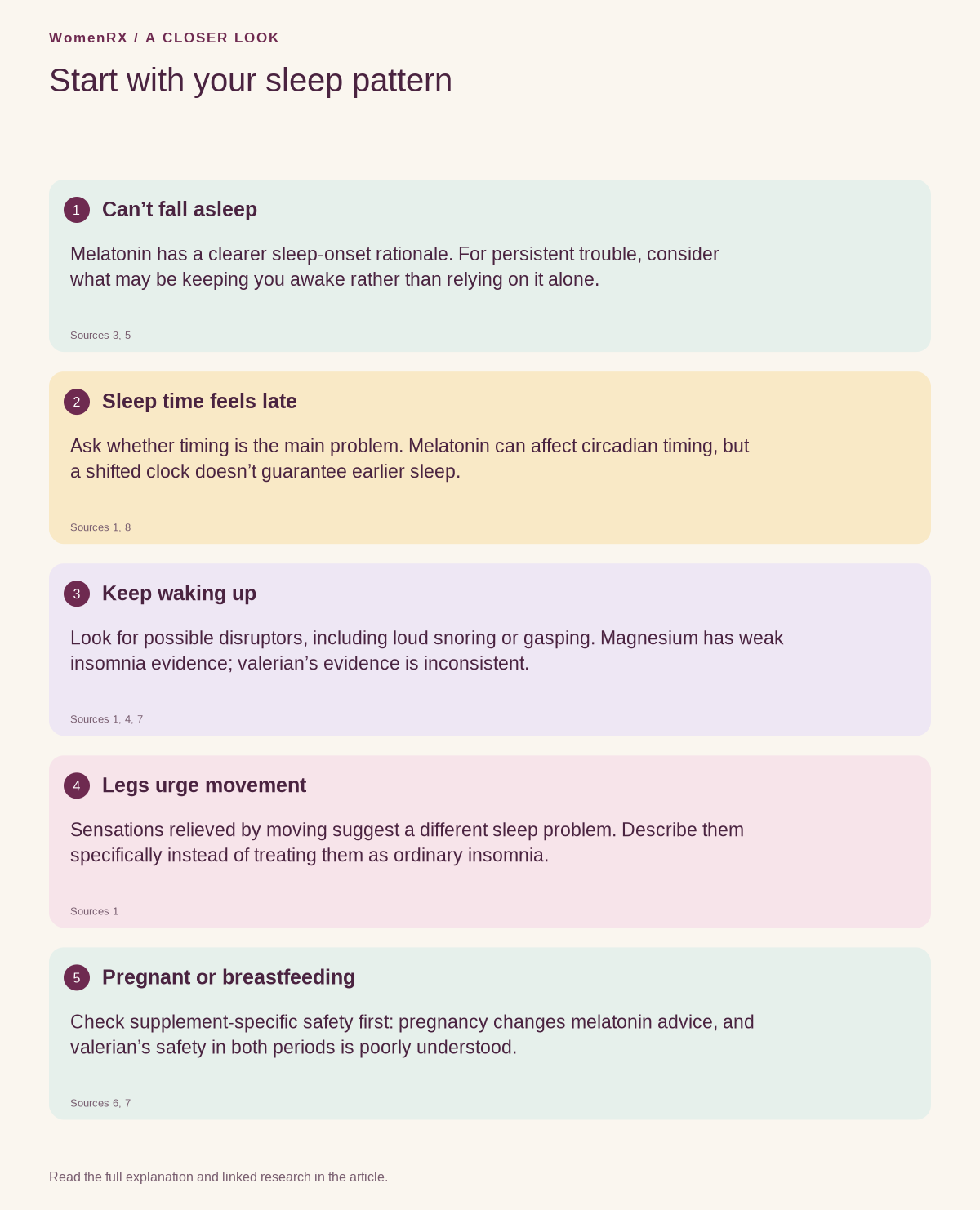
Start with your sleep pattern
Can’t fall asleep: Melatonin has a clearer sleep-onset rationale. For persistent trouble, consider what may be keeping you awake rather than relying on it alone.35
Sleep time feels late: Ask whether timing is the main problem. Melatonin can affect circadian timing, but a shifted clock doesn’t guarantee earlier sleep.18
Keep waking up: Look for possible disruptors, including loud snoring or gasping. Magnesium has weak insomnia evidence; valerian’s evidence is inconsistent.147
Legs urge movement: Sensations relieved by moving suggest a different sleep problem. Describe them specifically instead of treating them as ordinary insomnia.1
Pregnant or breastfeeding: Check supplement-specific safety first: pregnancy changes melatonin advice, and valerian’s safety in both periods is poorly understood.67
Read the figure as text
Use the part of the night that’s difficult to decide which supplement question, or which other cause, deserves attention first.- Can’t fall asleep: Melatonin has a clearer sleep-onset rationale. For persistent trouble, consider what may be keeping you awake rather than relying on it alone.35
- Sleep time feels late: Ask whether timing is the main problem. Melatonin can affect circadian timing, but a shifted clock doesn’t guarantee earlier sleep.18
- Keep waking up: Look for possible disruptors, including loud snoring or gasping. Magnesium has weak insomnia evidence; valerian’s evidence is inconsistent.147
- Legs urge movement: Sensations relieved by moving suggest a different sleep problem. Describe them specifically instead of treating them as ordinary insomnia.1
- Pregnant or breastfeeding: Check supplement-specific safety first: pregnancy changes melatonin advice, and valerian’s safety in both periods is poorly understood.67
More questions, answered
If my legs keep me awake, is that the same as insomnia?
Not necessarily. An urge to move your legs with uncomfortable sensations that ease when you move is a recognized sign of restless legs syndrome. Describe the sensation and when it happens rather than treating it as ordinary difficulty falling asleep. 1
Sources you can check
- Sleep Disorders | MedlinePlusAccessed 2026-09-25Return to first citation
- Magnesium - Health Professional Fact SheetAccessed 2026-09-25Return to first citation
- Insomnia | MedlinePlusAccessed 2026-09-25Return to first citation
- Oral magnesium supplementation for insomnia in older adults: a Systematic Review & Meta-Analysis.Mah J, Pitre T. · BMC complementary medicine and therapies · 2021Return to first citation
- About melatonin - NHSAccessed 2026-09-25Return to first citation
- Pregnancy, breastfeeding and fertility while taking melatonin - NHSAccessed 2026-09-25Return to first citation
- Valerian: Usefulness and Safety | NCCIHAccessed 2026-09-25Return to first citation
- Attention-Deficit/Hyperactivity Disorder and Delayed Sleep Phase Syndrome in Adults: A Randomized Clinical Trial on the Effects of Chronotherapy on Sleep.van Andel E, Bijlenga D, Vogel SWN, Beekman ATF, Kooij JJS. · Journal of biological rhythms · 2022Return to first citation