Sleep Supplements: Match the Evidence to Your Problem
The right first question is whether your sleep timing, sleep opportunity, or ability to stay asleep is the problem.
Supplements aren’t interchangeable sleep fixes. A review reports that melatonin can shift circadian timing, shorten time to fall asleep, and increase total sleep time in some people, but it isn’t a proven fix for every form of insomnia. 6 Evidence for magnesium as a routine insomnia treatment is inconsistent and low certainty. 4 First identify what’s disrupting your sleep, then check the risks of the particular product you’re considering. 1 2
Start with the kind of sleep problem
“Bad sleep” can mean different things: you may not feel sleepy until very late, wake repeatedly, or have too little time in bed because of work or caregiving. Those problems call for different questions. Insomnia commonly involves trouble falling asleep, staying asleep, or both, and can leave you unrefreshed during the day. Stress, medicines, health conditions, caffeine, tobacco, alcohol, and other sleep disorders can contribute. 2
Before choosing an ingredient, ask: Is my sleep schedule out of sync, do I have enough time available to sleep, or am I unable to sleep despite having the opportunity? A supplement trial reporting more sleep time doesn’t automatically show that a supplement fixes a schedule that leaves too little room for sleep.
When sleep timing feels shifted
Melatonin is a hormone involved in the body’s circadian rhythms, which help coordinate sleep and wake timing. That makes it different from a general-purpose sleep aid: the relevant question is whether your body’s timing is misaligned with the sleep schedule you need. A review describes melatonin’s ability to shift circadian timing and reports shorter time to fall asleep and more total sleep time in studies of people with insomnia or circadian rhythm disorders. Those findings don’t establish that melatonin reliably treats every kind of insomnia, and questions remain about optimal use and long-term safety. 6
If your sleepiness and waking time are consistently much later or earlier than the schedule you need, consider discussing a possible timing problem rather than choosing a supplement solely because falling asleep is difficult. A clinician can help distinguish a circadian rhythm issue from insomnia or another cause. A one-size-fits-all schedule or dose isn’t established. 6
When you can’t fall asleep or stay asleep
For ongoing insomnia, magnesium is often promoted, but the evidence doesn’t support treating it as a routine fix. A 2026 systematic review included 12 randomized trials of magnesium for sleep, insomnia, or poor sleep in adults. The trials used different formulations, measures, and durations; their results were inconsistent, and certainty was low to very low. The review found that magnesium may help some subjective sleep outcomes for some adults, but that isn’t the same as demonstrated treatment for insomnia. 4
A separate three-week randomized trial studied a five-ingredient supplement in 128 perimenopausal and postmenopausal women with moderate-to-severe sleep disturbance and minimal hot flashes or night sweats. Sleep-disturbance scores improved compared with placebo. But the blend contained several ingredients, so the result can’t show that magnesium, melatonin, or any other single ingredient caused the change. A short trial of one blend also can’t establish long-term benefit or safety. 5
For persistent insomnia, look beyond supplements. Sleep problems can be a symptom or side effect of another condition, medication, or sleep disorder. Cognitive behavioral therapy can help with ongoing insomnia, and addressing an underlying cause may be part of treatment. 2 If sleep problems have lasted for months or are making daily life hard to manage, seek an evaluation rather than continuing to switch supplements. 3
When there may not be enough time to sleep
If your schedule, caregiving, or work routinely leaves a short window for sleep, start by looking at that opportunity. A supplement study that measures sleep duration doesn’t tell you whether you’re allowing enough time for sleep in the first place. That distinction matters: sleep-onset, sleep-duration, and insomnia outcomes are not interchangeable. 5
If you’re sleepy while driving, take that seriously. Insomnia-related sleepiness can make driving dangerous; a supplement shouldn’t be treated as a way to make drowsy driving safe. 2
Consider life stage without assuming a supplement will help
If you’re pregnant or breastfeeding, don’t assume findings in menopausal women establish supplement safety or benefit for you. 5 Before trying melatonin, check whether the particular product is appropriate for you, especially if you take medicines; pregnancy, breastfeeding, and medicine use are separate safety considerations. 1
After giving birth, sleep difficulty still needs to be understood by its pattern and possible causes; the menopause trial described above doesn’t establish what helps postpartum sleep. If you’re breastfeeding, check the specific product rather than assuming a supplement is safe. 2 5 1
Perimenopause and postmenopause can also coincide with sleep disturbance, but that doesn’t mean menopause caused it. The trial described above involved women with minimal hot flashes and night sweats; it tested a multi-ingredient blend for three weeks, not a standard supplement for all menopausal sleep problems. 5
What to check before choosing a product
Some over-the-counter sleep aids, including products with natural ingredients, can cause drowsiness. That warning is broad; it doesn’t establish that every supplement or ingredient has the same effect. 3 Check the ingredients of the product you’re considering, and ask a pharmacist or clinician about that product if you take medicines or are pregnant or breastfeeding. Don’t assume all sleep aids have the same risks. 1 3
Match your next step to the problem: ask about circadian timing if your sleep schedule is consistently shifted; look for causes and established insomnia care if you can’t sleep despite having the opportunity; and consider whether your schedule allows enough sleep time. For magnesium, current trial evidence doesn’t justify assuming it will treat insomnia. For melatonin, the reported effects on sleep timing and some sleep outcomes make it worth distinguishing a shifted schedule from other sleep problems, not treating it as a universal or long-term solution. 2 4 6
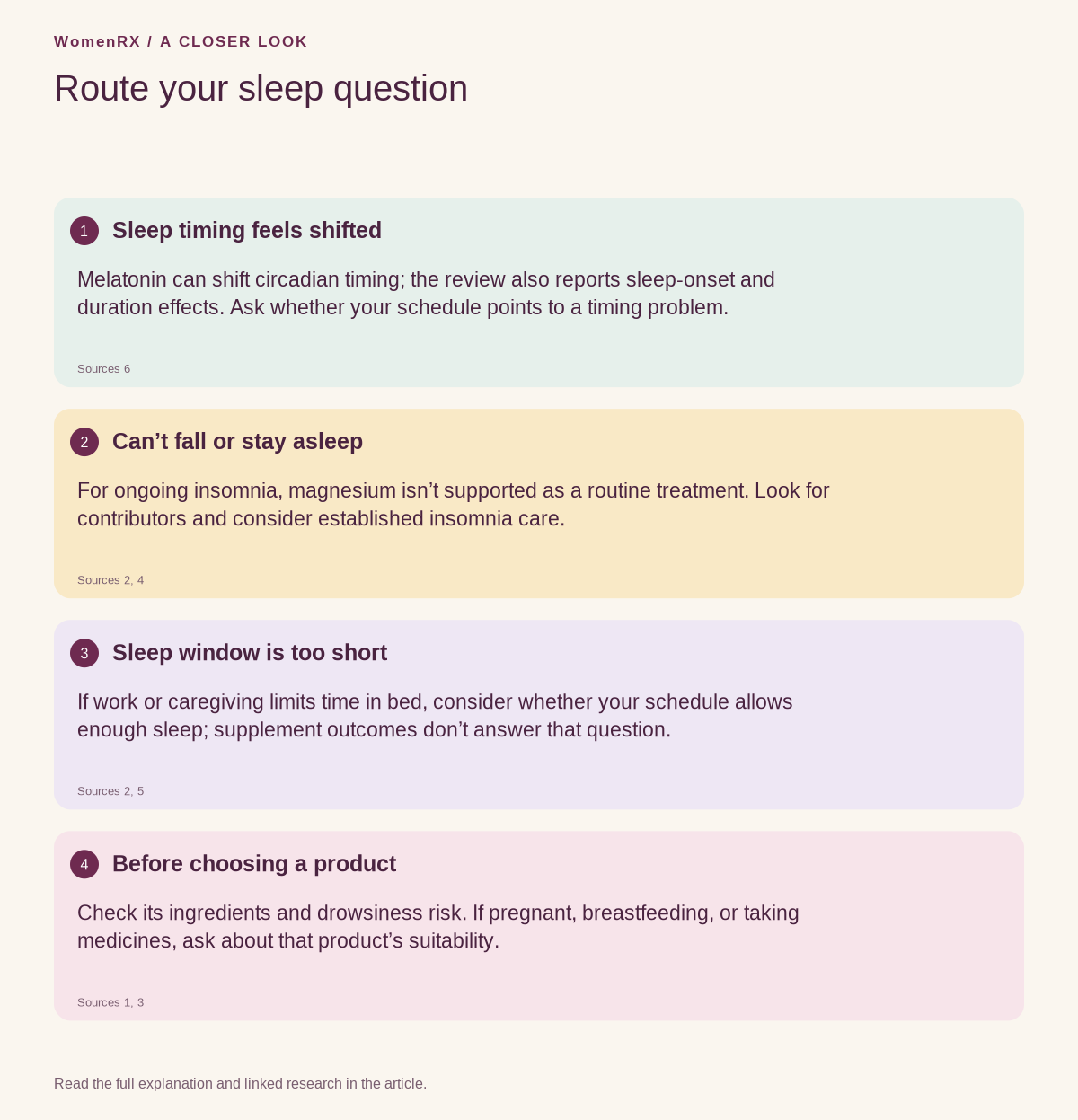
Route your sleep question
Sleep timing feels shifted: Melatonin can shift circadian timing; the review also reports sleep-onset and duration effects. Ask whether your schedule points to a timing problem.6
Can’t fall or stay asleep: For ongoing insomnia, magnesium isn’t supported as a routine treatment. Look for contributors and consider established insomnia care.24
Sleep window is too short: If work or caregiving limits time in bed, consider whether your schedule allows enough sleep; supplement outcomes don’t answer that question.25
Before choosing a product: Check its ingredients and drowsiness risk. If pregnant, breastfeeding, or taking medicines, ask about that product’s suitability.13
Read the figure as text
Start with the difficulty you recognize, follow its evidence and next step, then check the particular product before using it.- Sleep timing feels shifted: Melatonin can shift circadian timing; the review also reports sleep-onset and duration effects. Ask whether your schedule points to a timing problem.6
- Can’t fall or stay asleep: For ongoing insomnia, magnesium isn’t supported as a routine treatment. Look for contributors and consider established insomnia care.24
- Sleep window is too short: If work or caregiving limits time in bed, consider whether your schedule allows enough sleep; supplement outcomes don’t answer that question.25
- Before choosing a product: Check its ingredients and drowsiness risk. If pregnant, breastfeeding, or taking medicines, ask about that product’s suitability.13
More questions, answered
Does a supplement that increases sleep time treat insomnia?
Not necessarily. Sleep duration is only one outcome. Insomnia also involves difficulty falling or staying asleep and may relate to medicines, health conditions, stress, or another sleep disorder. A change in sleep time doesn’t by itself show that an underlying cause has been treated. 2 4
Is magnesium proven to help women sleep?
No. The reviewed adult trials had mixed results and low to very low certainty, and the review didn’t establish a routine insomnia benefit specifically for women. A trial of a multi-ingredient blend in menopausal women can’t identify magnesium’s individual effect. 4 5
Can I assume a sleep supplement is safe with my medicines?
No. Melatonin has medicine-use considerations, and some sleep aids can cause drowsiness. Check the ingredients of the particular product and ask a pharmacist or clinician about combining it with your medicines rather than treating all supplements as interchangeable. 1 3
Sources you can check
- Melatonin: a hormone used for sleep problems - NHSAccessed 2026-09-25Return to first citation
- Insomnia | MedlinePlusAccessed 2026-09-25Return to first citation
- Insomnia - NHSAccessed 2026-09-25Return to first citation
- Magnesium Supplementation for Sleep in Adults: A Systematic Review of Randomized Controlled Trials.Lopresti AL, Smith SJ, Drummond PD. · Journal of dietary supplements · 2026Return to first citation
- Nonsedating neurotransmitter-modulating supplement for nonvasomotor sleep disturbance in menopause.Carbonneau S, Mysliwiec V, Doyle AL, Stratton M, Dweck A, Tartar J, Alesi M, Mason L, Komorowski J, VanDusseldorp TA. · Menopause (New York, N.Y.) · 2026Return to first citation
- Melatonin and sleep: Exploring its role in regulating the circadian rhythm and sleep-wake cycle.Wani PD. · Journal of family medicine and primary care · 2026Return to first citation