Melatonin for Sleep: Start With the Timing Problem
The right melatonin question is whether you’re trying to shift a late sleep schedule or address a different kind of sleeplessness.
There’s no single melatonin dose to take every day for every sleep problem. The amount and timing depend on what you’re trying to change and the formulation you use. For example, UK medicine guidance describes a different approach for short-term insomnia than for jet lag; neither is a personal dosing plan for a US supplement. Check other medicines, pregnancy or breastfeeding, and when you’ll reassess before starting. 8910
Is your sleep late, or is it broken?
Suppose you sleep reasonably well when you can follow your own schedule, but you can’t fall asleep until much later than you need to on work nights. That pattern raises a different question from falling asleep at a comfortable time and waking repeatedly. Circadian rhythm sleep-wake disorders involve difficulty sleeping or waking at the right times; insomnia can involve trouble falling asleep, staying asleep, or both. 12
That distinction matters for melatonin. A clinical guideline gives a weak recommendation in favor of strategically timed melatonin for delayed sleep-wake phase disorder, a condition in which sleep timing is delayed. “Strategically timed” is the key phrase: it isn’t a recommendation to take any amount whenever you happen to go to bed. 5
If you’re regularly awake for long stretches, waking too early, or feeling unrefreshed, increasing a melatonin dose may miss the reason. Stress, other health conditions, medicines, caffeine, alcohol, and other sleep disorders can contribute to insomnia. Cognitive behavioral therapy for insomnia (CBT-I) is an established approach for ongoing insomnia. Researchers are still testing whether circadian approaches add benefit for selected people with insomnia; they aren’t a substitute for identifying the problem. 24
Why the formulation and timing matter
Melatonin isn’t a routine daily nutrient with one standard amount. As an example of how much the purpose changes the plan, the UK’s NHS describes a 2 mg slow-release tablet taken 1 to 2 hours before bedtime for short-term insomnia in adults. For jet lag, it describes a 3 mg standard-release tablet taken at the destination’s normal bedtime for up to 5 days. Those are different formulations for different situations under UK medicine guidance, not interchangeable instructions for choosing or timing a US supplement. 8
If your concern is a consistently late sleep schedule, write down when you tend to fall asleep and when you need to sleep and wake. That makes the timing question more useful than simply asking whether to take melatonin “at bedtime.” If your concern is repeated waking, look first at what may be interrupting sleep. The recommendation for delayed sleep-wake phase disorder does not make melatonin a general fix for insomnia. 125
Treat duration as part of the plan, too. UK guidance describes melatonin for short-term adult insomnia as usually taken for 1 to 4 weeks, with longer use in some circumstances under clinical care. That isn’t a reason to keep taking a US supplement indefinitely. Decide when you’ll review whether the sleep problem you meant to change has actually improved. If you’re taking it night after night without a clear benefit, revisit the problem rather than continuing by habit. 28
Check your medicines before adding melatonin
Review your medicines with a pharmacist or clinician before adding melatonin, particularly if you take fluvoxamine. In laboratory work using human liver material, fluvoxamine strongly inhibited a main pathway that breaks down melatonin. The researchers also noted evidence that fluvoxamine increased nighttime melatonin levels in healthy people. That does not tell us how much to adjust a supplement dose, but it is a specific reason to check the combination rather than guess. 7
Other combinations deserve a check for different reasons. Sedating medicines, including benzodiazepines, opioid pain medicines, and other sleep medicines, may add to drowsiness. UK medicine guidance also flags warfarin, medicines that lower blood pressure, and estrogens used in contraception or hormone therapy as medicines to discuss before taking melatonin. Don’t change an existing medicine to make room for a supplement. 9
Don’t assume findings about ramelteon, a prescription drug that acts at melatonin receptors, apply directly to melatonin supplements. A study found a large fluvoxamine interaction with ramelteon, but ramelteon is a different substance. 6
What changes during pregnancy, breastfeeding, or menopause?
If you’re pregnant or trying to become pregnant, discuss melatonin before using it. It’s not usually recommended during pregnancy because little is known about its effects on babies. Breastfeeding calls for a separate conversation: breast milk naturally contains melatonin, but how much manufactured melatonin passes into milk isn’t known. If you’re taking it and your baby seems unusually sleepy or isn’t feeding as usual, seek prompt care advice. 10
If menopause is affecting your sleep, don’t assume every sleep problem is a body-clock problem. Menopause can contribute to insomnia, but it does not, by itself, tell you what melatonin dose to take; start with the pattern of your sleep trouble. 34
A quick stop-and-review check
Before starting, or before continuing after an unhelpful trial, ask yourself:
- What’s happening? Is sleep consistently shifted later than the schedule you need, or are you waking through the night? 12
- What product and when? Check the stated amount and whether it’s standard- or slow-release. Relate the proposed time to the sleep problem you’re trying to change, rather than borrowing a schedule meant for jet lag or a different formulation. 8
- What’s the goal and review point? Decide what improvement you’re looking for and when you’ll check whether it happened. If it hasn’t, don’t keep increasing the amount by habit. 28
- What else deserves attention? Could stress, another condition, caffeine, alcohol, or a medicine be affecting sleep? 2
- What should be checked first? Review your medicines and mention pregnancy or breastfeeding. If melatonin leaves you dizzy or drowsy, don’t drive or use machinery while you feel that way. 91011
If poor sleep is affecting your days or keeps recurring, identifying which sleep problem you have gives you a better basis for choosing a treatment than escalating a dose that may not address it. 12
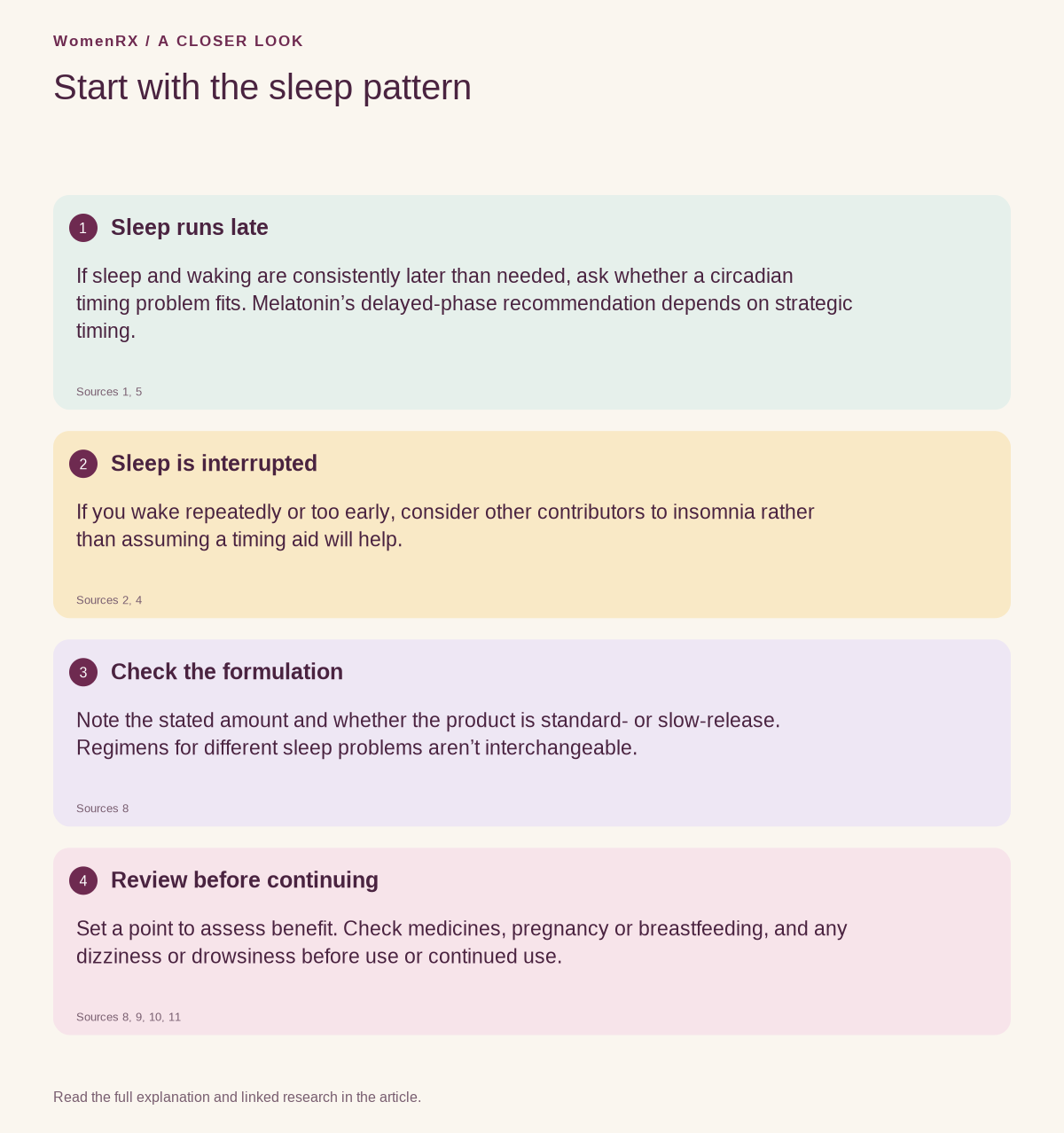
Start with the sleep pattern
Sleep runs late: If sleep and waking are consistently later than needed, ask whether a circadian timing problem fits. Melatonin’s delayed-phase recommendation depends on strategic timing.15
Sleep is interrupted: If you wake repeatedly or too early, consider other contributors to insomnia rather than assuming a timing aid will help.24
Check the formulation: Note the stated amount and whether the product is standard- or slow-release. Regimens for different sleep problems aren’t interchangeable.8
Review before continuing: Set a point to assess benefit. Check medicines, pregnancy or breastfeeding, and any dizziness or drowsiness before use or continued use.891011
Read the figure as text
Use this flow to decide which question to answer before choosing a melatonin product or amount.- Sleep runs late: If sleep and waking are consistently later than needed, ask whether a circadian timing problem fits. Melatonin’s delayed-phase recommendation depends on strategic timing.15
- Sleep is interrupted: If you wake repeatedly or too early, consider other contributors to insomnia rather than assuming a timing aid will help.24
- Check the formulation: Note the stated amount and whether the product is standard- or slow-release. Regimens for different sleep problems aren’t interchangeable.8
- Review before continuing: Set a point to assess benefit. Check medicines, pregnancy or breastfeeding, and any dizziness or drowsiness before use or continued use.891011
Sources you can check
- Sleep Disorders | MedlinePlusAccessed 2026-09-25Return to first citation
- Insomnia | MedlinePlusAccessed 2026-09-25Return to first citation
- Insomnia - NHSAccessed 2026-09-25Return to first citation
- Circadian dimensions in insomnia disorder: mechanistic evidence, candidate phenotypes, and a phenotype-stratified research framework.Zhang S, Liu Y, Tan J, Si W, Liu H, Huang Y, Li Y, Xiao J. · Frontiers in psychiatry · 2026Return to first citation
- Group bright light therapy compared to treatment as usual for delayed sleep-wake phase disorder among patients in psychiatric care (the SIP trials): a protocol for a pragmatic, randomised controlled trial.Wilhelmsen-Langeland A, Osnes B, Gradisar M, Vågenes VA, Sørensen L, Bjorvatn B, Fasmer OB, Koenig J, Pallesen S, Saxvig IW. · BMJ open · 2025Return to first citation
- Metabolism of ramelteon in human liver microsomes and correlation with the effect of fluvoxamine on ramelteon pharmacokinetics.Obach RS, Ryder TF. · Drug metabolism and disposition: the biological fate of chemicals · 2010Return to first citation
- Cytochrome P450 isoforms involved in melatonin metabolism in human liver microsomes.Facciolá G, Hidestrand M, von Bahr C, Tybring G. · European journal of clinical pharmacology · 2001Return to first citation
- How and when to take melatonin - NHSAccessed 2026-09-25Return to first citation
- Taking melatonin with other medicines and herbal supplements - NHSAccessed 2026-09-25Return to first citation
- Pregnancy, breastfeeding and fertility while taking melatonin - NHSAccessed 2026-09-25Return to first citation
- Side effects of melatonin - NHSAccessed 2026-09-25Return to first citation