Melatonin for Sleep: What a Timing Trial Tested
A small trial studied timed melatonin alongside behavioral measures for a delayed sleep schedule, not as a fix for every kind of poor sleep.
A small trial studied timed melatonin alongside evening dim light and a set sleep schedule in adults with delayed sleep-wake phase disorder. It compared two ways of scheduling melatonin, not different amounts or melatonin alone. Insomnia linked to stress or another health problem, or sleep interrupted repeatedly, may call for a different assessment. 127
First ask what kind of sleep problem you have
A small trial of timed melatonin focused on delayed sleep-wake phase disorder, a timing problem in which sleep and wake times fall later than desired. 17 That differs from insomnia, which means trouble falling asleep, staying asleep, or waking too early. Sleep disorders also include breathing problems and movement-related conditions, and a shifted schedule can be linked to shift work or jet lag. The same complaint, “I can’t sleep,” can therefore point to different problems. 12
This distinction matters because melatonin is involved in circadian rhythms, your body’s timing system, but that doesn’t make it a universal sleep aid. If you’re lying awake despite having a suitable sleep schedule, or waking repeatedly, increasing melatonin may not address the reason sleep is disrupted. Persistent insomnia can be related to medicines, health conditions, caffeine, tobacco, alcohol, stress, or another sleep disorder. 12
What a timing study can, and can’t, tell you
A randomized, double-blind trial studied 40 adults with delayed sleep-wake phase disorder for four weeks. Everyone received a package of behavioral measures, including dimmer light in the evening and a scheduled time in bed, as well as 0.5 mg of melatonin timed using either a measured or an estimated circadian marker. Most measured outcomes changed over the study, but there was no statistically clear difference between the two timing methods. The researchers concluded that the combined approach may help circadian and sleep measures. Because both groups received melatonin and behavioral measures, the trial can’t tell us how much change came from melatonin alone, or whether taking more would help. The researchers also said a larger trial is needed. 7
The practical takeaway isn’t to copy the study schedule or choose a dose from its results. It’s that timing was part of a planned approach for a specific circadian problem, not a test of melatonin as a general insomnia treatment. The study didn’t compare formulations. If you take other medicines or are concerned about how you might feel the next day, raise those questions with a clinician or pharmacist before trying a supplement. 17
Formulation is a separate question
A product’s formulation and its timing are not interchangeable decisions. The timing trial describes a regimen for delayed sleep-wake phase disorder; it doesn’t compare formulations or show that one is preferable for falling asleep versus staying asleep. If you’re considering melatonin, ask a clinician or pharmacist whether the formulation and timing make sense for the sleep problem you’re trying to address, and whether it could interact with medicines you take. Avoid assuming that a larger amount will solve a timing mismatch. 17
Sleep changes in pregnancy, postpartum life, and menopause
A review of melatonin research in pregnancy-related disorders discusses its potential for those conditions, but it doesn’t answer whether melatonin helps pregnancy-related sleep problems or is appropriate to take for them. 5
For breastfeeding, a 2026 review focused on lactating animals says well-controlled human studies of melatonin supplementation are lacking. An older LactMed entry also describes the limited human safety information and notes that recommendations have differed. That uncertainty is a reason to discuss use with your maternity or baby’s clinician rather than treating a general sleep study as guidance for breastfeeding. 46
After birth, sleep may be interrupted by the demands of caring for a newborn, alongside physical and emotional changes. Melatonin won’t necessarily address those causes of lost sleep. If sleep problems persist, consider what is interrupting sleep and whether you need support for the underlying issue, rather than assuming a supplement is the answer. 3
The timing study doesn’t establish a menopause-specific benefit for melatonin. If sleep problems arise during menopause, the same distinction still helps: a shifted sleep schedule is different from insomnia or sleep interrupted for another reason. Identifying the pattern and likely cause is more useful than assuming melatonin treats all of them. 127
When poor sleep keeps going
Short-term insomnia may ease with changes in sleep habits. For ongoing insomnia, cognitive behavioral therapy can help with the anxiety linked to it; when insomnia is secondary to another condition or a medicine, addressing that cause may matter. A sleep history and, in some cases, a physical exam or sleep study can help identify what is going on. 2
The small trial studied two ways to time melatonin within a combined approach for a delayed body clock; it did not test whether timing matters more than amount. 7 When sleep is persistently poor, frequently interrupted, or connected to pregnancy, breastfeeding, postpartum demands, or menopause, the more useful next step is to identify the cause and discuss whether melatonin’s timing and formulation fit it.
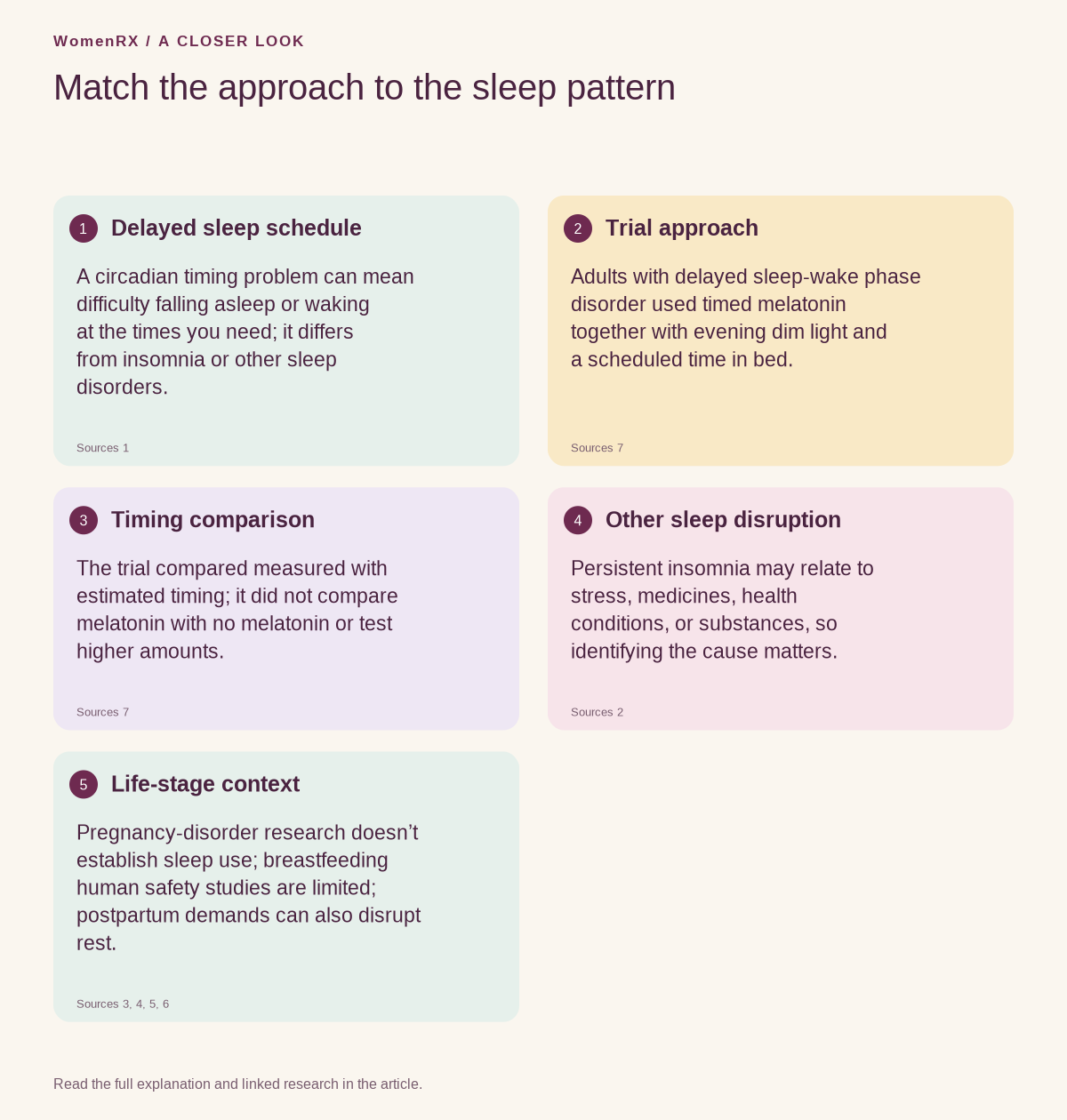
Match the approach to the sleep pattern
Delayed sleep schedule: A circadian timing problem can mean difficulty falling asleep or waking at the times you need; it differs from insomnia or other sleep disorders.1
Trial approach: Adults with delayed sleep-wake phase disorder used timed melatonin together with evening dim light and a scheduled time in bed.7
Timing comparison: The trial compared measured with estimated timing; it did not compare melatonin with no melatonin or test higher amounts.7
Other sleep disruption: Persistent insomnia may relate to stress, medicines, health conditions, or substances, so identifying the cause matters.2
Life-stage context: Pregnancy-disorder research doesn’t establish sleep use; breastfeeding human safety studies are limited; postpartum demands can also disrupt rest.3456
Read the figure as text
This comparison separates a shifted sleep schedule from other sleep problems and shows what the small timing trial actually tested, without turning its schedule into personal dosing advice.- Delayed sleep schedule: A circadian timing problem can mean difficulty falling asleep or waking at the times you need; it differs from insomnia or other sleep disorders.1
- Trial approach: Adults with delayed sleep-wake phase disorder used timed melatonin together with evening dim light and a scheduled time in bed.7
- Timing comparison: The trial compared measured with estimated timing; it did not compare melatonin with no melatonin or test higher amounts.7
- Other sleep disruption: Persistent insomnia may relate to stress, medicines, health conditions, or substances, so identifying the cause matters.2
- Life-stage context: Pregnancy-disorder research doesn’t establish sleep use; breastfeeding human safety studies are limited; postpartum demands can also disrupt rest.3456
More questions, answered
Does the timing trial show that melatonin alone works?
No. Participants also used evening dim light and a scheduled time in bed, and both groups received melatonin. The trial compared two ways of scheduling it, not melatonin with no melatonin. 7
What if my problem is staying asleep rather than falling asleep?
The timing trial didn’t compare melatonin formulations for staying asleep versus falling asleep. Repeated waking can have different causes, so persistent trouble is worth assessing rather than assuming a timing problem. 127
Is melatonin established as a sleep treatment during breastfeeding?
No. A recent review focused on lactating animals reports that well-controlled human supplementation studies are lacking; an older LactMed entry also describes limited safety information and differing recommendations. Discuss it with your maternity or baby’s clinician. 46
Sources you can check
- Sleep Disorders | MedlinePlusAccessed 2026-09-25Return to first citation
- Insomnia | MedlinePlusAccessed 2026-09-25Return to first citation
- Postpartum Care: MedlinePlusAccessed 2026-09-25Return to first citation
- Melatonin and Lactation in Ruminants Dairy Animals: A Systematic Review and Meta-Analysis of Preclinical Studies.Sattarpour R, Noori M, Sadeghimoghadam P, Sattarpour N, Bastani P. · Health science reports · 2026Return to first citation
- Melatonin in Pregnancy-Related Disorders: A Review of Protective Mechanisms and Therapeutic Potential.Waseem S, Zhan J, Yu L, Xiao X. · Reproductive sciences (Thousand Oaks, Calif.) · 2026Return to first citation
- Melatonin2006Return to first citation
- Low-dose exogenous melatonin plus evening dim light and time in bed scheduling advances circadian phase irrespective of measured or estimated dim light melatonin onset time: preliminary findings.Swanson LM, de Sibour T, DuBuc K, Conroy DA, Raglan GB, Lorang K, Zollars J, Hershner S, Arnedt JT, Burgess HJ. · Journal of clinical sleep medicine : JCSM : official publication of the American Academy of Sleep Medicine · 2024Return to first citation