Melatonin for Sleep: What to Check Before Taking It
Melatonin may help some sleep problems, but the reason you’re awake matters as much as what’s on the bottle.
Melatonin isn’t a one-size-fits-all sleep aid. In pooled trials, dose and timing affected sleep outcomes, but the findings don’t give everyone a personal schedule.4 Notice whether bedtime keeps drifting later or your sleep keeps getting interrupted. Check the label and your medicines, and watch for next-day tiredness or dizziness. Alcohol can make those effects worse. Pregnancy and breastfeeding call for separate decisions.125
First, name the sleep problem
If your bedtime keeps drifting later, sleep timing is one possible question to explore. A late bedtime alone doesn’t tell you why it’s happening. Evening light can push circadian timing later, although screens may also keep you awake through notifications or engaging content.3 Lying awake despite feeling sleepy, repeatedly waking overnight, and waking unrefreshed raise other questions. Sleep problems can have causes including pain, sleep apnea, and restless legs syndrome.1
This matters when you’re deciding what to ask melatonin to do. If you’re wondering about timing, taking something simply because it says “sleep” on the package skips the question: What’s keeping my bedtime later than I want? If you regularly wake through the night, consider what might be interrupting sleep rather than repeatedly changing the amount of a supplement. Loud snoring with gasping, an urge to move your legs at night, or frequent daytime sleepiness are reasons to look beyond a supplement.1
Why timing and amount aren’t interchangeable
A review of 26 randomized trials in people with insomnia and healthy volunteers found that melatonin’s modeled effect on falling asleep and total sleep time varied with dose. In its dose-response analysis, the sleep-promoting effects peaked at 4 mg per day. The researchers also suggested that taking melatonin three hours before the desired bedtime might work better for sleep onset than the commonly studied schedule of 2 mg taken 30 minutes before bed. These are pooled, modeled findings, not a personal regimen or an established schedule for someone whose main problem is a late body clock.4
Before buying or taking a product, read the milligrams per serving, how many tablets or gummies make up that serving, and whether it contains other sleep-related ingredients. A larger number on the front of a package isn’t evidence that it’s a better choice for your particular problem. The review’s reported dose-and-timing findings don’t establish the quality or contents of a retail product.4 If you want to ask about product quality, you could check whether independent testing covers the finished product’s identity and melatonin amount, and whether any claimed certification applies to the exact product. Treat that as an optional question, not a guarantee of what’s in the bottle. If you’re unsure how a product’s directions fit your sleep schedule, bring the package or a photo of its full label to a pharmacist instead of guessing from a general dosing tip.
The medication and next-morning check
Before adding melatonin, put your prescription medicines, over-the-counter sleep aids, other supplements, and the product label in front of a pharmacist or your care team. Ask whether adding it changes anything about what you already take. MedlinePlus advises checking before taking a medicine or supplement.1 One combination you can check yourself is alcohol: it can make melatonin-related tiredness and dizziness worse.2
Pay attention to how you function the next day. Melatonin can cause tiredness, dizziness, and headache. Don’t drive or use tools or machinery if you feel sleepy or dizzy.2 If an effect keeps bothering you, that’s a reason to revisit the product rather than assume you must get used to it. Get urgent medical help if you faint or suddenly become severely confused. Call your local emergency number immediately if your mouth or throat swells and you have trouble breathing.2
Pregnancy and breastfeeding are different questions
Melatonin is not usually recommended during pregnancy because little is known about its effects on babies. If you become pregnant while taking it, discuss whether to continue rather than making the decision based on how well it helps you sleep.5
Breastfeeding guidance is more nuanced: breast milk naturally contains melatonin, but it isn’t known how much manufactured melatonin passes into milk. NHS guidance says it may be used while breastfeeding a healthy baby after a care professional has reviewed the situation. It also advises against sharing a bed with your baby while taking melatonin. If your baby seems unusually sleepy or feeds less well than usual, get advice promptly.5 Those points do not make long-term use during breastfeeding an established safe routine.
A change in sleep during perimenopause or after menopause doesn’t, by itself, tell you that melatonin is the answer. Start with what’s happening: Is bedtime drifting later, are you waking repeatedly, or is something else disturbing sleep? Those are useful questions, not a way to diagnose the cause on your own.13
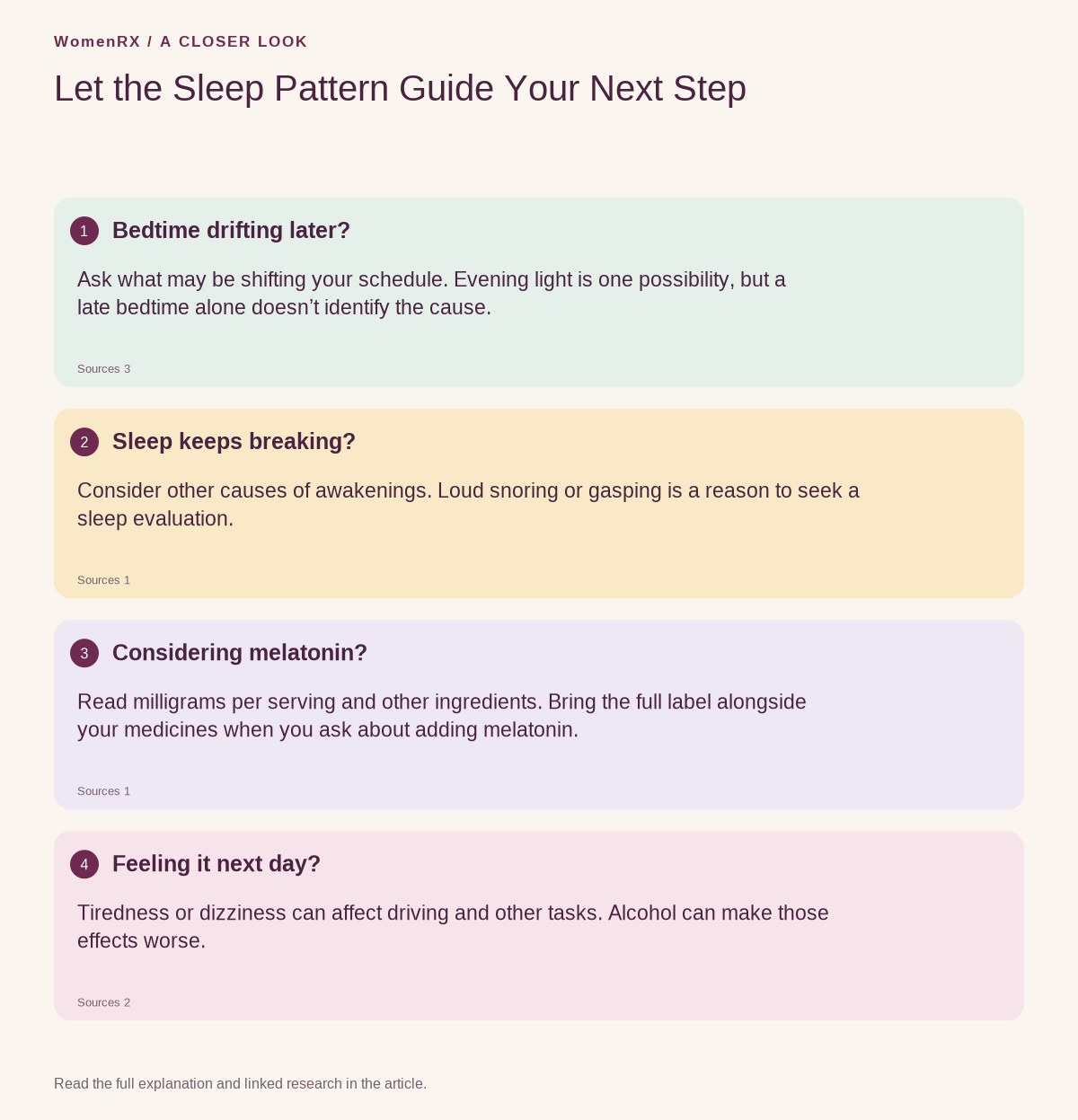
Let the Sleep Pattern Guide Your Next Step
Bedtime drifting later?: Ask what may be shifting your schedule. Evening light is one possibility, but a late bedtime alone doesn’t identify the cause.3
Sleep keeps breaking?: Consider other causes of awakenings. Loud snoring or gasping is a reason to seek a sleep evaluation.1
Considering melatonin?: Read milligrams per serving and other ingredients. Bring the full label alongside your medicines when you ask about adding melatonin.1
Feeling it next day?: Tiredness or dizziness can affect driving and other tasks. Alcohol can make those effects worse.2
Read the figure as text
Start with what happens at night, then check whether melatonin fits and how you feel afterward.- Bedtime drifting later?: Ask what may be shifting your schedule. Evening light is one possibility, but a late bedtime alone doesn’t identify the cause.3
- Sleep keeps breaking?: Consider other causes of awakenings. Loud snoring or gasping is a reason to seek a sleep evaluation.1
- Considering melatonin?: Read milligrams per serving and other ingredients. Bring the full label alongside your medicines when you ask about adding melatonin.1
- Feeling it next day?: Tiredness or dizziness can affect driving and other tasks. Alcohol can make those effects worse.2
Sources you can check
- Sleep Disorders | MedlinePlusAccessed 2026-09-25Return to first citation
- Side effects of melatonin - NHSAccessed 2026-09-25Return to first citation
- Evening Light-Emitting Diode Screen Exposure, Melanopsin-Mediated Circadian Disruption, and Optical Filtration for Sleep Hygiene: A Narrative Review in the Indian Context.Dubey SA, Elango N, Blessy Coelho L, Chaudhry M. · Cureus · 2026Return to first citation
- Optimizing the Time and Dose of Melatonin as a Sleep-Promoting Drug: A Systematic Review of Randomized Controlled Trials and Dose-Response Meta-Analysis.Cruz-Sanabria F, Bruno S, Crippa A, Frumento P, Scarselli M, Skene DJ, Faraguna U. · Journal of pineal research · 2024Return to first citation
- Pregnancy, breastfeeding and fertility while taking melatonin - NHSAccessed 2026-09-25Return to first citation