Melatonin Timing for Insomnia and Jet Lag
Timing advice for sleep trouble and jet lag differs by intended use and formulation.
For insomnia, UK medicine guidance gives different before-bed intervals for particular slow-release melatonin uses. For jet lag, its timing example follows bedtime at your destination. Neither is a general plan for shifting a persistently late body clock, and the examples aren’t universal instructions for US supplements. 3 5
Start with the goal, not the clock
Melatonin can have sleep-promoting and circadian-timing effects, but that doesn’t make every timing recommendation interchangeable. A schedule studied for sleep symptoms may not tell you when to shift your body clock, and a jet-lag schedule is tied to the time at your destination. 5
For a sleep-onset concern, the most concrete examples in the guidance are product- and use-specific. UK NHS medicine guidance lists slow-release melatonin taken 1 to 2 hours before bedtime for short-term insomnia. For longer-term sleep problems managed by a specialist, it gives a different interval: 30 to 60 minutes before bedtime. These are directions for particular prescribed uses, not universal instructions for US supplements or every formulation. 3
A 2024 systematic review and meta-analysis of 26 randomized trials, involving people with insomnia and healthy volunteers, found that the time between taking melatonin and the sleep episode was associated with sleep-onset latency. The authors proposed taking it 3 hours before desired bedtime together with a higher dose, compared with the commonly used schedule of 2 mg 30 minutes before bedtime. Because timing and dose changed together in that comparison, the review does not show that moving the timing earlier by itself improves sleep. It also doesn’t establish a rule for every person, product, or sleep problem. 4
Jet lag uses destination time
For jet lag, UK NHS medicine guidance describes a standard tablet taken at the destination’s normal bedtime, within a window that is not before 8 p.m. or after 4 a.m., for up to five days. That window is part of that specific guidance, not a general circadian-shift schedule or a US supplement direction. 3
There’s also a meaningful qualification: the NHS jet-lag information says melatonin tablets aren’t recommended there for jet lag because evidence that they work is insufficient. It also describes non-medicine measures, including getting daylight after arrival and keeping sleep aligned with local night. So the timing window should be understood as a product-guidance example, not proof that melatonin is needed or reliably effective for jet lag. 2 3
A persistent body-clock shift is outside these schedules
If your aim is to shift when your body feels ready for sleep night after night, neither the insomnia intervals nor the destination-time jet-lag window provides a timing plan. Expert recommendations for adults with certain neuropsychiatric conditions distinguish immediate-release melatonin for circadian sleep disturbances from prolonged-release melatonin for insomnia symptoms, but they do not give a schedule that applies to a persistently late sleep pattern in general. That’s a different timing question to raise with a sleep clinician rather than adapting one of the schedules above. 3 5
Pregnancy, breastfeeding, and menopause
Pregnancy and breastfeeding deserve their own discussion rather than an adult schedule borrowed by default. The NHS says melatonin is not usually recommended during pregnancy because its effects on the baby are not well known. For breastfeeding, it says the amount of manufactured melatonin that enters milk is unknown; longer use might make a baby sleepy. Its advice is conditional on a clinician’s assessment. 1
The reported findings of the 2024 review cover people with insomnia and healthy volunteers, but don’t establish a menopause-specific timing schedule or whether timing differs for women. They also can’t be assumed to apply equally across pregnancy, postpartum, cycling years, and postmenopause. 4
A useful way to compare timing advice
Before following a timing suggestion, check what it was designed for: a particular product and insomnia indication or jet lag at a destination. Also check whether it names the formulation. Those details explain why two sources can give different intervals without either being a universal bedtime rule. If you’re pregnant or breastfeeding, the NHS guidance itself flags uncertainty and clinician involvement; don’t assume an adult schedule applies. 1 3
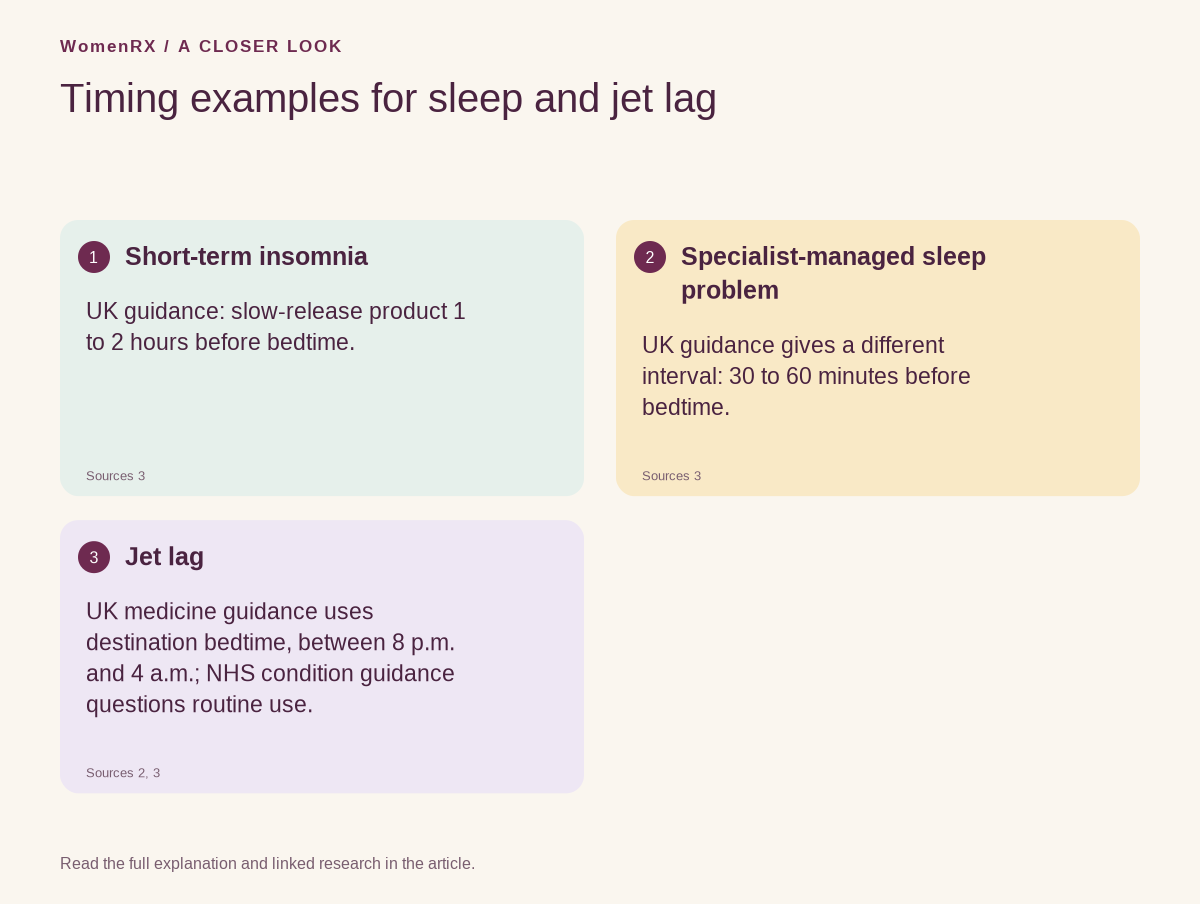
Timing examples for sleep and jet lag
Short-term insomnia: UK guidance: slow-release product 1 to 2 hours before bedtime.3
Specialist-managed sleep problem: UK guidance gives a different interval: 30 to 60 minutes before bedtime.3
Jet lag: UK medicine guidance uses destination bedtime, between 8 p.m. and 4 a.m.; NHS condition guidance questions routine use.23
Read the figure as text
These UK guidance examples address different uses and formulations; they are not interchangeable instructions for US supplements.- Short-term insomnia: UK guidance: slow-release product 1 to 2 hours before bedtime.3
- Specialist-managed sleep problem: UK guidance gives a different interval: 30 to 60 minutes before bedtime.3
- Jet lag: UK medicine guidance uses destination bedtime, between 8 p.m. and 4 a.m.; NHS condition guidance questions routine use.23
More questions, answered
Does taking melatonin at bedtime always help you fall asleep?
No. Bedtime is not a universal timing rule. A review found that the interval before the sleep episode was associated with sleep-onset results, but its proposed earlier timing was paired with a higher dose. It can’t show that changing timing alone helps, or prove one schedule works for everyone. 3 4
Is there a menopause-specific melatonin schedule?
The reported findings of the 2024 review don’t establish a menopause-specific timing schedule or show whether timing should differ for women in menopause. 4
Sources you can check
- Pregnancy, breastfeeding and fertility while taking melatonin - NHSAccessed 2026-09-25Return to first citation
- Jet lag - NHSAccessed 2026-09-25Return to first citation
- How and when to take melatonin - NHSAccessed 2026-09-25Return to first citation
- Optimizing the Time and Dose of Melatonin as a Sleep-Promoting Drug: A Systematic Review of Randomized Controlled Trials and Dose-Response Meta-Analysis.Cruz-Sanabria F, Bruno S, Crippa A, Frumento P, Scarselli M, Skene DJ, Faraguna U. · Journal of pineal research · 2024Return to first citation
- International Expert Opinions and Recommendations on the Use of Melatonin in the Treatment of Insomnia and Circadian Sleep Disturbances in Adult Neuropsychiatric Disorders.Palagini L, Manni R, Aguglia E, Amore M, Brugnoli R, Bioulac S, Bourgin P, Micoulaud Franchi JA, Girardi P, Grassi L, Lopez R, Mencacci C, Plazzi G, Maruani J, Minervino A, Philip ... · Frontiers in psychiatry · 2021Return to first citation