Menopause, Hormones, and Insomnia: What We Know
Menopause can overlap with sleep trouble, but hot flashes, stress, mood, and other sleep problems may matter alongside hormone changes.
Sleep problems are common around menopause, but the evidence doesn’t show that hormone changes alone cause insomnia. In one study of women ages 45 to 54, nighttime hot flashes, not measured hormone concentrations, directly predicted self-reported insomnia in the researchers’ model. Other contributors can include stress, mood, medicines, substances, and sleep disorders, so what wakes you matters. 6 7 1 2
A hot-flash awakening isn’t the whole story
Insomnia can mean trouble falling asleep, trouble staying asleep, or waking without feeling refreshed. A hot flash may wake you with heat or sweating, but sleep can also be difficult on nights when you don’t notice one. The patterns can overlap: a flash may interrupt sleep, while other factors can contribute to ongoing trouble falling or staying asleep. 1 6
That distinction is useful because “menopause insomnia” doesn’t point to one cause. Notice whether you wake with heat or sweating, lie awake before falling asleep, or wake for a reason that doesn’t seem connected to temperature. These are clues about the pattern, not a diagnosis.
Hormone links are plausible, but not settled
Research reviewed in 2025 found that both hot flashes and reproductive hormones predicted sleep problems in recent studies. But neither alone explained the range of sleep changes. The review also describes inconsistent findings, with differences in study methods, menopause stage, and whether participants already had sleep complaints. 6
Two analyses from the Midlife Women’s Health Study illustrate why the findings can look different. They draw on the same study cohort, not two independent groups of women, and they examined different sleep outcomes and hormone measures.
In one analysis, 762 women ages 45 to 54 reported insomnia, hot flashes, and depression at the first assessment; 389 of them answered similar questions four years later. In the researchers’ model, self-reported nighttime hot flashes directly predicted self-reported insomnia at the first assessment, while measured hormone concentrations did not. At the later assessment, earlier insomnia predicted reported insomnia. This is an association in a particular model, not proof that hot flashes cause insomnia or that hormones never affect sleep. The report does not provide a separate result for postmenopausal women. 7
The other analysis included 762 women ages 45 to 54: 459 were premenopausal and 303 perimenopausal. It found associations between some measured hormone levels and self-reported sleep disturbances or insomnia. Those observational associations don’t show that hormone changes caused the sleep problems, and the analysis did not include a postmenopausal group. 8
Taken together, the research doesn’t support treating a hormone level as a complete explanation for poor sleep. Nor does it establish one hormone pattern that explains insomnia across perimenopause and postmenopause. The broader review covers both stages but notes that results vary with stage and study design. 6 7 8
Stress, mood, and sleep disorders can overlap
Stress can affect the body’s arousal around sleep. In a small laboratory experiment involving perimenopausal women, anticipating a stressful task affected measures of cortisol and nervous-system activity before and during the night. The study offers a possible pathway, not proof that stress explains any one woman’s insomnia. 5
Stress, anxiety, depression, some medicines, caffeine, tobacco, and alcohol can also contribute to insomnia. And insomnia may be a symptom of another medical problem or sleep disorder, rather than a menopause effect by itself. 1 2
If poor sleep continues, it’s worth considering whether you have difficulty falling asleep, wake repeatedly with hot flashes, or suspect another contributor such as a medicine or a sleep disorder. Persistent trouble that affects your days deserves attention; you don’t have to assume it’s simply a hormone problem. A sleep history and, in some cases, a sleep study can help assess other causes. 1 2
Match the question to the symptom
If hot flashes are clearly waking you, treatment discussions can focus on those symptoms. Menopause hormone therapy is the most effective treatment for vasomotor symptoms, and evidence-based nonhormonal treatments are also available. That evidence is about treating hot flashes, not a guarantee that either approach will resolve every kind of insomnia. 3 4
If you’re struggling to sleep even without hot flashes, or the problem continues alongside stress, mood changes, medicine use, or daytime effects, those details matter too. The key point is not to choose between “hormones” and “not hormones” too quickly: more than one pathway can contribute, and the sleep pattern can help clarify what to address.
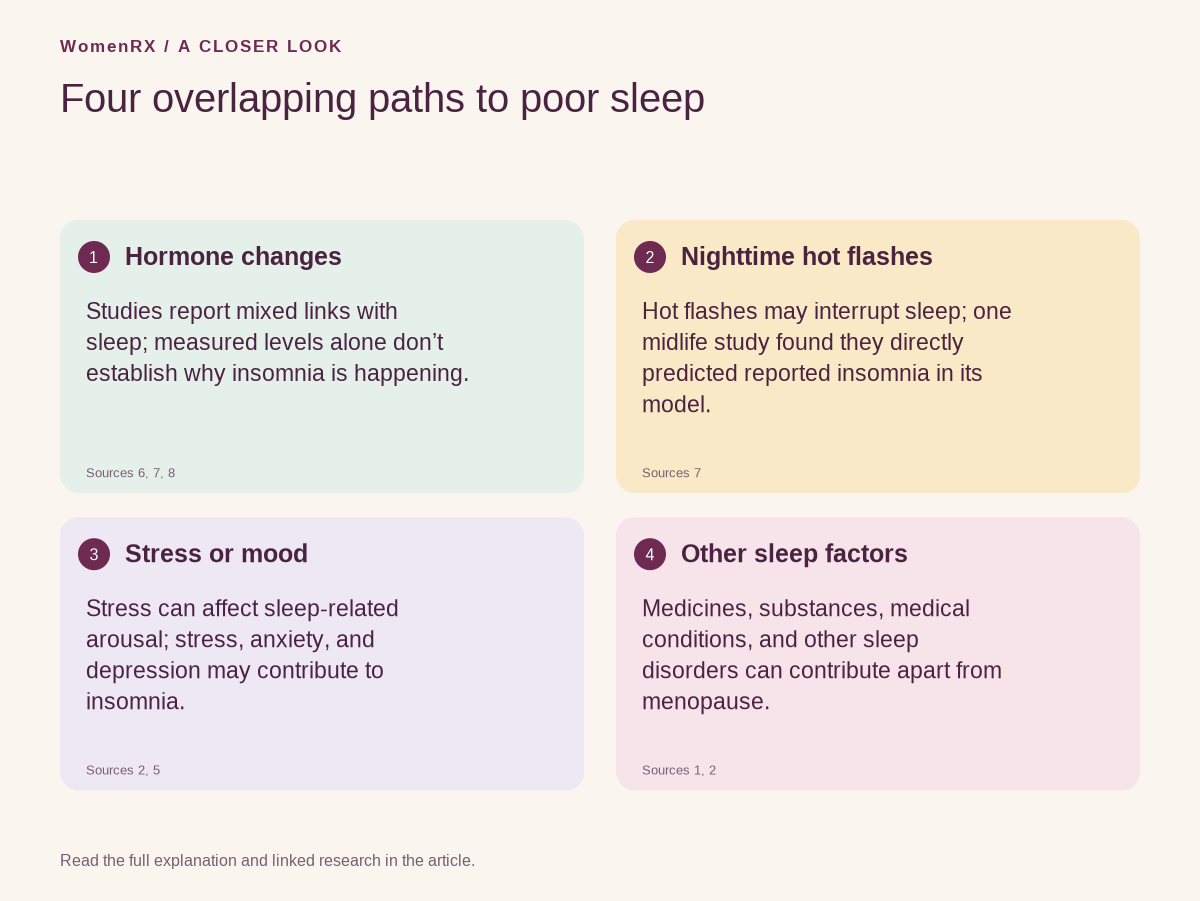
Four overlapping paths to poor sleep
Hormone changes: Studies report mixed links with sleep; measured levels alone don’t establish why insomnia is happening.678
Nighttime hot flashes: Hot flashes may interrupt sleep; one midlife study found they directly predicted reported insomnia in its model.7
Stress or mood: Stress can affect sleep-related arousal; stress, anxiety, and depression may contribute to insomnia.25
Other sleep factors: Medicines, substances, medical conditions, and other sleep disorders can contribute apart from menopause.12
Read the figure as text
These pathways can overlap. The evidence points to possible contributors, not a single automatic explanation for insomnia.- Hormone changes: Studies report mixed links with sleep; measured levels alone don’t establish why insomnia is happening.678
- Nighttime hot flashes: Hot flashes may interrupt sleep; one midlife study found they directly predicted reported insomnia in its model.7
- Stress or mood: Stress can affect sleep-related arousal; stress, anxiety, and depression may contribute to insomnia.25
- Other sleep factors: Medicines, substances, medical conditions, and other sleep disorders can contribute apart from menopause.12
More questions, answered
Does a hormone test explain menopause-related insomnia?
A hormone result alone can’t explain the whole picture. One analysis of midlife women found that measured hormone concentrations did not directly predict self-reported insomnia in its model; another analysis from the same study cohort found associations between some hormone measures and reported sleep problems. Neither establishes cause and effect. 7 8
Can treating hot flashes help when sleep is the main concern?
It may be relevant if hot flashes are what wake you. Hormone therapy is an effective treatment for vasomotor symptoms, and evidence-based nonhormonal options are available. That doesn’t mean either approach treats every form of insomnia. 3 4
Sources you can check
- Insomnia | MedlinePlusAccessed 2026-09-25Return to first citation
- Insomnia - NHSAccessed 2026-09-25Return to first citation
- The 2022 hormone therapy position statement of The North American Menopause Society.“The 2022 Hormone Therapy Position Statement of The North American Menopause Society” Advisory Panel. · Menopause (New York, N.Y.) · 2022Return to first citation
- The 2023 nonhormone therapy position statement of The North American Menopause Society.Menopause (New York, N.Y.) · 2023Return to first citation
- Acute stress alters autonomic modulation during sleep in women approaching menopause.de Zambotti M, Sugarbaker D, Trinder J, Colrain IM, Baker FC. · Psychoneuroendocrinology · 2016Return to first citation
- Sleep disturbance and menopause.Carmona NE, Solomon NL, Adams KE. · Current opinion in obstetrics & gynecology · 2025Return to first citation
- Nocturnal Hot Flashes, but Not Serum Hormone Concentrations, as a Predictor of Insomnia in Menopausal Women: Results from the Midlife Women's Health Study.Hatcher KM, Smith RL, Chiang C, Flaws JA, Mahoney MM. · Journal of women's health (2002) · 2023Return to first citation
- Association of phthalate exposure and endogenous hormones with self-reported sleep disruptions: results from the Midlife Women's Health Study.Hatcher KM, Smith RL, Chiang C, Li Z, Flaws JA, Mahoney MM. · Menopause (New York, N.Y.) · 2020Return to first citation