Menopause Insomnia: What’s Waking You and What Helps
Hot flashes can interrupt sleep, but the right approach depends on whether you’re waking hot, struggling to fall asleep, or noticing signs of another sleep disorder.
Start with what happens during the night. If you wake feeling hot, treating hot flashes may help; if you regularly lie awake or can’t get back to sleep, cognitive behavioral therapy for insomnia (CBT-I) is a proven option. Snoring with choking sounds or an urge to move your legs calls for a different assessment. More than one cause can be present. 23568
Start with the interruption, not the label
Sleep problems become more common during perimenopause and postmenopause, and hot flashes can be part of the picture. But menopause doesn’t explain every wake-up. Insomnia can mean difficulty falling asleep, staying asleep, or both; stress, medicines, and other sleep disorders can contribute at any age. 36
Consider a few different nights. On one, you wake feeling hot and then fall back asleep. On another, you’re comfortable but spend a long time awake worrying about whether you’ll sleep. On a third, someone notices snoring followed by a choking sound. Those patterns point toward different conversations about care. They aren’t a way to diagnose yourself, and you may recognize more than one. 2346
When hot flashes seem to lead the wake-ups
If waking hot is the clear interruption, it makes sense to address the hot flashes rather than assume you need a sleep aid. Menopause treatments include hormone therapy and nonhormone medicines for hot flashes; some nonhormone options may also help with sleep problems. The choice depends on your symptoms, medical history, and preferences. None is a guaranteed cure for insomnia, especially if you also struggle to sleep on nights without hot flashes. 86
Simple sleep-habit changes may help, particularly when sleep trouble is short-lived. A room that’s too hot or too cold can itself disturb sleep, so making the room comfortable is a reasonable place to start. That’s useful, but it isn’t a substitute for assessing persistent insomnia or a possible breathing problem during sleep. 34
When the problem is being awake in bed
Sometimes a wake-up has an obvious trigger, but the difficulty becomes falling asleep again. If you regularly spend long stretches awake at bedtime or after waking, ask about CBT-I, a structured treatment for insomnia. It works on the thoughts and behaviors that can keep sleep difficult, rather than relying only on a list of sleep-hygiene tips. CBT-I programs commonly include stimulus control and a carefully planned change to time spent in bed. 345
This is more than a plausible idea: a systematic review and meta-analysis of randomized trials found higher odds of insomnia remission with individual, group, and internet-delivered CBT-I than with their control groups. Those results address insomnia across the studied populations, not a promised result for every woman in menopause. The review also found that completing all sessions was less common in internet formats than in individual treatment, a practical consideration when choosing how to get help. 5
CBT-I can make sense even when hot flashes are also being addressed. The two approaches answer different questions: one targets the insomnia pattern, while hot-flash treatment targets a possible source of wake-ups. If anxiety or low mood is affecting your nights, say so during an assessment; stress, anxiety, and depression can also contribute to insomnia. 348
Clues that call for a different assessment
A strong urge to move your legs while resting at night, often with tingling, throbbing, itching, or pain, fits the pattern of restless legs syndrome. Its treatment depends on the cause. For example, an assessment may identify low iron or a medicine that worsens symptoms; that’s a reason to check the cause, not to start iron on your own. Seek an assessment if these symptoms are stopping you from sleeping. 1
Loud snoring together with snorting or choking sounds during sleep raises the possibility of sleep apnea. Repeatedly interrupted breathing can leave you drowsy during the day, and assessment may include a sleep study. Not everyone who snores has sleep apnea, so the sound alone isn’t a diagnosis. If you’re so sleepy that driving feels unsafe, don’t drive while drowsy and arrange an assessment. 2
These possibilities matter even if hot flashes are unmistakable. A menopause-related symptom and a separate sleep disorder can both deserve attention. 26
What about melatonin or other “natural” sleep aids?
A product marketed as natural isn’t necessarily a treatment for the reason you’re awake. Research on supplements marketed for menopause symptoms has mixed results, long-term safety information is limited, and some products can cause side effects or interact with medicines. Melatonin is among the products used for sleep problems, but that fact alone doesn’t establish that it treats menopause-related insomnia. Before trying a supplement or sleep aid, check how it fits with your medicines and symptoms. 78
If trouble sleeping has continued for months, changes to sleep habits haven’t helped, or you recognize the breathing or leg symptoms above, an assessment can help match treatment to the problem. You don’t have to decide in advance whether it’s “just menopause” or insomnia. Describe what happens when you first wake and what keeps you awake afterward; those may be two different parts of the same night. 1246
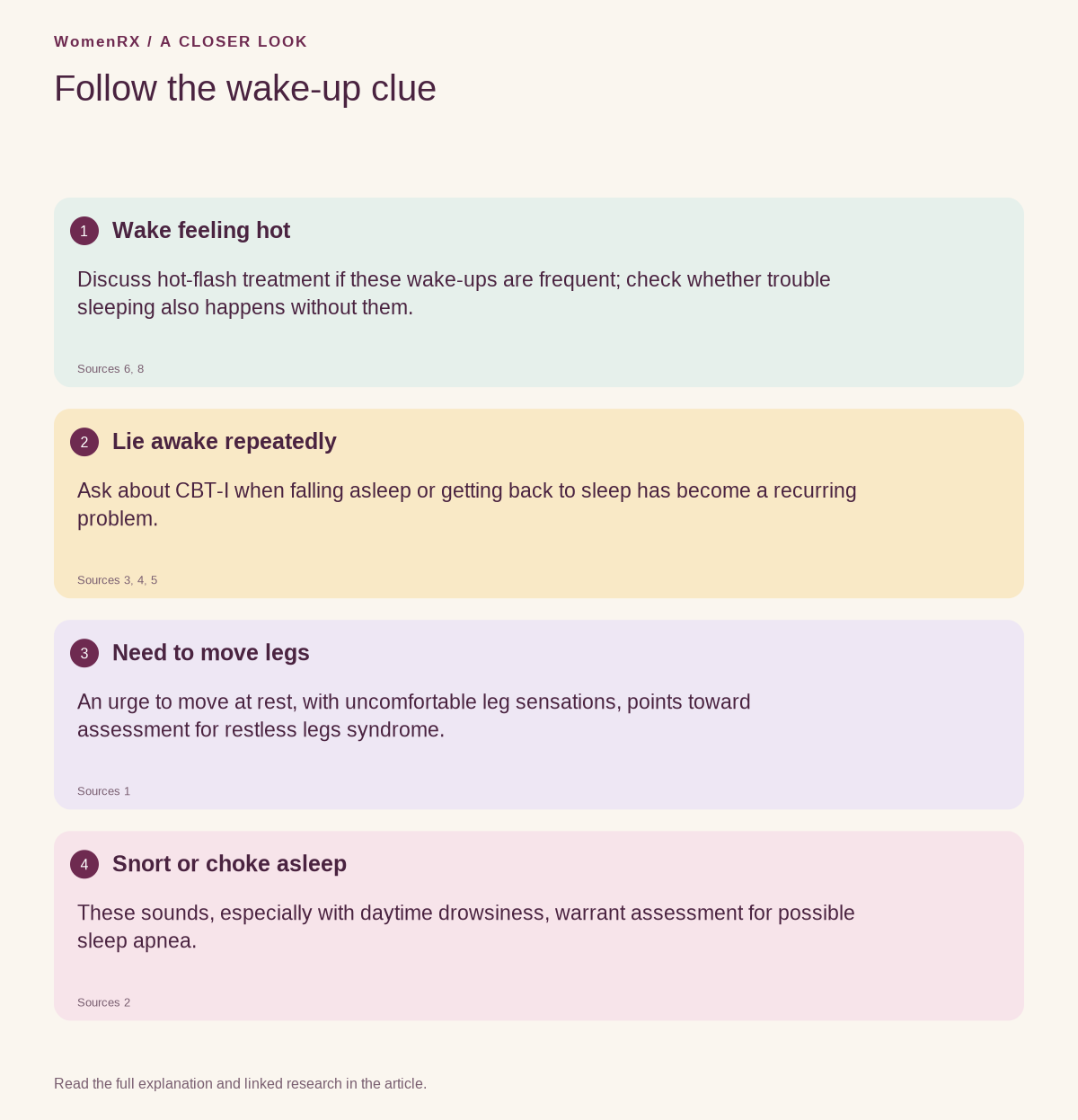
Follow the wake-up clue
Wake feeling hot: Discuss hot-flash treatment if these wake-ups are frequent; check whether trouble sleeping also happens without them.68
Lie awake repeatedly: Ask about CBT-I when falling asleep or getting back to sleep has become a recurring problem.345
Need to move legs: An urge to move at rest, with uncomfortable leg sensations, points toward assessment for restless legs syndrome.1
Snort or choke asleep: These sounds, especially with daytime drowsiness, warrant assessment for possible sleep apnea.2
Read the figure as text
Use the most noticeable part of the night to identify a useful next question, not to diagnose yourself.- Wake feeling hot: Discuss hot-flash treatment if these wake-ups are frequent; check whether trouble sleeping also happens without them.68
- Lie awake repeatedly: Ask about CBT-I when falling asleep or getting back to sleep has become a recurring problem.345
- Need to move legs: An urge to move at rest, with uncomfortable leg sensations, points toward assessment for restless legs syndrome.1
- Snort or choke asleep: These sounds, especially with daytime drowsiness, warrant assessment for possible sleep apnea.2
More questions, answered
Can I try CBT-I online?
Yes. CBT-I has been studied in individual, group, and internet-based formats, with better insomnia remission outcomes than control conditions across those formats. In a review of randomized trials, completion of all sessions was lower for internet-based formats than for individual treatment, so consider how much support would help you stick with it. 5
If hot-flash treatment helps, do I still need CBT-I?
Not necessarily. If sleep is working well again, there may be no remaining insomnia problem to treat. If you still regularly struggle to fall asleep or return to sleep, CBT-I addresses that pattern directly. 3458
Sources you can check
- Restless legs syndrome - NHSAccessed 2026-09-25Return to first citation
- Sleep Apnea | MedlinePlusAccessed 2026-09-25Return to first citation
- Insomnia | MedlinePlusAccessed 2026-09-25Return to first citation
- Insomnia - NHSAccessed 2026-09-25Return to first citation
- Remission, treatment response, and treatment adherence across the delivery methods of cognitive behavioral therapy for insomnia: A systematic review and meta-analysis of randomized controlled trials.Takano Y, Okajima I, Osao M, Ibata R, Machida N, Higami K, Takagi S, Inoue Y. · Sleep medicine reviews · 2025Return to first citation
- Sleep Disruption in the Menopausal Transition and Postmenopause: A Narrative Review.Lyu AC, Kravitz HM. · Obstetrics and gynecology · 2026Return to first citation
- Sleep Disorders | MedlinePlusAccessed 2026-09-25Return to first citation
- Menopause | Menopause Symptoms | MedlinePlusAccessed 2026-09-25Return to first citation