Perimenopause Insomnia: How Long It Can Last
Sleep trouble during perimenopause doesn’t have one predictable end date, and hot flashes aren’t the only possible cause.
Perimenopause-related insomnia can’t be assigned a reliable countdown: sleep problems vary by person and may also occur after menopause. Notice whether you’re waking with heat and sweating, struggling to fall asleep, or waking for another reason. If sleep trouble lasts for months or affects your days, ask about insomnia treatment and other sleep problems, not only menopause symptoms. 3 5 6
There’s no set number of months
Perimenopause insomnia doesn’t follow a predictable schedule. Sleep problems are more common during the menopause transition and after menopause, but their frequency depends on factors including menopause stage, hot flashes, and how sleep problems are measured. That pattern can’t tell you how long your own symptoms will last, and it’s not a reason to assume sleep will improve as soon as your periods stop. 5 6
It helps to separate insomnia from sleep interrupted by another symptom. Insomnia can mean difficulty falling asleep, waking repeatedly, or waking early and being unable to return to sleep. A night of poor sleep now and then isn’t the same as a persistent problem affecting your waking life. 2 3
What does the night look like?
You wake hot or sweaty. If waking comes with a sudden feeling of heat or sweating, vasomotor symptoms, such as hot flashes and night sweats, may be part of the picture. Hormone therapy is the most effective treatment for bothersome vasomotor symptoms, according to the North American Menopause Society. But easing hot flashes may not resolve sleep problems that have another cause. 4 5
You lie awake before sleep or after waking, without heat. That pattern may fit insomnia even if you also have menopause symptoms. Women can report insomnia without vasomotor symptoms, while some women with severe vasomotor symptoms sleep without disruption. Cognitive behavioral therapy for insomnia, or CBT-I, is worth asking about as an insomnia-focused option; a published trial protocol describes it as the treatment of choice for insomnia in adults, while also noting that menopause-specific studies have been limited. 5
Something else repeatedly wakes you. Pain, medicines, snoring or interrupted breathing, and other sleep disorders can contribute to poor sleep. Menopause-stage sleep problems can include conditions such as obstructive sleep apnea and restless legs syndrome, so persistent sleep trouble deserves a broader look than “it must be hormones.” 2 3 6
Match the next step to the pattern
If waking seems tied to hot flashes or night sweats, ask about options for bothersome vasomotor symptoms, including the benefits and risks of menopausal hormone therapy for your circumstances. Hormone therapy’s benefits and risks vary with factors such as treatment type, timing, and whether a progestogen is used, so the decision is individual. 4
If the main problem is being unable to fall asleep or return to sleep, ask specifically about CBT-I rather than assuming that treating hot flashes will fix everything. The evidence base for CBT-I specifically in perimenopausal women is still developing: a 2025 study protocol planned to compare CBT-I, hormone therapy, and sleep hygiene in late-perimenopausal women with insomnia and vasomotor symptoms. A protocol describes a study plan, not its results. 5
You can make the conversation more useful by noting which pattern fits best: trouble falling asleep, repeated waking, or early waking; whether you wake hot or sweaty; and whether something else, such as pain, a medicine, or breathing disruption, seems involved. Also note whether poor sleep is affecting your daytime energy or ability to function. This is not a diagnostic test; it helps clarify what to assess. 2 3
If sleep trouble has lasted for months, is affecting daily life, or is not improving with changes to sleep habits, seek an assessment. Regular night sweats that soak clothing or bedding also deserve medical attention, particularly if they come with other concerning symptoms. 1 3
The useful question isn’t only “When will it end?”
A better next question is: What is waking me, and what treatment targets that cause? If the answer is hot flashes, discussing vasomotor-symptom treatment makes sense. If you remain awake even when you aren’t hot, or have signs of another sleep problem, ask about insomnia-focused care and other causes. Sleep can change across the menopause transition, but you don’t have to wait for a certain stage to get persistent insomnia assessed.
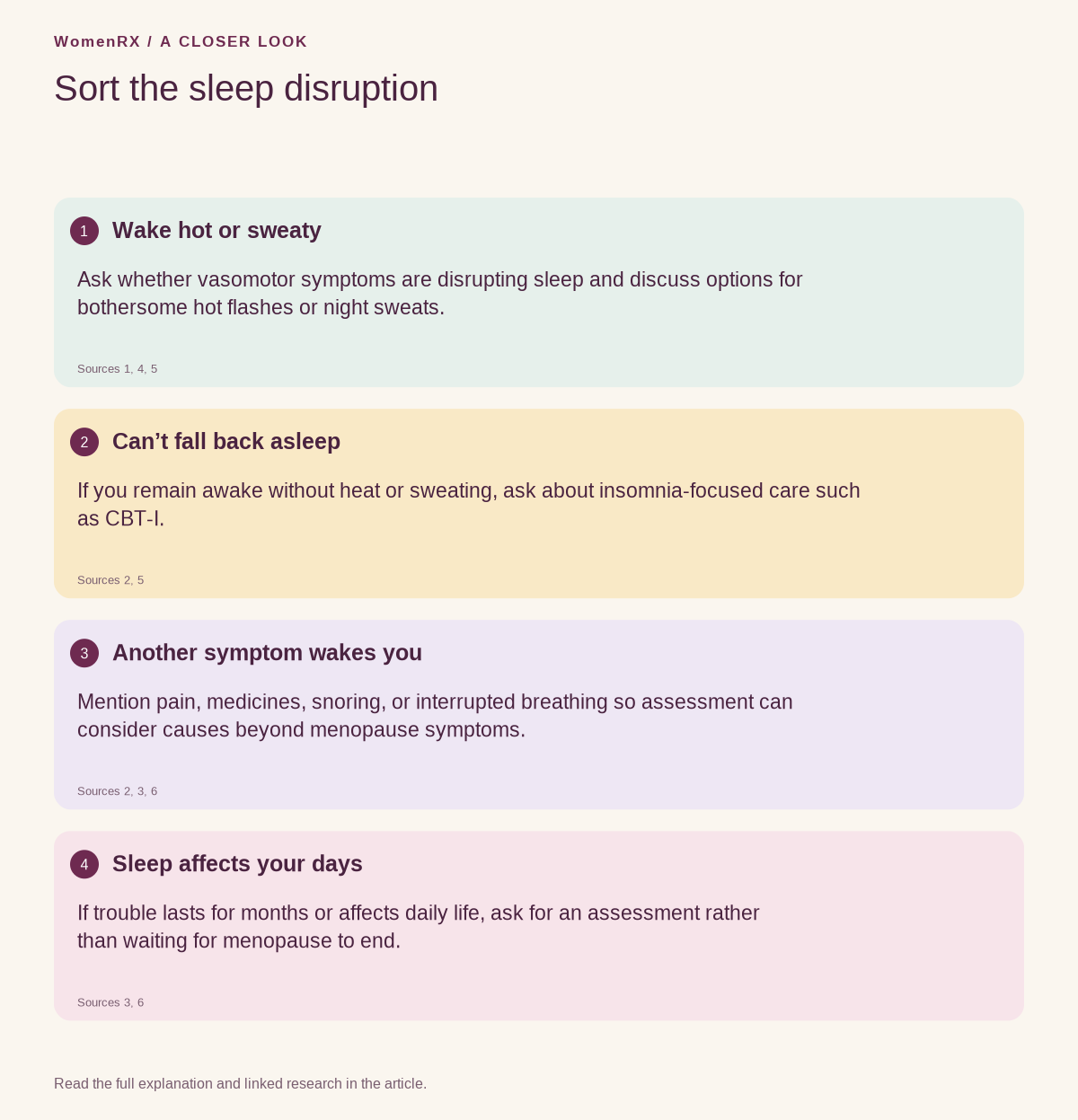
Sort the sleep disruption
Wake hot or sweaty: Ask whether vasomotor symptoms are disrupting sleep and discuss options for bothersome hot flashes or night sweats.145
Can’t fall back asleep: If you remain awake without heat or sweating, ask about insomnia-focused care such as CBT-I.25
Another symptom wakes you: Mention pain, medicines, snoring, or interrupted breathing so assessment can consider causes beyond menopause symptoms.236
Sleep affects your days: If trouble lasts for months or affects daily life, ask for an assessment rather than waiting for menopause to end.36
Read the figure as text
Use the pattern of waking to identify what to ask about next; this is a guide to assessment, not a diagnostic test.- Wake hot or sweaty: Ask whether vasomotor symptoms are disrupting sleep and discuss options for bothersome hot flashes or night sweats.145
- Can’t fall back asleep: If you remain awake without heat or sweating, ask about insomnia-focused care such as CBT-I.25
- Another symptom wakes you: Mention pain, medicines, snoring, or interrupted breathing so assessment can consider causes beyond menopause symptoms.236
- Sleep affects your days: If trouble lasts for months or affects daily life, ask for an assessment rather than waiting for menopause to end.36
More questions, answered
Does insomnia always stop after menopause?
There isn’t a dependable point when sleep trouble is expected to stop. Sleep disruption is reported during perimenopause and postmenopause, and causes can include vasomotor symptoms as well as other sleep or health problems. 5 6
What if I wake up sweating?
Hot flashes and night sweats are common menopause-related causes of night waking, but they are not the only possible cause. Regular soaking night sweats, especially with other symptoms such as unexplained weight loss, warrant an assessment. 1
Sources you can check
- Night sweats - NHSAccessed 2026-09-25Return to first citation
- Insomnia | MedlinePlusAccessed 2026-09-25Return to first citation
- Insomnia - NHSAccessed 2026-09-25Return to first citation
- The 2022 hormone therapy position statement of The North American Menopause Society.“The 2022 Hormone Therapy Position Statement of The North American Menopause Society” Advisory Panel. · Menopause (New York, N.Y.) · 2022Return to first citation
- No more sleepless nights in perimenopause-an open-label, randomized, parallel-group, active controlled intervention study in perimenopausal women with vasomotor symptoms and insomnia to investigate the efficacy of hormone replacement therapy and cognitive behavioral therapy for the treatment of insomnia: study protocol.Pavicic E, Stute P, Rudzik F, Urech A, Lozza-Fiacco S. · Trials · 2025Return to first citation
- Sleep Disruption in the Menopausal Transition and Postmenopause: A Narrative Review.Lyu AC, Kravitz HM. · Obstetrics and gynecology · 2026Return to first citation