Insomnia in Perimenopause: Sort the Pattern, Choose Next Steps
Sleep problems can have more than one contributor during perimenopause, so noticing what happens around each wake-up can help you choose a useful next step.
Insomnia means trouble falling asleep, staying asleep, or waking unrefreshed. During perimenopause, night sweats, mood symptoms, or another sleep disorder may also disrupt sleep. If insomnia continues, cognitive behavioral therapy for insomnia (CBT-I) addresses habits and thoughts that can keep it going. If hot flashes or night sweats are prominent, treating those symptoms may help, but may not resolve every sleep problem. 3 5 6
First, notice what “bad sleep” looks like
Insomnia describes difficulty falling asleep, staying asleep, or getting sleep that leaves you feeling refreshed. It can happen alongside another problem, including a medical condition, medication effect, pain, or a different sleep disorder. 3
Sleep difficulties are common during the menopausal transition, but they don’t all have one explanation. A review of research on perimenopause describes several possible contributors, including vasomotor symptoms, mood disorders, and other sleep disorders. The review includes research across perimenopause and postmenopause, so it doesn’t establish that every cause or treatment applies equally at every transition stage. 6
Look for a pattern, not a single explanation
A useful distinction is whether something seems to wake you, or whether you’re lying awake even when no clear symptom interrupts your sleep. These patterns can overlap, and a sleep record can’t diagnose the cause. It can help you explain what you’re experiencing and what might be worth addressing.
For a stretch of nights, jot down when you went to bed, whether you had trouble falling asleep or woke during the night, what you noticed when you woke, and how you felt the next day. If relevant, note hot or sweaty waking, mood changes, pain, alcohol or caffeine, and medication changes. These are possible contributors described in clinical information and menopause research, not a checklist that can identify a diagnosis. 1 3 6
Night sweats are more than feeling a little warm: they involve sweating enough to soak nightclothes or bedding even when the room is cool. Menopause symptoms are one common cause, though anxiety, alcohol or drug use, and other causes are also described. 1 Research reviews report that vasomotor symptoms can disrupt sleep, but a sweaty awakening alone doesn’t prove that they explain all your insomnia. 6
If you’re regularly waking with soaking-wet bedding, especially with other concerning symptoms such as unexplained weight loss, a cough, or fever, arrange a medical assessment rather than assuming it’s menopause. 1
Match the next step to the pattern
If difficulty sleeping continues even without an obvious interruption, ask about cognitive behavioral therapy for insomnia (CBT-I). It works on thoughts and behaviors that can keep insomnia going. CBT-I is more than general advice to sleep better: a program can include changing the habits that link bed with being awake, adjusting time spent in bed, working with thoughts that make sleep more stressful, relaxation, and sleep-habit changes. Those parts are typically brought together as a treatment rather than picked at random as a do-it-yourself checklist. General insomnia guidance describes cognitive behavioral therapy as helpful for ongoing insomnia, and a review reports CBT-I as an effective treatment during peri- and postmenopause. 3 4 6
There’s a useful evidence distinction here: the perimenopause-specific research base is smaller than the general insomnia evidence. A 2025 paper describing a planned trial says relatively few studies have examined CBT-I in peri- and postmenopause; its trial was a protocol, not a report of results. So CBT-I is a reasonable treatment discussion, but claims about exactly how well a particular program works for every perimenopausal sleep pattern should stay measured. 5 6
If hot flashes or night sweats are a prominent part of the problem, discuss treating those symptoms as well as the sleep difficulty. Hormone therapy may be considered for menopausal symptoms based on individual needs and risk factors, but it shouldn’t be treated as a universal insomnia treatment. For example, if sweaty waking becomes less frequent but you still spend long stretches awake, that remaining insomnia is a reason to discuss CBT-I too. Sleep problems can have contributors beyond vasomotor symptoms. 5 6
If another sleep disorder may be involved, raise that possibility rather than treating every waking as insomnia. Sleep apnea can interrupt breathing during sleep; loud snoring and waking with a snort or choking sound are described signs, though not everyone who snores has sleep apnea. A sleep evaluation may be appropriate when another sleep disorder is suspected. 2 4
If mood symptoms, pain, medication effects, or substances may be involved, include those in the conversation too. Insomnia can be associated with medical conditions and medicines, and caffeine, tobacco, and alcohol are among the possible contributors described in insomnia guidance. 3
Make the record useful
Instead of bringing a long list of nights, look for one or two patterns: “I wake sweaty and then fall back asleep,” “I’m awake for a long time even when I’m not hot,” or “I sleep poorly when my mood is especially low.” These examples don’t identify a cause on their own. They can help you and your clinician decide whether to focus first on vasomotor symptoms, CBT-I, another sleep condition, or more than one factor.
If sleep trouble has lasted for months or is making daily life hard to manage, it’s reasonable to seek care rather than waiting for it to pass. 4
Follow the sleep pattern
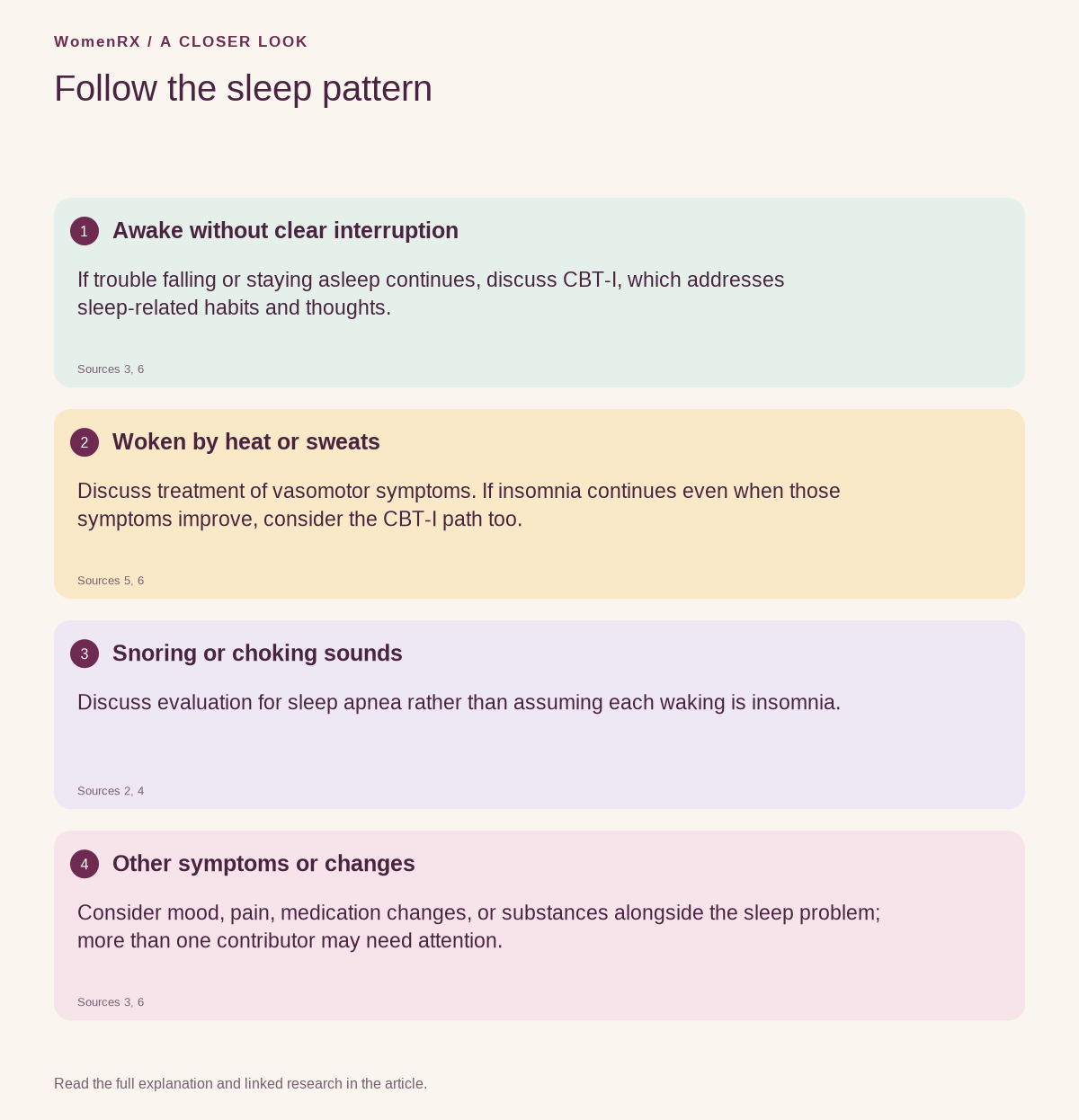
Awake without clear interruption: If trouble falling or staying asleep continues, discuss CBT-I, which addresses sleep-related habits and thoughts.36
Woken by heat or sweats: Discuss treatment of vasomotor symptoms. If insomnia continues even when those symptoms improve, consider the CBT-I path too.56
Snoring or choking sounds: Discuss evaluation for sleep apnea rather than assuming each waking is insomnia.24
Other symptoms or changes: Consider mood, pain, medication changes, or substances alongside the sleep problem; more than one contributor may need attention.36
Read the figure as text
Start with what happens at bedtime or around a waking, then follow the matching care discussion. More than one path may apply; this is not a diagnostic test.- Awake without clear interruption: If trouble falling or staying asleep continues, discuss CBT-I, which addresses sleep-related habits and thoughts.36
- Woken by heat or sweats: Discuss treatment of vasomotor symptoms. If insomnia continues even when those symptoms improve, consider the CBT-I path too.56
- Snoring or choking sounds: Discuss evaluation for sleep apnea rather than assuming each waking is insomnia.24
- Other symptoms or changes: Consider mood, pain, medication changes, or substances alongside the sleep problem; more than one contributor may need attention.36
More questions, answered
Does hormone therapy fix insomnia in perimenopause?
Not necessarily. It may be considered when menopausal symptoms such as vasomotor symptoms are part of the picture, but sleep problems can have other contributors. The research review also notes that sleep disturbance can occur in different symptom patterns. 5 6
Is CBT-I specifically proven for every perimenopausal sleep problem?
No. A review reports CBT-I as effective during peri- and postmenopause, while a trial protocol notes that relatively few studies have examined it in these groups. That supports discussing CBT-I for insomnia, while recognizing that evidence for particular programs and symptom patterns is more limited. 5 6
Sources you can check
- Night sweats - NHSAccessed 2026-09-25Return to first citation
- Sleep Apnea | MedlinePlusAccessed 2026-09-25Return to first citation
- Insomnia | MedlinePlusAccessed 2026-09-25Return to first citation
- Insomnia - NHSAccessed 2026-09-25Return to first citation
- No more sleepless nights in perimenopause-an open-label, randomized, parallel-group, active controlled intervention study in perimenopausal women with vasomotor symptoms and insomnia to investigate the efficacy of hormone replacement therapy and cognitive behavioral therapy for the treatment of insomnia: study protocol.Pavicic E, Stute P, Rudzik F, Urech A, Lozza-Fiacco S. · Trials · 2025Return to first citation
- Sleep Disturbance and Perimenopause: A Narrative Review.Troìa L, Garassino M, Volpicelli AI, Fornara A, Libretti A, Surico D, Remorgida V. · Journal of clinical medicine · 2025Return to first citation