Depression During Perimenopause: When to Get Help
Persistent low mood or loss of interest deserves attention, whether or not it began alongside changing periods or night sweats.
If low mood or loss of interest is affecting your daily life during perimenopause, ask for an assessment. Symptoms lasting at least two weeks can fit the pattern of major depression, but you don’t need to wait two weeks to seek help. Perimenopause may be part of the picture without being the only cause. Treatment can address depression and menopause symptoms separately or together. 1 4
When it’s more than a rough patch
A hard day, or even several, doesn’t necessarily mean you have depression. The distinction is whether low mood or a loss of interest persists and begins to change how you live. Sleep, eating, work, and other ordinary activities may become difficult. Depression doesn’t look the same in everyone, and it may not feel like sadness alone. 1
For major depression, low mood or loss of interest that affects daily activities and lasts at least two weeks is a key pattern. Think of two weeks as a diagnostic clue, not a waiting period. If you’re struggling to function, symptoms are getting worse, or you’re worried about yourself, it’s reasonable to ask for help sooner. 1
Why the timing matters, but doesn’t settle the cause
Depressive and anxiety symptoms occur during perimenopause, when ovarian hormones are changing. Researchers are still working out exactly how those changes affect mood and why some women are more vulnerable than others. A mood change that starts alongside changing periods may be related to the transition, but its timing alone cannot tell you that hormones caused it. 4 6
Your history matters here. Tell the person assessing you if you’ve had depression before, even if the current experience feels different. Mention hot flashes or night sweats, disrupted sleep, major stresses, health conditions, and medicines you take. These aren’t competing explanations that you have to sort out yourself. They’re parts of the picture that can shape care. Some medical conditions, including thyroid disorders, and some medicines can produce symptoms that resemble depression. 1 4 5
For example, you might be waking repeatedly with night sweats and finding that nothing you usually enjoy holds your interest. Treating the night sweats could address one problem, but it shouldn’t replace an assessment of the loss of interest. Conversely, noticing depressed mood doesn’t mean your sleep disruption or hot flashes should be ignored. 1 2 4
What care may look like
An assessment is a conversation about your symptoms, how long they’ve lasted, how daily life has changed, and your health and treatment history. A clinician may also consider whether a medical condition or medicine is contributing. You don’t need to know whether to call what you’re experiencing “perimenopausal depression” before making that appointment. 1 5
If depression is diagnosed, options may include psychotherapy, such as cognitive behavioral therapy (CBT), and antidepressant medication, including selective serotonin reuptake inhibitors (SSRIs) or serotonin-norepinephrine reuptake inhibitors (SNRIs). The right discussion depends on your symptoms, history, preferences, and how you respond to care. Antidepressants can have side effects, including nausea, dizziness, agitation, or reduced sex drive, so those tradeoffs belong in the conversation. 4 7
Menopause symptoms may need their own plan. Hormone therapy is an effective treatment for bothersome hot flashes and night sweats, but its benefits and risks vary with a woman’s circumstances. It is not a reason to skip a depression assessment or assume that treating hot flashes will resolve a depressive episode. Some nonhormonal options, including CBT and certain SSRIs or SNRIs, have evidence for hot flashes too; evidence that something helps hot flashes is not, by itself, evidence that it treats depression. 2 3 4
There is also research on hormone treatment for mood during perimenopause, including reports of short-term benefit with estradiol. That possibility is worth discussing when menopause symptoms and depression overlap, but it doesn’t establish hormone therapy as the right depression treatment for every woman. 9 2 4
Movement can be one supportive part of care if it feels manageable. A review of exercise trials in perimenopausal and postmenopausal women found improvements in depressive symptom scores, but the studies also included women without a formal depression diagnosis. That makes exercise a possible addition to a plan, not a substitute for assessing depression that is affecting your life. 8
If thoughts of death or suicide come up
Thoughts of death or suicide can be a symptom of depression. Seek help as soon as they come up: tell a healthcare or mental-health provider promptly rather than waiting for a routine appointment or for symptoms to last two weeks. 1
If your mood is making daily life hard, a primary care or mental-health appointment is a useful next move. You can say plainly: “I’ve lost interest in things I usually care about, and it’s affecting my day. I’m also in perimenopause. Can we look at both?” 1 4
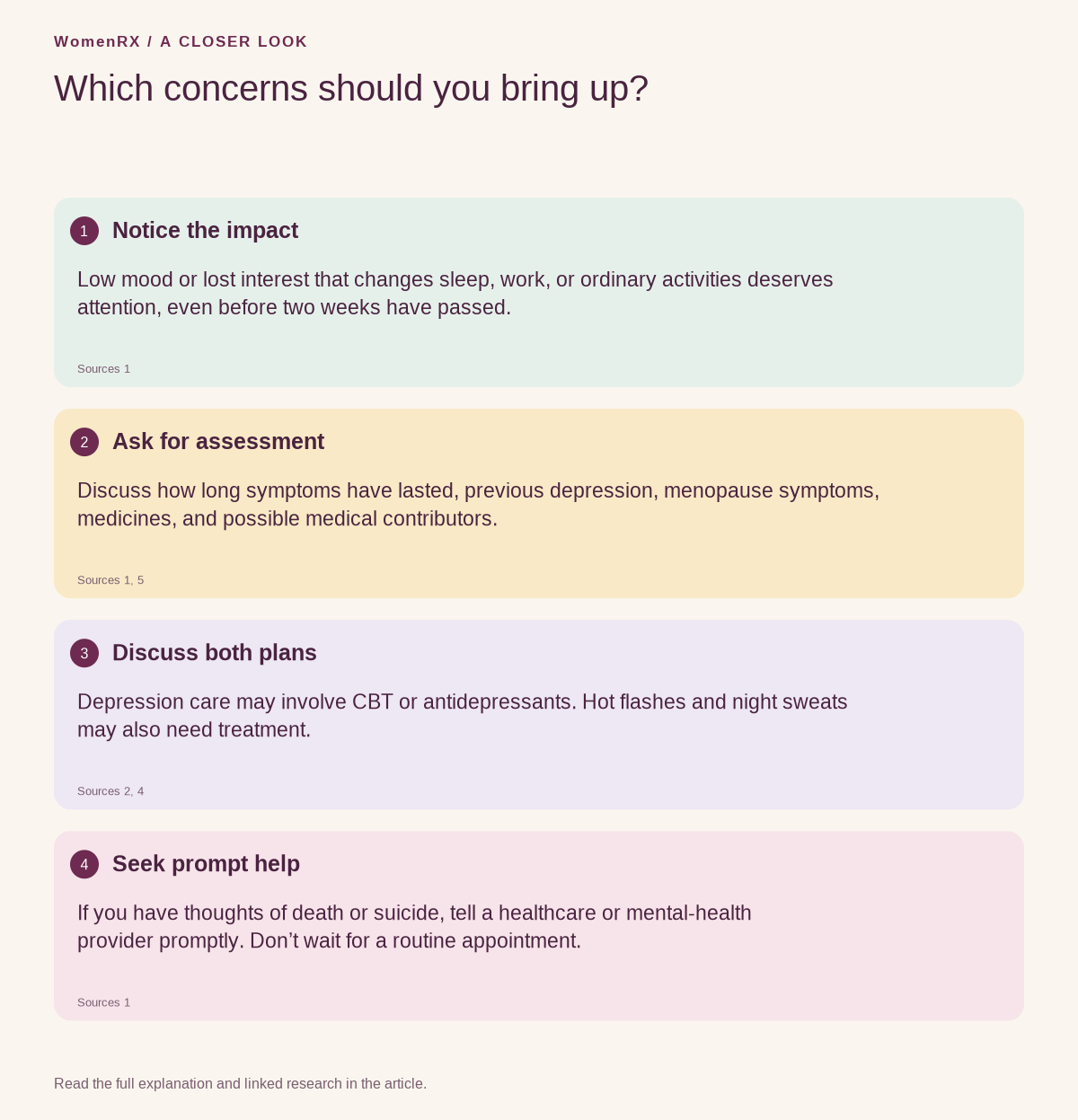
Which concerns should you bring up?
Notice the impact: Low mood or lost interest that changes sleep, work, or ordinary activities deserves attention, even before two weeks have passed.1
Ask for assessment: Discuss how long symptoms have lasted, previous depression, menopause symptoms, medicines, and possible medical contributors.15
Discuss both plans: Depression care may involve CBT or antidepressants. Hot flashes and night sweats may also need treatment.24
Seek prompt help: If you have thoughts of death or suicide, tell a healthcare or mental-health provider promptly. Don’t wait for a routine appointment.1
Read the figure as text
Use daily impact, not menopause timing alone, to decide whether to ask for an assessment.- Notice the impact: Low mood or lost interest that changes sleep, work, or ordinary activities deserves attention, even before two weeks have passed.1
- Ask for assessment: Discuss how long symptoms have lasted, previous depression, menopause symptoms, medicines, and possible medical contributors.15
- Discuss both plans: Depression care may involve CBT or antidepressants. Hot flashes and night sweats may also need treatment.24
- Seek prompt help: If you have thoughts of death or suicide, tell a healthcare or mental-health provider promptly. Don’t wait for a routine appointment.1
More questions, answered
Should I wait two weeks before asking for an assessment?
No. At least two weeks is part of the symptom pattern used to identify major depression, not a requirement for asking for help. Reach out sooner if symptoms are worsening or interfering with daily life. If you’re having thoughts of death or suicide, seek help promptly rather than waiting for a routine appointment. 1
Sources you can check
- Depression: MedlinePlusAccessed 2026-09-25Return to first citation
- The 2022 hormone therapy position statement of The North American Menopause Society.“The 2022 Hormone Therapy Position Statement of The North American Menopause Society” Advisory Panel. · Menopause (New York, N.Y.) · 2022Return to first citation
- The 2023 nonhormone therapy position statement of The North American Menopause Society.Menopause (New York, N.Y.) · 2023Return to first citation
- FIGO best practice recommendations for the mental health of women at menopausal age.Khadilkar S, Divakar H, Benedetto C, Genazzani A, Ramos D, Argale E, Deshpande G, Hicky M, Filho ALDS, Herrera E, Balkrishnan M. · International journal of gynaecology and obstetrics: the official organ of the International Federation of Gynaecology and Obstetrics · 2026Return to first citation
- The primary care management of perimenopausal depression.Kulkarni J, Cashell C, Harvey E, Chelvanayagam S, Gurvich C, Mu E. · Australian journal of general practice · 2026Return to first citation
- Functional neural changes linked to depression during the menopause transition and the effects of hormone therapy: A narrative review.Bondy E, Gibson K, Hynd M, Gray R, Nathan MD, Dichter GS, Schiller CE. · Progress in neuro-psychopharmacology & biological psychiatry · 2026Return to first citation
- Other medicines for menopause symptoms - NHSAccessed 2026-09-25Return to first citation
- Optimal doses of different exercise types for improving depressive symptoms in climacteric women: a systematic review and network meta-analysis.Wang H, Li S, Cui S, Wang Y, Zhu Y, Zhou R, Zhong Z, Zhang X, Xiao Z, Qin Q, Feng J, Wang P, Li D. · Frontiers in psychology · 2026Return to first citation
- The Role and Mechanism of Estrogen in Perimenopausal Depression.Liu Y, Fu X, Guan B, Cui R, Yang W. · Current neuropharmacology · 2026Return to first citation