Anxiety Around Menopause: When to Seek Help
Anxiety that disrupts daily life deserves attention, even when it starts during the menopause transition.
If anxiety is interfering with work, relationships, sleep, or everyday tasks, make an appointment with a primary care provider or mental health professional. Anxiety can be assessed and treated, and a clinician can check whether another health issue may be contributing. If you’re having suicidal thoughts, call or text 988 for crisis support. Menopause timing alone doesn’t establish the cause. 1 2 3
Anxiety can feel like persistent worry, tension, restlessness, or a racing heartbeat. It’s worth seeking help when it doesn’t ease, is getting worse, or is making daily life harder. You don’t need to prove that menopause caused it before asking for support. 3
First, separate crisis support from an appointment
If you’re having suicidal thoughts, call or text the 988 Suicide & Crisis Lifeline. The National Institute of Mental Health identifies thoughts of death or suicide among mental health warning signs and directs people with suicidal thoughts to 988. 1
If anxiety is affecting your ability to work, care for yourself, sleep, or maintain relationships, arrange an appointment rather than waiting for it to become unbearable. Changes in sleep or eating, severe mood changes that affect relationships, and difficulty managing everyday tasks are also signs worth raising with a provider. 2
Menopause may be part of the picture, but it isn’t a diagnosis
Symptoms alone can’t show what’s causing anxiety. The menopause transition may be part of the context, and NIMH identifies perimenopausal depression as a mental health concern around hormone change. That doesn’t establish that menopause causes anxiety. A change in timing is useful information for an assessment, not proof that hormones are the cause. 1 3
At an appointment, a provider can ask about your symptoms and health history, and may consider an exam or lab tests to check whether another health problem could explain them. A psychological evaluation may also help clarify whether anxiety fits an anxiety disorder or another concern. 3
Make the appointment about the whole pattern
You might jot down a few details before you go. This isn’t a diagnostic checklist; it’s a way to make the conversation more specific:
- When the anxiety started and whether it comes and goes or feels persistent.
- What it feels like for you, including physical sensations or thoughts that are hard to control.
- How it affects sleep, work, relationships, or daily tasks.
- Any changes you’ve noticed in menstrual patterns, hot flashes, sleep, or mood. These details help describe what else is happening at the same time; they don’t establish a cause.
- Your health history and medications or supplements, so the provider can consider the broader picture.
A useful opening could be: “My anxiety has changed recently, and it’s affecting _. I’m also noticing _.” Then ask what else could contribute, whether an assessment or tests make sense, and which treatment options fit your needs.
Ask about treatments for anxiety, not just menopause symptoms
Psychotherapy and medication are common treatment approaches for anxiety disorders. Cognitive behavioral therapy (CBT) works on changing patterns of thought and behavior that contribute to anxiety. Some antidepressants and anti-anxiety medicines are also used; the choice depends on the person and the type of anxiety. 3
Menopausal hormone therapy is a separate discussion. In a study of women treated in early postmenopause, a specific hormone therapy formulation was associated with mood benefits compared with placebo. That finding does not establish menopausal hormone therapy as a treatment for anxiety, or as the right choice for everyone. Ask your provider to distinguish options aimed at anxiety from options considered for other menopause-related concerns. 4
You can start with primary care if you’re unsure where to go. A primary care provider can assess the concern and refer you to a mental health professional when appropriate. 1
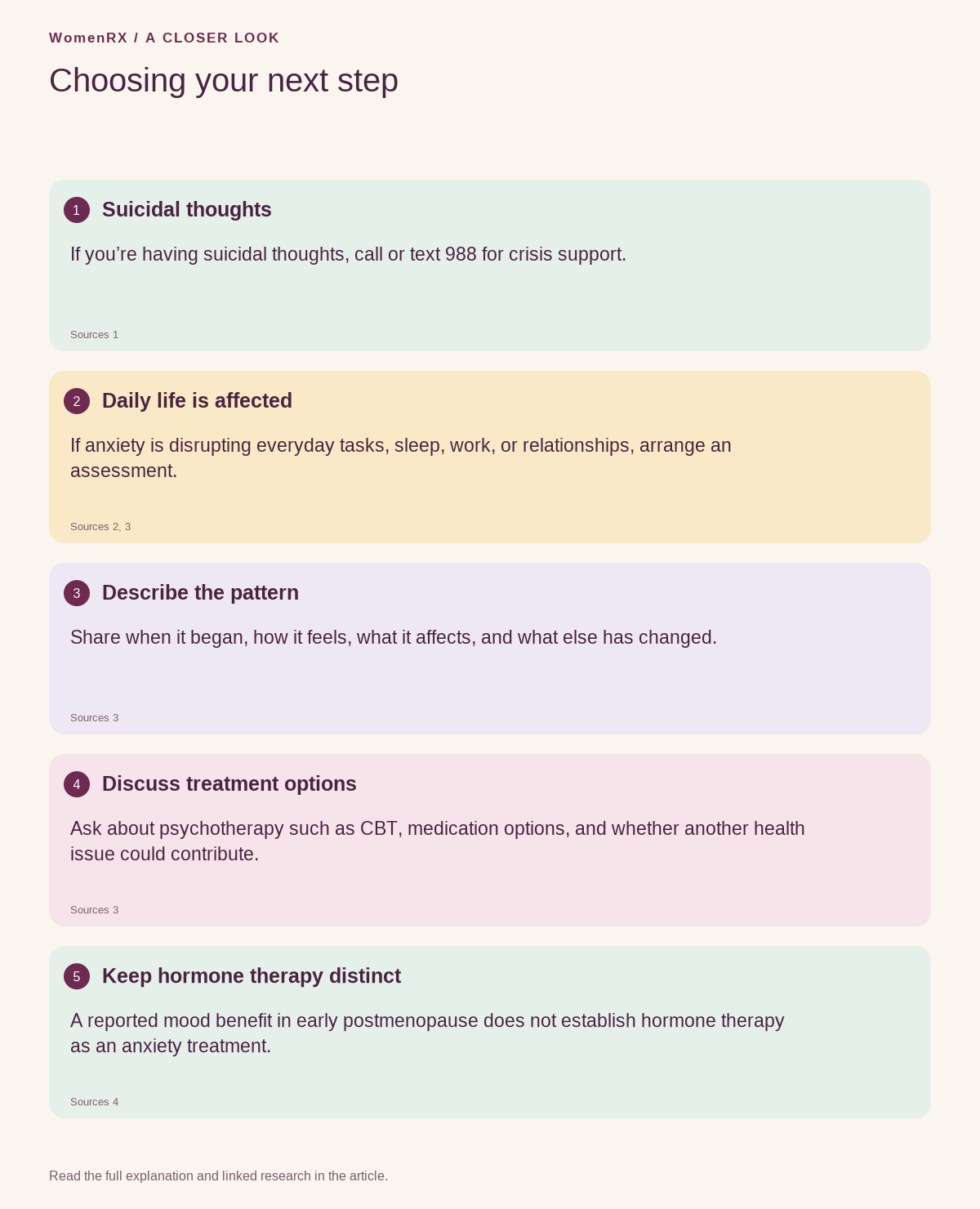
Choosing your next step
Suicidal thoughts: If you’re having suicidal thoughts, call or text 988 for crisis support.1
Daily life is affected: If anxiety is disrupting everyday tasks, sleep, work, or relationships, arrange an assessment.23
Describe the pattern: Share when it began, how it feels, what it affects, and what else has changed.3
Discuss treatment options: Ask about psychotherapy such as CBT, medication options, and whether another health issue could contribute.3
Keep hormone therapy distinct: A reported mood benefit in early postmenopause does not establish hormone therapy as an anxiety treatment.4
Read the figure as text
A simple route from safety concerns to a useful routine appointment, without treating menopause timing as a diagnosis.- Suicidal thoughts: If you’re having suicidal thoughts, call or text 988 for crisis support.1
- Daily life is affected: If anxiety is disrupting everyday tasks, sleep, work, or relationships, arrange an assessment.23
- Describe the pattern: Share when it began, how it feels, what it affects, and what else has changed.3
- Discuss treatment options: Ask about psychotherapy such as CBT, medication options, and whether another health issue could contribute.3
- Keep hormone therapy distinct: A reported mood benefit in early postmenopause does not establish hormone therapy as an anxiety treatment.4
More questions, answered
Should I wait to see whether menopause-related anxiety passes?
You don’t have to wait if anxiety is worsening or interfering with daily life. A provider can assess your symptoms and consider other possible causes; the timing alone doesn’t identify the cause. 2 3
Does hormone therapy treat anxiety?
A study finding a mood benefit in early postmenopause does not establish menopausal hormone therapy as an anxiety treatment. Mood and anxiety are different outcomes. 4
Sources you can check
- NIMH: Women and mental healthAccessed 2026-09-25Return to first citation
- Mental Health: MedlinePlusAccessed 2026-09-25Return to first citation
- Anxiety: MedlinePlusAccessed 2026-09-25Return to first citation
- Long-term cognitive effects of menopausal hormone therapy: Findings from the KEEPS Continuation Study.Gleason CE, Dowling NM, Kara F, James TT, Salazar H, Ferrer Simo CA, Harman SM, Manson JE, Hammers DB, Naftolin FN, Pal L, Miller VM, Cedars MI, Lobo RA, Malek-Ahmadi M, Kantarci K... · PLoS medicine · 2024Return to first citation