Depression During Menopause: Signs and Support
Mood changes can accompany the menopause transition, but depression that persists and disrupts daily life deserves care in its own right.
Depression is more than a few difficult days: symptoms such as low mood or loss of interest that occur most of the day, nearly every day, for at least two weeks and interfere with daily life warrant an assessment. Perimenopause can be a vulnerable time, especially with a history of depression. Psychotherapy and antidepressants are established treatments; care for hot flashes may be considered alongside them, not instead of them. 2 6
When a low stretch may be depression
A rough week can leave you irritable, tired, or unlike yourself. Depression is more concerning when low mood or loss of interest persists most of the day, nearly every day, for at least two weeks, and starts making everyday activities harder. Changes in sleep, eating, thinking, or ability to work can be part of the picture. The two-week threshold is a guide for assessment, not a reason to wait if you’re struggling or getting worse. 2
Thoughts of death or suicide, or a major change in behavior, are warning signs. If you might act on suicidal thoughts or can’t keep yourself safe, seek emergency help now. 2 3
Why the menopause stage matters
Perimenopause, including early postmenopause, can be a window of vulnerability for depressive symptoms and major depressive episodes. That does not mean depression is inevitable, or that every mood change is caused by hormones. Many midlife women who experience a major depressive episode during this period have had a previous episode. 6
Hot flashes, disrupted sleep, and life stress can occur alongside depression and make its effects harder to sort out. A useful assessment considers menopause stage, mood symptoms, sleep and other menopause symptoms, psychosocial pressures, and other possible explanations. Some medical conditions and medicines can cause depression-like symptoms, so an evaluation may include checking for those causes. 2 6
Treatment for depression, and treatment for hot flashes
Psychotherapy and antidepressants are front-line treatments for perimenopausal depression. Talk therapy can help you work with difficult thoughts, feelings, and behaviors and develop coping strategies. Antidepressants are another established option. The right choice depends on your symptoms, health history, preferences, and possible side effects; some people use both approaches. 2 6
Antidepressants don’t work the same way for everyone. It may take time to find one that helps, and side effects such as sexual problems can matter to your quality of life. If a medicine isn’t helping or its effects are difficult to manage, discuss options with the prescriber rather than stopping or changing it on your own. 1
Hot-flash care is a separate part of the decision. Menopause guidance recognizes hormone therapy as the most effective treatment for bothersome vasomotor symptoms, while SSRIs and SNRIs are among the evidence-supported nonhormonal options. A treatment chosen for hot flashes may also be considered in the context of depression care, but relief of hot flashes alone doesn’t establish that depression is being treated. Hormone therapy isn’t approved as a treatment for perimenopausal depression. Research suggests estrogen may have antidepressant effects for some perimenopausal women, particularly those with hot flashes; evidence on estrogen combined with progestin is sparse and inconclusive. 4 5 6
So if both low mood and hot flashes are affecting you, name both. The choice to use hormone therapy depends on the reason for treatment and an individualized consideration of benefits and risks; it shouldn’t be treated as a substitute for established depression care. 4 6
Where exercise and supplements fit
A 2025 systematic review and meta-analysis of 21 studies involving 2,020 participants found lower depressive-symptom scores with physical activity than with comparison groups. The studies covered women in different menopause stages, and the result concerns symptom scores, not proof that exercise alone treats clinical depression. Physical activity can be a supportive part of care, but it shouldn’t delay assessment or replace psychotherapy or medication when those are needed. 7
Research on nutritional interventions is less clear about which specific approach helps. A review found varied interventions and meaningful differences in study quality and methods, leaving the effects of particular supplements uncertain. Don’t rely on a supplement as a substitute for depression treatment. 8
A useful next move
You don’t need to decide whether hormones, life stress, or depression is the single explanation before asking for help. Describe how long the change has lasted, what has become difficult, whether sleep or hot flashes are involved, and whether you’ve had depression before. Those details help guide an assessment and a treatment discussion that addresses both mood and menopause symptoms. 2 6
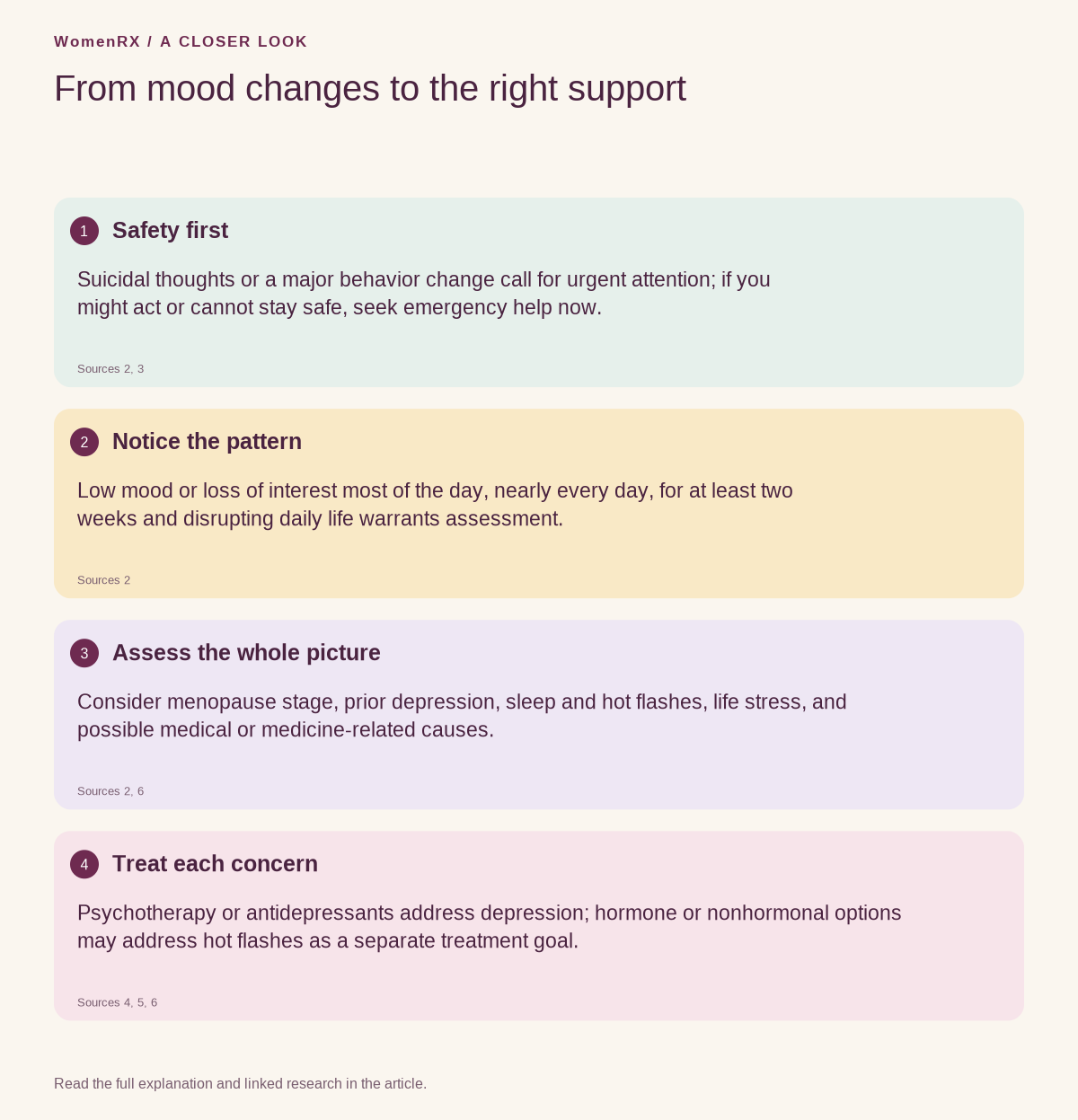
From mood changes to the right support
Safety first: Suicidal thoughts or a major behavior change call for urgent attention; if you might act or cannot stay safe, seek emergency help now.23
Notice the pattern: Low mood or loss of interest most of the day, nearly every day, for at least two weeks and disrupting daily life warrants assessment.2
Assess the whole picture: Consider menopause stage, prior depression, sleep and hot flashes, life stress, and possible medical or medicine-related causes.26
Treat each concern: Psychotherapy or antidepressants address depression; hormone or nonhormonal options may address hot flashes as a separate treatment goal.456
Read the figure as text
A simple decision path separates urgent safety needs, depression assessment, and treatment for co-occurring hot flashes.- Safety first: Suicidal thoughts or a major behavior change call for urgent attention; if you might act or cannot stay safe, seek emergency help now.23
- Notice the pattern: Low mood or loss of interest most of the day, nearly every day, for at least two weeks and disrupting daily life warrants assessment.2
- Assess the whole picture: Consider menopause stage, prior depression, sleep and hot flashes, life stress, and possible medical or medicine-related causes.26
- Treat each concern: Psychotherapy or antidepressants address depression; hormone or nonhormonal options may address hot flashes as a separate treatment goal.456
Sources you can check
- Antidepressants | Depression Medicines | MedlinePlusAccessed 2026-09-25Return to first citation
- Depression: MedlinePlusAccessed 2026-09-25Return to first citation
- Antidepressants - NHSAccessed 2026-09-25Return to first citation
- The 2022 hormone therapy position statement of The North American Menopause Society.“The 2022 Hormone Therapy Position Statement of The North American Menopause Society” Advisory Panel. · Menopause (New York, N.Y.) · 2022Return to first citation
- The 2023 nonhormone therapy position statement of The North American Menopause Society.Menopause (New York, N.Y.) · 2023Return to first citation
- Guidelines for the evaluation and treatment of perimenopausal depression: summary and recommendations.Maki PM, Kornstein SG, Joffe H, Bromberger JT, Freeman EW, Athappilly G, Bobo WV, Rubin LH, Koleva HK, Cohen LS, Soares CN, Board of Trustees for The North American Menopause Socie... · Menopause (New York, N.Y.) · 2018Return to first citation
- Effects of physical activity on depressive and anxiety symptoms of women in the menopausal transition and menopause: a comprehensive systematic review and meta-analysis of randomized controlled trials.Yue H, Yang Y, Xie F, Cui J, Li Y, Si M, Li S, Yao F. · The international journal of behavioral nutrition and physical activity · 2025Return to first citation
- Effects of nutritional interventions on the severity of depressive and anxiety symptoms of women in the menopausal transition and menopause: a systematic review, meta-analysis, and meta-regression.Grigolon RB, Ceolin G, Deng Y, Bambokian A, Koning E, Fabe J, Lima M, Gerchman F, Soares CN, Brietzke E, Gomes FA. · Menopause (New York, N.Y.) · 2023Return to first citation