Depression Around Menopause: What Needs Care Now
Low mood can overlap with menopause symptoms, but persistent depression deserves its own assessment and treatment.
A rough few days and depression aren’t the same thing. If low mood or loss of interest affects daily life for at least two weeks, seek a depression assessment rather than assuming it’s menopause. Treatment may include psychotherapy or an antidepressant; hot flashes and disrupted sleep can be addressed too, but treating them isn’t a substitute for depression care. If you’re thinking about suicide, get help right away. 32
When low mood is more than a rough patch
Perimenopause can bring mood changes alongside hot flashes and broken sleep. That overlap can make it hard to tell what needs attention first. Depression is more than feeling sad or irritable for a few days: it can change how you think and feel, drain your interest in things you usually enjoy, and make ordinary activities such as working, eating or sleeping difficult. A clinician assessing depression will ask whether depressed mood or loss of interest has been present most of the day, nearly every day, for at least two weeks. You don’t need to wait two weeks to reach out if you’re struggling. 35
Think about what happens beyond a bad night. For example, waking hot and exhausted may leave you short-tempered the next day. If you’re also losing interest in people and activities, or finding it hard to function even on better-rested days, those symptoms deserve a depression assessment. Sleep trouble and depression can occur together; sorting one from the other isn’t a test you have to pass before asking for help. 35
If you’re thinking about hurting yourself or suicide, get help right away. In the US, call or text 988 for the Suicide & Crisis Lifeline. If you’re in immediate danger, call 911. 23
Why the assessment looks beyond hormones
Hormonal changes are one part of the picture, not a complete explanation for depression. Biological, psychological and environmental factors can all contribute. A depression assessment considers your symptoms and medical history, including medicines and conditions that can resemble depression; thyroid disorders are one example. Mention a previous episode of depression, including one around pregnancy or after birth, so the clinician understands your history rather than treating today’s symptoms as an isolated menopause complaint. 3
Night sweats are worth describing specifically, too. Menopause-related hot flashes are one possible cause, but anxiety and some medicines, including antidepressants, can also cause night sweats. Regularly waking with soaked clothes or sheets warrants a medical assessment, particularly if you also have a fever, cough or unexplained weight loss. That doesn’t mean your mood symptoms are just a consequence of poor sleep. It means both problems deserve a fair look. 13
This distinction still matters after menopause. Depression can happen at any age, while studies of women in perimenopause and postmenopause also describe sleep disturbance and depressive symptoms. The timing of your last period is useful context, not a diagnosis or a reason to dismiss persistent symptoms. 356
Match the care to the problem
For depression, ask about depression treatment. Psychotherapy can help you work with troubling thoughts, emotions and behaviors. Antidepressants are another option; finding one that helps may take time, and side effects can matter. For example, SSRIs and SNRIs can cause nausea, agitation or a reduced sex drive. Those tradeoffs belong in a treatment conversation, especially if sexual changes or poor sleep are already bothering you. 37
For hot flashes, address hot flashes. Menopause treatment has a different job. In a 12-week trial of 183 postmenopausal women, an estradiol-and-levonorgestrel patch formulation relieved moderate to severe hot flashes better than placebo at weeks 4 and 12. That finding supports treatment of hot flashes, not use of the patch as a replacement for depression care. The right approach to menopause symptoms depends on your health history and which symptoms are most disruptive. 4
For disrupted sleep, name what’s waking you. A systematic review of 12 studies in perimenopausal and postmenopausal women with significant hot flashes or night sweats found that most studies reported better sleep with cognitive behavioral approaches or clinical hypnosis aimed at menopause symptoms. Sleep was a secondary outcome in those studies. This is a reason to take sleep seriously, not evidence that treating sleep alone treats clinical depression. 5
Movement may be another useful part of ongoing support. A review of 21 randomized trials involving 2,020 women in the menopausal transition or after menopause found that physical activity improved depressive symptom scores compared with control groups. The studies don’t establish exercise as a stand-alone treatment for a diagnosed depressive disorder. If activity feels manageable, it can be one part of care rather than another task you must complete before getting help. 6
The next move is to describe the whole pattern: your mood and interest, how daily life has changed, your sleep and hot flashes, and any past depression. That gives you and a clinician room to address depression directly while also treating menopause symptoms that are making the days harder. 35
Match the next step to the symptom
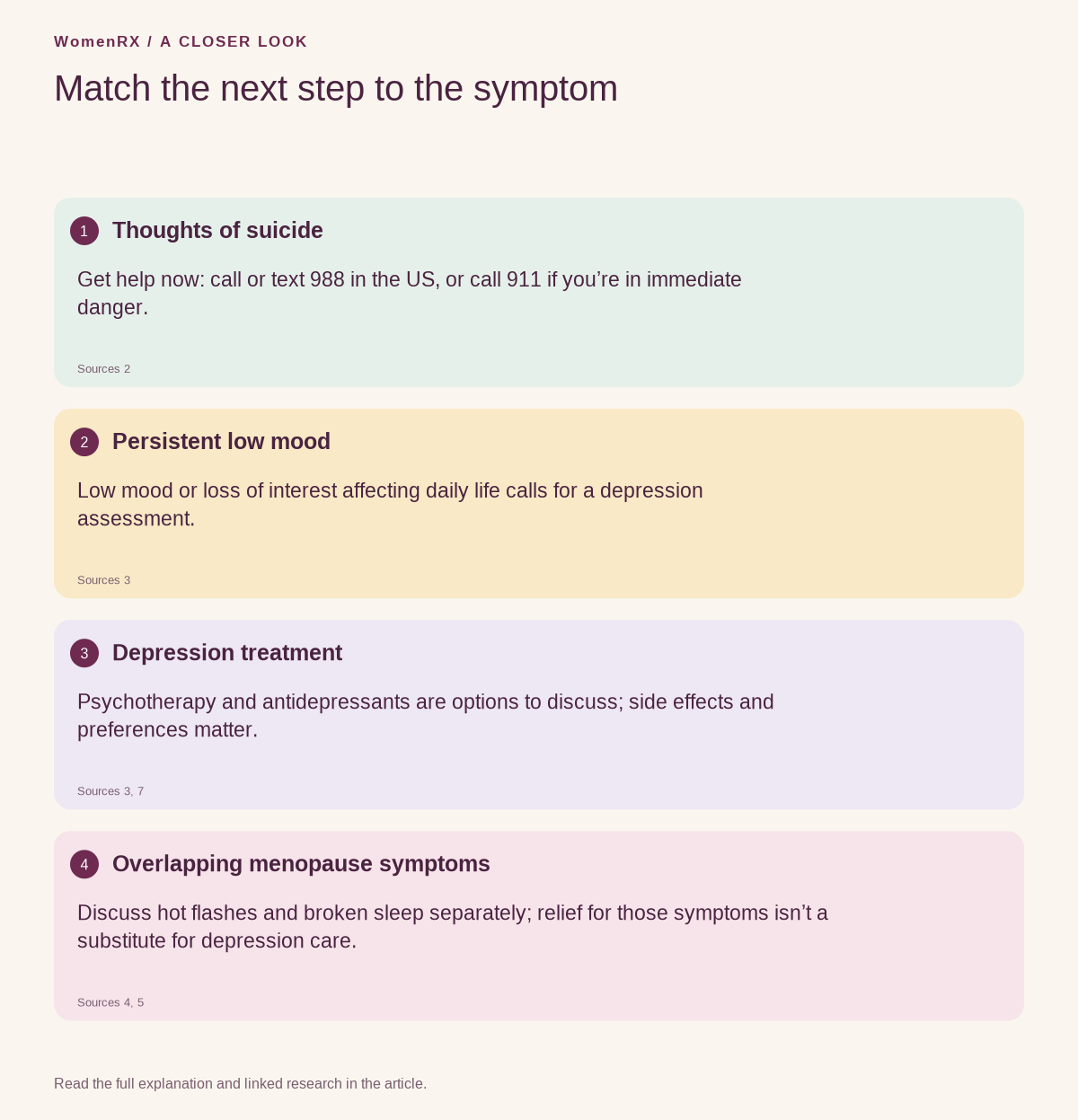
Thoughts of suicide: Get help now: call or text 988 in the US, or call 911 if you’re in immediate danger.2
Persistent low mood: Low mood or loss of interest affecting daily life calls for a depression assessment.3
Depression treatment: Psychotherapy and antidepressants are options to discuss; side effects and preferences matter.37
Overlapping menopause symptoms: Discuss hot flashes and broken sleep separately; relief for those symptoms isn’t a substitute for depression care.45
Read the figure as text
Mood, sleep and hot flashes can overlap, but they don’t all call for the same care.- Thoughts of suicide: Get help now: call or text 988 in the US, or call 911 if you’re in immediate danger.2
- Persistent low mood: Low mood or loss of interest affecting daily life calls for a depression assessment.3
- Depression treatment: Psychotherapy and antidepressants are options to discuss; side effects and preferences matter.37
- Overlapping menopause symptoms: Discuss hot flashes and broken sleep separately; relief for those symptoms isn’t a substitute for depression care.45
Sources you can check
- Night sweats - NHSAccessed 2026-09-25Return to first citation
- Suicide: MedlinePlusAccessed 2026-09-25Return to first citation
- Depression: MedlinePlusAccessed 2026-09-25Return to first citation
- CLIMARA PRO (ESTRADIOL AND LEVONORGESTREL) PATCH [BAYER HEALTHCARE PHARMACEUTICALS INC.] | US prescribing information and patient instructionsAccessed 2026-09-25Return to first citation
- Sleep effects of psychological therapies for menopausal symptoms in women with hot flashes and night sweats: A systematic review.Carmona NE, Starick E, Millett GE, Green SM, Carney CE. · Post reproductive health · 2024Return to first citation
- Effects of physical activity on depressive and anxiety symptoms of women in the menopausal transition and menopause: a comprehensive systematic review and meta-analysis of randomized controlled trials.Yue H, Yang Y, Xie F, Cui J, Li Y, Si M, Li S, Yao F. · The international journal of behavioral nutrition and physical activity · 2025Return to first citation
- Other medicines for menopause symptoms - NHSAccessed 2026-09-25Return to first citation