Depression Around Menopause: How Strong Is the Estrogen Link?
Hormonal changes may be part of the picture, but they don’t prove that estrogen is causing your low mood or that hormone therapy is the right treatment.
Depression can occur during the menopause transition, and changing hormones may contribute for some women. But a possible link isn’t proof that estrogen is the cause, and hormone therapy isn’t an established stand-alone depression treatment. The next step is to assess the mood symptoms themselves while also discussing menopause symptoms and treatment goals separately. 1 2 4
The connection is plausible, not a diagnosis
Depression has several possible contributors, including biological, psychological, and environmental factors. MedlinePlus notes that hormonal changes during menopause may be one factor in women’s depression, but that doesn’t tell you what is causing one person’s symptoms. A low mood during perimenopause deserves attention whether or not it seems connected to the menstrual cycle or other menopause changes. 1
A 2026 narrative review describes possible mood benefits from estrogen therapy, especially transdermal estradiol during perimenopause, but says the evidence is less clear for depression after menopause. The review also describes uncertainty across different hormone formulations. This is a reason to keep the question open, not a basis for assuming estrogen will treat depression. 4
What the treatment studies can, and can’t, show
One small randomized pilot study tested bazedoxifene plus conjugated estrogen against placebo for 12 weeks in 37 women. Both groups’ scores improved on a standard depression rating scale, with no significant difference between groups. On a menopause-specific depression scale, the hormone-therapy group improved more than the placebo group. The finding is worth studying, but the small pilot and its differing results across rating scales don’t establish hormone therapy as a general depression treatment. Nor do they show that other estrogen products have the same effect. 3
The North American Menopause Society’s 2022 position statement describes hormone therapy as an effective treatment for hot flashes and other vasomotor symptoms and for genitourinary symptoms, and as a way to prevent bone loss. It says the balance of benefits and risks depends on factors such as type, route, timing, duration, and whether a progestogen is used. These established menopause-related treatment goals are different from treating depression. 2
In practice, it helps to name the goals separately: Are you seeking help for depression, menopause symptoms, or both? If you also have bothersome hot flashes or genitourinary symptoms, hormone therapy may be discussed for those symptoms, with its own benefits and risks. A possible mood effect shouldn’t replace a plan to assess and treat depression. 2 3
Don’t wait for the hormone question to be settled
Depression is more than feeling sad or irritable for a few days. Symptoms can include depressed mood or loss of interest that affects daily life. A depression assessment considers how long symptoms have lasted, their impact, and your health history. Medical conditions, including thyroid disorders, and some medicines can cause symptoms that resemble depression. 1
If symptoms are present most of the day, nearly every day, for at least two weeks, especially with loss of interest or difficulty managing daily activities, raise them with a medical or mental health provider. That assessment can help distinguish depression from other causes and identify care options. MedlinePlus describes psychotherapy and medication as common treatments; which options fit depends on the individual assessment. 1
A useful conversation can cover two questions at once: “Could menopause symptoms be contributing to how I feel?” and “What is the plan for assessing and treating my depression symptoms?” If hormone therapy is being considered, clarify which menopause symptoms it is intended to address and how its benefits and risks fit your circumstances. There’s no need to postpone depression care while trying to determine whether estrogen is involved. 1 2
If you’re thinking about hurting yourself or attempting suicide, get help right away. If there’s an emergency, call 911. 1
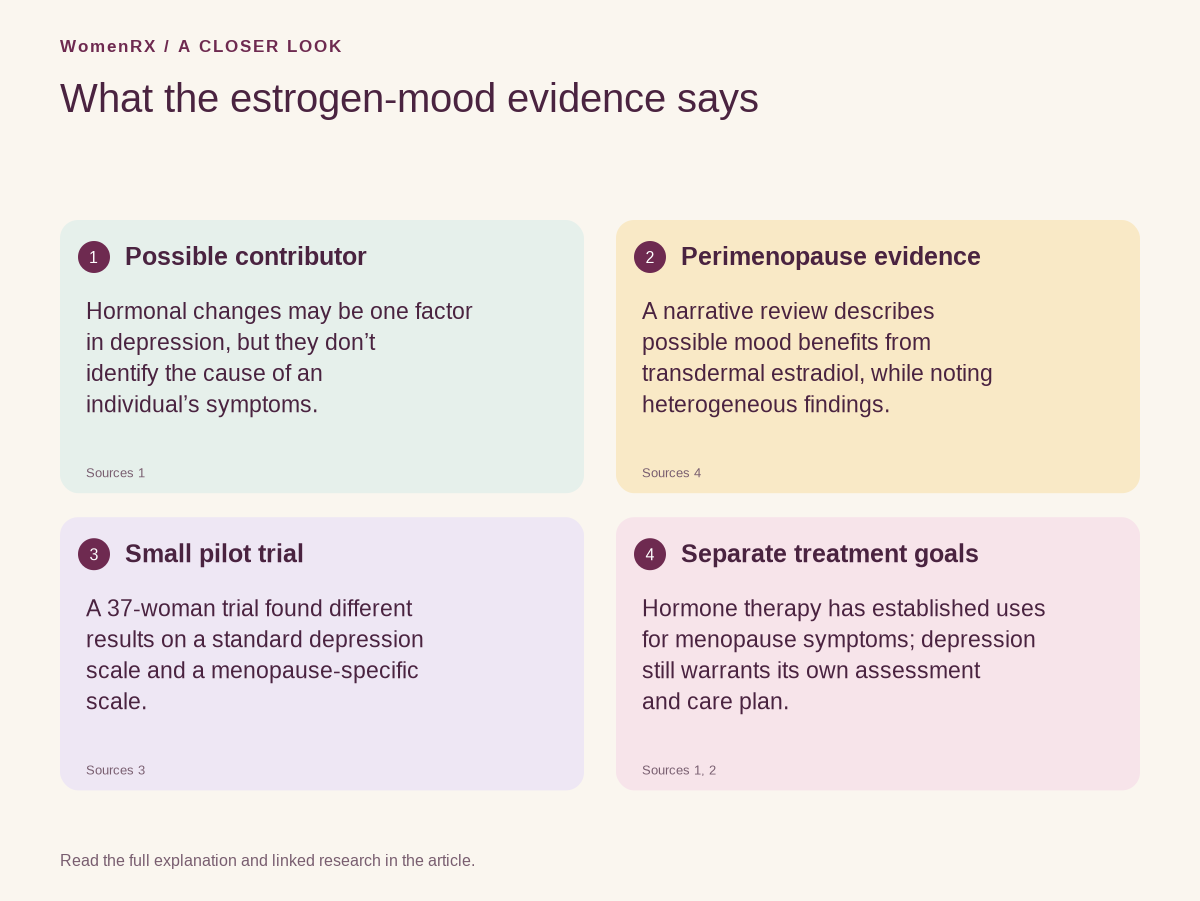
What the estrogen-mood evidence says
Possible contributor: Hormonal changes may be one factor in depression, but they don’t identify the cause of an individual’s symptoms.1
Perimenopause evidence: A narrative review describes possible mood benefits from transdermal estradiol, while noting heterogeneous findings.4
Small pilot trial: A 37-woman trial found different results on a standard depression scale and a menopause-specific scale.3
Separate treatment goals: Hormone therapy has established uses for menopause symptoms; depression still warrants its own assessment and care plan.12
Read the figure as text
These distinctions separate a possible menopause-related contribution from the limited evidence for hormone therapy as depression treatment.- Possible contributor: Hormonal changes may be one factor in depression, but they don’t identify the cause of an individual’s symptoms.1
- Perimenopause evidence: A narrative review describes possible mood benefits from transdermal estradiol, while noting heterogeneous findings.4
- Small pilot trial: A 37-woman trial found different results on a standard depression scale and a menopause-specific scale.3
- Separate treatment goals: Hormone therapy has established uses for menopause symptoms; depression still warrants its own assessment and care plan.12
More questions, answered
Does estrogen treat depression after menopause?
The evidence is less clear for depression after menopause than for possible mood benefits during perimenopause. A small pilot study of one combined hormone treatment had mixed results across depression rating scales, so it doesn’t establish estrogen as a general depression treatment. 3 4
How is depression different from a brief mood change?
Depression can involve low mood or loss of interest that affects daily life, rather than a few days of feeling sad or irritable. Assessment considers symptom duration and impact; symptoms occurring most of the day, nearly every day, for at least two weeks are a reason to raise the concern. 1
Sources you can check
- Depression: MedlinePlusAccessed 2026-09-25Return to first citation
- The 2022 hormone therapy position statement of The North American Menopause Society.“The 2022 Hormone Therapy Position Statement of The North American Menopause Society” Advisory Panel. · Menopause (New York, N.Y.) · 2022Return to first citation
- Bazedoxifene plus conjugated estrogen to treat menopausal depression-A pilot study.Kulkarni J, Mu E, Li Q, Malicka M, Gavrilidis E, de Castella A, Gurvich C. · The Journal of pharmacology and experimental therapeutics · 2025Return to first citation
- The role of hormone replacement therapy in the management of perimenopausal mental health symptoms: A narrative review.Langhe R, Kelly T, Ibrahim R, Al-Janabi R, Mohammed G, Mousa N. · International journal of gynaecology and obstetrics: the official organ of the International Federation of Gynaecology and Obstetrics · 2026Return to first citation