Can Estrogen Therapy Help Mood Symptoms Around Menopause?
Hormone therapy may ease some mood symptoms, but evidence differs by menopause stage and doesn’t establish it as treatment for depression.
Menopausal hormone therapy may improve some mood symptoms, but it isn’t an established treatment for depressive illness. A review describes a possible estradiol benefit during perimenopause, while evidence for postmenopausal depression is less clear. Mood symptoms that last, disrupt daily life, or feel severe deserve direct attention rather than being assumed to be caused by menopause. 1 5
Low mood, irritability, anxiety, or feeling emotionally worn down can happen around menopause. The timing may be relevant, but it doesn’t establish the cause or mean estrogen therapy is the right treatment. It helps to distinguish mood changes occurring alongside menopause symptoms from depression that needs direct assessment.
When mood symptoms may need more than a menopause explanation
Mood changes can occur during the menopause transition, sometimes alongside sleep problems. But a few difficult days aren’t the same as depression. MedlinePlus describes major depression symptoms as depressed mood or loss of interest that affects daily activities and occurs most of the day, nearly every day, for at least two weeks. Some medicines and medical conditions, including thyroid disorders, can also cause symptoms that resemble depression. 1
For example, irritability that comes and goes with other menopause symptoms is useful context, but it doesn’t rule depression in or out. Depression can happen at any age, and hormonal changes related to menstruation, pregnancy, the postpartum period, and menopause may be among several contributing factors. 1
What hormone-therapy research says about mood
A 2026 systematic review and meta-analysis combined 51 randomized trials of hormone therapy, involving 41,821 participants, and reported improvement in psychological symptoms overall. Those outcomes covered more than depression alone, and some significant findings did not hold up to further statistical checks. So the results suggest possible benefit for some symptoms, but don’t establish hormone therapy as a treatment for depressive illness or predict how it will affect you. 3
Menopause stage may matter, but the evidence doesn’t settle the question. A narrative review describes a possible antidepressant effect of estradiol during perimenopause and says its efficacy for postmenopausal depression is less clear. The meta-analysis reported stage-related differences for some outcomes, but those differences do not establish a benefit for postmenopausal depression. 3 5
A retrospective study from a UK specialist clinic adds another piece of evidence, but it answers a different question. Among 920 peri- and postmenopausal women, mean mood-symptom scores decreased by 44.59% after hormone therapy was started or optimized; the average follow-up was 107 days. Because the study looked back at care rather than randomly assigning treatment, it cannot show that hormone therapy caused the improvement. It’s an observation, not proof of an antidepressant effect. 4
The reason for considering therapy matters
The North American Menopause Society identifies hormone therapy as an effective treatment for bothersome hot flashes and night sweats, and for genitourinary symptoms of menopause; it can also prevent bone loss. The route matters: systemic therapy is used for symptoms such as hot flashes, while low-dose vaginal estrogen is an option for bothersome genitourinary symptoms when systemic hormone therapy isn’t indicated. These are distinct uses, and the position statement does not establish mood treatment as a primary reason to start hormone therapy. 2
The balance of benefits and risks varies with factors including the type of therapy, timing, and a person’s health. The position statement recommends individualized decisions and periodic reassessment. If mood symptoms occur alongside bothersome menopause symptoms, it may make sense to discuss both. But treating hot flashes or vaginal symptoms doesn’t guarantee that depression will improve. 2
Keep mood care in the picture
If low mood or loss of interest lasts, disrupts daily life, or feels severe, ask about an assessment for depression rather than assuming menopause therapy will address it. Hormone therapy and depression treatment aren’t interchangeable. Your symptom pattern, how long it has been going on, menopause stage, and mental-health history all help shape the conversation. 1 5
If you’re already receiving mental-health care, don’t stop or replace it on the assumption that hormones will take its place. Discuss mood symptoms and menopause concerns together so each can be considered directly. If you’re thinking about suicide or hurting yourself, get help right away; if there’s immediate danger, call 911. 1
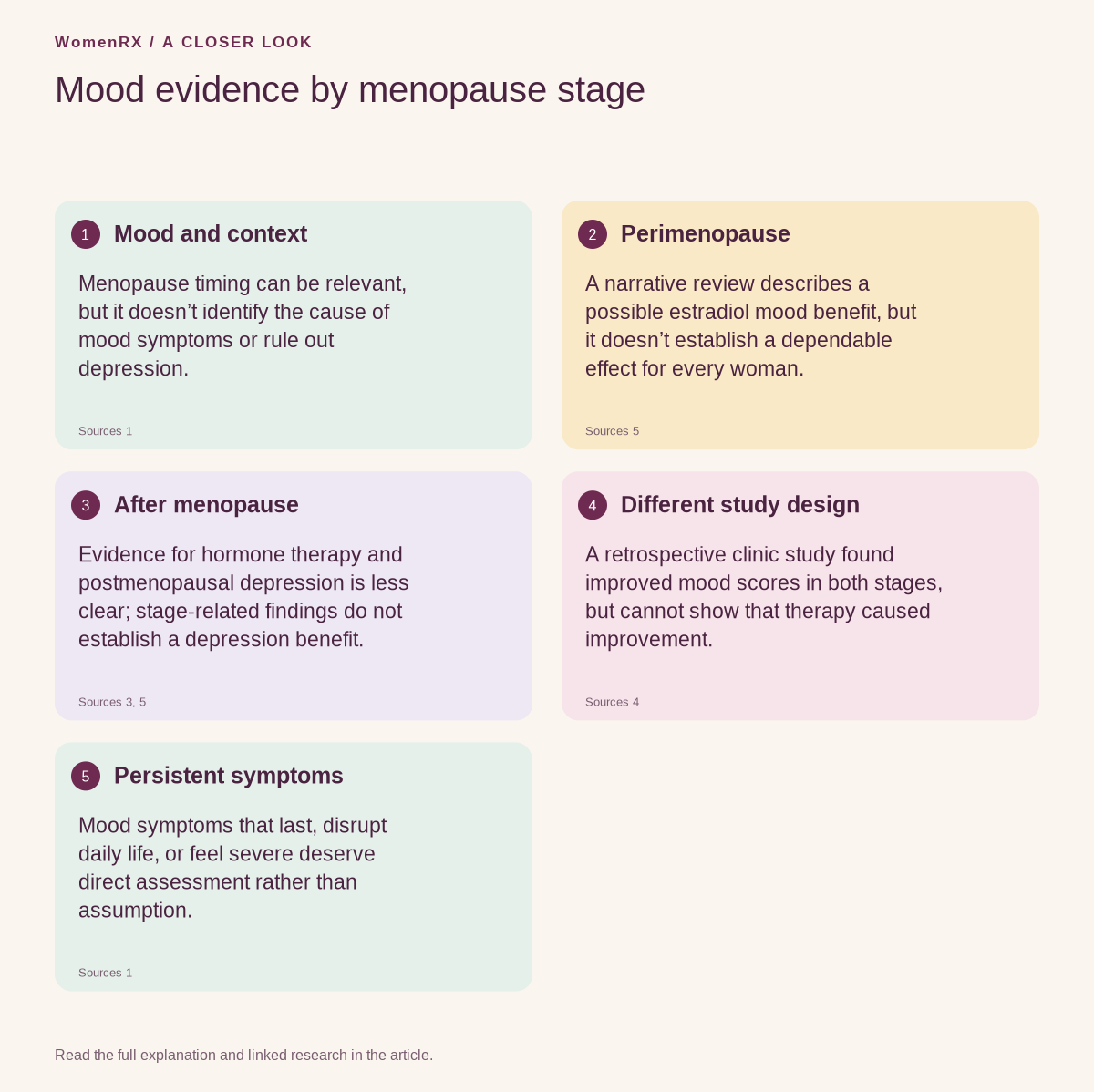
Mood evidence by menopause stage
Mood and context: Menopause timing can be relevant, but it doesn’t identify the cause of mood symptoms or rule out depression.1
Perimenopause: A narrative review describes a possible estradiol mood benefit, but it doesn’t establish a dependable effect for every woman.5
After menopause: Evidence for hormone therapy and postmenopausal depression is less clear; stage-related findings do not establish a depression benefit.35
Different study design: A retrospective clinic study found improved mood scores in both stages, but cannot show that therapy caused improvement.4
Persistent symptoms: Mood symptoms that last, disrupt daily life, or feel severe deserve direct assessment rather than assumption.1
Read the figure as text
This evidence map separates what menopause-stage findings suggest from what they can establish about depression and hormone therapy.- Mood and context: Menopause timing can be relevant, but it doesn’t identify the cause of mood symptoms or rule out depression.1
- Perimenopause: A narrative review describes a possible estradiol mood benefit, but it doesn’t establish a dependable effect for every woman.5
- After menopause: Evidence for hormone therapy and postmenopausal depression is less clear; stage-related findings do not establish a depression benefit.35
- Different study design: A retrospective clinic study found improved mood scores in both stages, but cannot show that therapy caused improvement.4
- Persistent symptoms: Mood symptoms that last, disrupt daily life, or feel severe deserve direct assessment rather than assumption.1
More questions, answered
Is estrogen more likely to help mood during perimenopause than after menopause?
A narrative review describes a possible antidepressant effect of estradiol during perimenopause and says its efficacy for postmenopausal depression is less clear. A retrospective clinic study reported improvement in both groups, but it can’t show that hormone therapy caused the change. 4 5
Can hormone therapy replace depression treatment?
The available evidence doesn’t establish hormone therapy as a treatment for depressive illness. If you’re receiving mental-health care, don’t treat hormones as a substitute; discuss mood symptoms and treatment choices together. 1 3
Sources you can check
- Depression: MedlinePlusAccessed 2026-09-25Return to first citation
- The 2022 hormone therapy position statement of The North American Menopause Society.“The 2022 Hormone Therapy Position Statement of The North American Menopause Society” Advisory Panel. · Menopause (New York, N.Y.) · 2022Return to first citation
- Efficacy of hormone therapy and phytoestrogens on the psychological symptoms of menopausal women: a systematic review, meta-analysis, and trial sequential analysis.Shou M, Ye M, Lou C, Chen X, Yao Y, Yan J, Zhou W, Fu Z, Liu Z. · Frontiers in medicine · 2026Return to first citation
- Transdermal oestradiol and testosterone therapy for menopausal depression and mood symptoms: retrospective cohort study.Glynne S, Kamal A, McColl L, Newson L, Reisel D, Mu E, Hendriks O, Saini P, Gurvich C, Kulkarni J. · The British journal of psychiatry : the journal of mental science · 2026Return to first citation
- The role of hormone replacement therapy in the management of perimenopausal mental health symptoms: A narrative review.Langhe R, Kelly T, Ibrahim R, Al-Janabi R, Mohammed G, Mousa N. · International journal of gynaecology and obstetrics: the official organ of the International Federation of Gynaecology and Obstetrics · 2026Return to first citation