Does Estrogen Therapy Affect Weight After Menopause?
Hormone therapy isn’t a weight-loss treatment, and trials haven’t shown that it prevents the weight gain that can happen around menopause.
For most women, menopausal hormone therapy has not been shown to cause extra weight gain compared with not using it, but it also hasn’t been shown to prevent the weight gain that may occur around menopause. Some evidence suggests it may help limit shifts toward abdominal fat or preserve aspects of body composition. Those are different outcomes from losing pounds, so weight alone shouldn’t determine whether HRT is right for you. 3
The scale doesn’t tell the whole story
Menopause hormone therapy (MHT), sometimes called hormone replacement therapy or HRT, isn’t a treatment for weight loss. Trials and reviews summarized in a 2026 clinical review found no evidence that estrogen alone or estrogen with a progestogen adds weight gain beyond the changes usually seen around menopause. But the same evidence doesn’t show that hormone therapy prevents that weight gain, either. 3
That distinction matters because body weight combines fat, muscle, bone, and water. A stable number on the scale can coexist with changes in body composition, and a change in weight doesn’t tell you where fat is being stored. 1
Weight, waist, and body composition are separate questions
Body weight is the number on the scale. In the trials summarized by the review, most hormone therapy regimens did not produce statistically significant weight gain compared with non-use. A Cochrane review of 28 randomized trials involving 28,559 women, as reported in that review, found no evidence that estrogen alone or combined with a progestogen changed body weight beyond the weight gain usually seen around menopause. It also found no evidence that hormone therapy prevented menopause-related weight gain. 3
Fat distribution asks where fat is stored. During the menopause transition, changes in body composition can include more abdominal or visceral fat. The clinical review reports that randomized trials and meta-analyses suggest MHT may attenuate central fat accumulation. That is a possible effect on fat distribution, not proof that MHT reduces overall weight or reliably shrinks a particular person’s waist. 3
Body composition includes the balance of fat and lean tissue. The same review reports that MHT may help preserve favorable body composition. These findings may matter even when scale weight changes little, but they don’t make MHT a weight-management medicine. The review notes that evidence about combining MHT with obesity medications is limited and observational, so it can’t establish that the combination causes better weight outcomes. 3
What changes around menopause, and what doesn’t follow from it
The menopause transition is associated with body-composition changes, including increased total body fat, more visceral fat, and less lean body mass, according to the clinical review. Those patterns don’t mean every woman will gain weight, or that a particular change is caused by estrogen levels alone. Weight is only one measure, and it includes more than fat. 3 1
The evidence supports a careful middle ground: menopause-related changes may affect fat distribution and body composition, and MHT may modestly influence those patterns, but it hasn’t been shown to stop weight gain or produce weight loss. If your weight changes, the number itself can’t establish why. 3 1
Keep the MHT decision separate from a weight-loss goal
A more useful question than “Will this make me lose weight?” is “Do I have a symptom or health indication for MHT, and do its benefits and risks fit my situation?” The North American Menopause Society’s 2022 position statement identifies bothersome hot flashes and night sweats, prevention of bone loss in appropriate candidates, and menopause-related genitourinary symptoms among established reasons to consider hormone therapy. It recommends individualizing the decision based on factors including age, time since menopause, treatment type, and whether a progestogen is used. 2
For example, someone considering MHT mainly to lose weight has a different reason for treatment than someone seeking relief from disruptive hot flashes. The weight evidence doesn’t support using MHT as the solution to the first goal. If MHT is being considered for a recognized indication, weight concerns can still be part of the conversation, but they shouldn’t replace the usual benefit-and-risk assessment. 2 3
If you’re concerned about a change, consider whether you mean a change in scale weight, waist, or strength and body composition. Those are related but not interchangeable measures. A sudden, unexpected change in weight is a reason to discuss possible causes, rather than assuming it is due to menopause or hormone therapy. 1
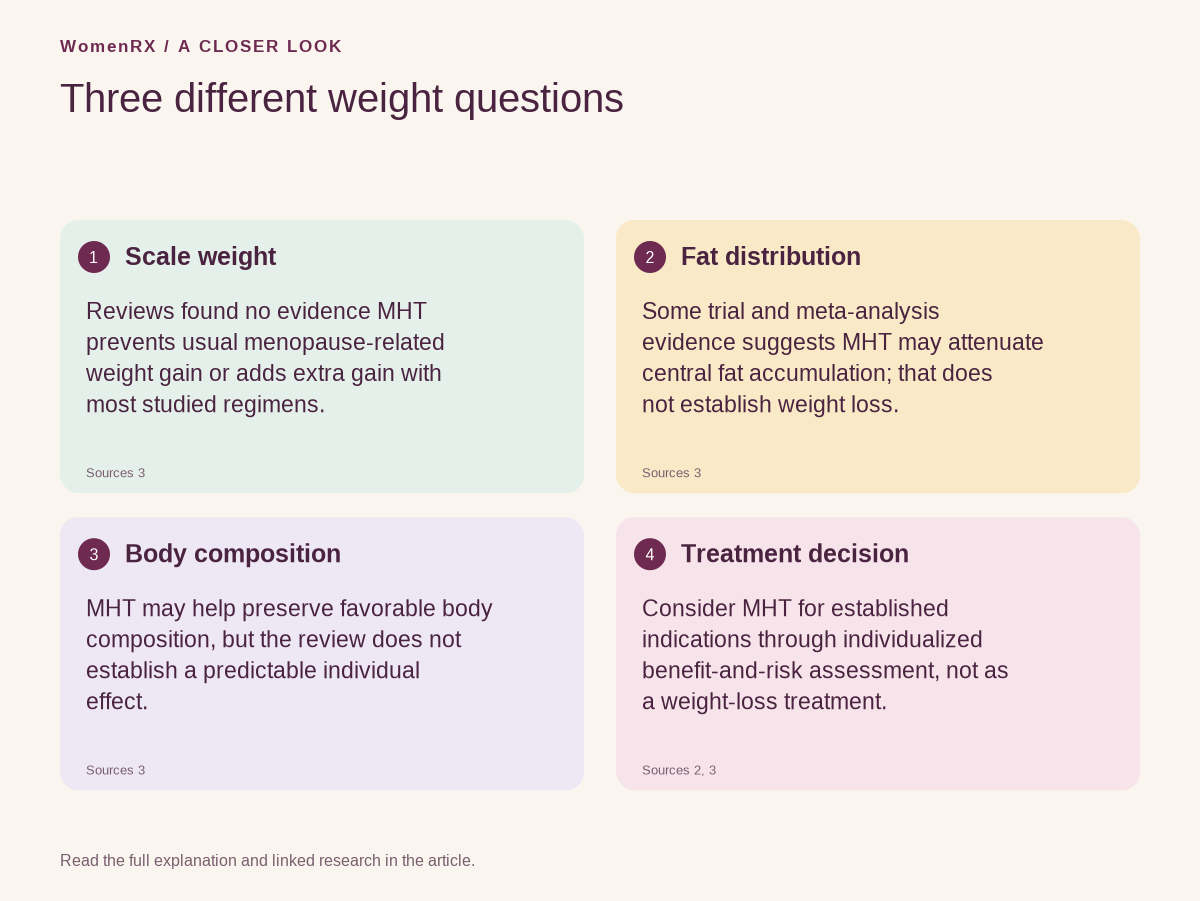
Three different weight questions
Scale weight: Reviews found no evidence MHT prevents usual menopause-related weight gain or adds extra gain with most studied regimens.3
Fat distribution: Some trial and meta-analysis evidence suggests MHT may attenuate central fat accumulation; that does not establish weight loss.3
Body composition: MHT may help preserve favorable body composition, but the review does not establish a predictable individual effect.3
Treatment decision: Consider MHT for established indications through individualized benefit-and-risk assessment, not as a weight-loss treatment.23
Read the figure as text
The evidence looks different depending on whether a study measures pounds, where fat is stored, or the balance of fat and lean tissue.- Scale weight: Reviews found no evidence MHT prevents usual menopause-related weight gain or adds extra gain with most studied regimens.3
- Fat distribution: Some trial and meta-analysis evidence suggests MHT may attenuate central fat accumulation; that does not establish weight loss.3
- Body composition: MHT may help preserve favorable body composition, but the review does not establish a predictable individual effect.3
- Treatment decision: Consider MHT for established indications through individualized benefit-and-risk assessment, not as a weight-loss treatment.23
More questions, answered
Should I start estrogen therapy just to prevent weight gain?
No. Evidence summarized in a clinical review found no evidence that MHT prevents the weight gain usually seen around menopause, and it isn’t indicated as a primary weight-loss treatment. MHT decisions should be based on established indications and an individualized benefit-and-risk assessment. 3 2
Can I gain weight while taking hormone therapy?
Yes. A person can gain weight while taking MHT, but that timing alone doesn’t show the medicine caused the change. Trials summarized in a review did not find extra weight gain from most MHT regimens compared with non-use. Weight is also affected by more than body fat. 3 1
Sources you can check
- Body Weight: MedlinePlusAccessed 2026-09-25Return to first citation
- The 2022 hormone therapy position statement of The North American Menopause Society.“The 2022 Hormone Therapy Position Statement of The North American Menopause Society” Advisory Panel. · Menopause (New York, N.Y.) · 2022Return to first citation
- Clinical review: Menopause hormone therapy in weight management.Younglove C. · Obesity pillars · 2026Return to first citation