Does Estrogen Therapy Cause Weight Loss During Menopause?
Hormone therapy isn’t a weight-loss treatment, though research suggests it may affect body composition or where fat is stored.
No. Menopausal hormone therapy shouldn’t be started to lose weight. In trials summarized in a clinical review, one treatment group gained no more weight than placebo over two years, while another averaged about 1 kg less than placebo over three years. Those findings don’t establish reliable weight loss for an individual. Possible effects on body composition or central fat are different from losing pounds. 3
What the scale can’t tell you
Menopausal hormone therapy (MHT), which may include estrogen with or without a progestogen, isn’t a treatment for weight loss or obesity. A clinical review describes possible effects on central fat accumulation and body composition, but that’s not the same as showing that treatment reliably lowers body weight. 3
These outcomes answer different questions:
- Body weight is the total number on the scale. It includes muscle, bone, fat, and water.
- Body composition describes the balance of fat and lean tissue.
- Fat distribution describes where fat is stored, such as around the abdomen.
A change in one doesn’t guarantee a change in another. For example, someone might have a different balance of fat and lean tissue without seeing much change on the scale. Waist circumference can also tell you something the scale doesn’t, though it isn’t a direct measure of total body fat. 1 3
What trials show about weight
The clinical review summarizes two randomized trials with different results. In a two-year trial involving 2,673 participants, MHT did not lead to greater weight gain than placebo. In a three-year trial involving 847 participants, the MHT group weighed about 1 kg less than the placebo group and had more favorable body-composition findings. These are comparisons between groups, not a promise that an individual will lose weight. The review’s summary also doesn’t provide enough detail to predict how results would apply to a particular woman or treatment plan. 3
The same review describes research suggesting MHT may help limit central fat accumulation or preserve favorable body composition. That possibility matters if you’re asking about changes in waist or fat and lean tissue, but it doesn’t turn MHT into a dependable way to lose pounds. Evidence about a treatment’s effect on one measure shouldn’t be treated as proof of an effect on another. 3
The menopause transition itself can bring changes in body composition, including more total and visceral fat and less lean body mass. The review describes these changes as occurring independently of chronological age. That doesn’t mean aging is irrelevant to your own experience; it means studies need to distinguish menopause-stage changes from age-related changes rather than treating them as the same thing. 3
Keep the treatment goal clear
The 2022 North American Menopause Society position statement identifies MHT as the most effective treatment for hot flashes and other vasomotor symptoms, and says it has been shown to prevent bone loss and fracture. It recommends weighing benefits and risks for each person. Weight loss isn’t one of the stated treatment purposes. 2
That balance also depends on timing and health context. The statement describes a favorable benefit-risk balance for women younger than 60 or within 10 years of menopause onset, without contraindications, when treatment is used for bothersome vasomotor symptoms or prevention of bone loss. It describes a less favorable balance when treatment starts later. 2
If your main concern is weight, it may help to name the outcome you mean: pounds, waist size, or a change in body composition. Those questions can overlap, but they’re not interchangeable. If you’re considering MHT, its potential benefits should be considered in relation to established menopause-related treatment goals, not an expectation of weight loss. 2 3
Three measures, different answers
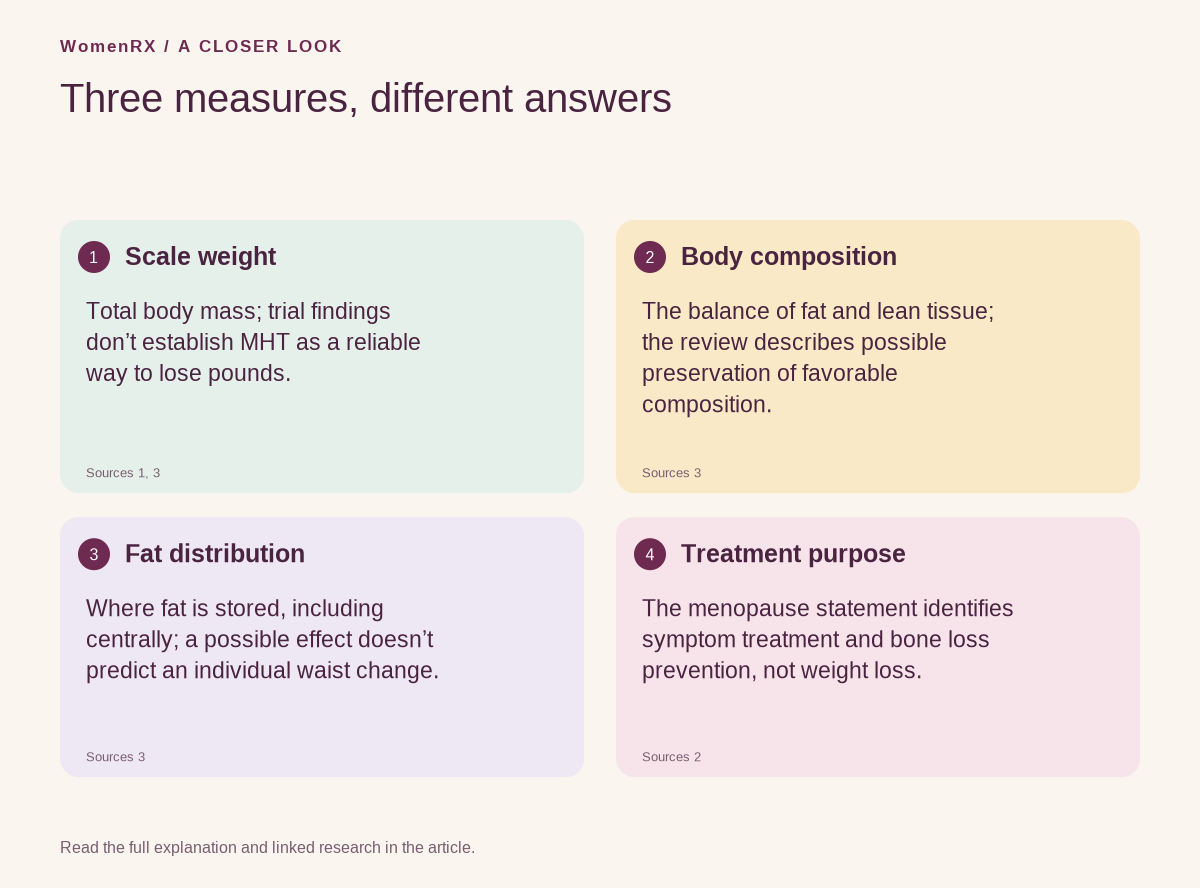
Scale weight: Total body mass; trial findings don’t establish MHT as a reliable way to lose pounds.13
Body composition: The balance of fat and lean tissue; the review describes possible preservation of favorable composition.3
Fat distribution: Where fat is stored, including centrally; a possible effect doesn’t predict an individual waist change.3
Treatment purpose: The menopause statement identifies symptom treatment and bone loss prevention, not weight loss.2
Read the figure as text
A scale, body-composition assessment, and waist measurement describe different aspects of change. Possible effects on one don’t prove weight loss.- Scale weight: Total body mass; trial findings don’t establish MHT as a reliable way to lose pounds.13
- Body composition: The balance of fat and lean tissue; the review describes possible preservation of favorable composition.3
- Fat distribution: Where fat is stored, including centrally; a possible effect doesn’t predict an individual waist change.3
- Treatment purpose: The menopause statement identifies symptom treatment and bone loss prevention, not weight loss.2
More questions, answered
Could estrogen affect belly fat without changing my weight?
A clinical review describes a possible effect on central fat accumulation, but it doesn’t establish a predictable waist change for an individual. A possible change in fat distribution also wouldn’t necessarily mean weight loss. 3
What if weight gain is my only reason for considering hormone therapy?
The clinical review says MHT shouldn’t be prescribed for weight loss or obesity treatment. The menopause position statement discusses other purposes, including treating bothersome hot flashes and preventing bone loss, with benefits and risks assessed individually. 2 3
Sources you can check
- Body Weight: MedlinePlusAccessed 2026-09-25Return to first citation
- The 2022 hormone therapy position statement of The North American Menopause Society.“The 2022 Hormone Therapy Position Statement of The North American Menopause Society” Advisory Panel. · Menopause (New York, N.Y.) · 2022Return to first citation
- Clinical review: Menopause hormone therapy in weight management.Younglove C. · Obesity pillars · 2026Return to first citation