When Is Estrogen Treatment an Option for Menopause Symptoms?
The right estrogen approach depends on which symptoms you want to treat, your health history, when menopause began, and whether you have a uterus.
Estrogen may be an option for bothersome hot flashes and night sweats, or for vaginal and related genitourinary symptoms. Systemic hormone therapy treats symptoms throughout the body; low-dose vaginal estrogen targets vaginal symptoms with much less hormone reaching the rest of the body. Age, time since menopause, health history, and whether you have a uterus all affect the discussion. 1 2
Start with the symptom you want help with
Estrogen isn’t a single approach for every menopause concern. The first useful question is what you want treatment to address.
For bothersome hot flashes and night sweats, systemic menopausal hormone therapy is the most effective treatment. It also helps prevent bone loss, though whether that benefit matters for you depends on your overall health and treatment goals. Hormone therapy isn’t automatically the answer to every change in mood, sleep, weight, or energy during menopause; those concerns can have other causes and may call for different options. 2 3
For vaginal dryness or irritation, or discomfort with sex related to vaginal symptoms, low-dose vaginal estrogen may be an option. It acts locally and is not intended to relieve hot flashes or other symptoms throughout the body. If vaginal symptoms are the main concern, you may not need systemic hormone therapy. 1 2 4
Systemic or local: what’s the difference?
Systemic estrogen reaches the body more broadly. It may make sense to discuss when symptoms such as hot flashes are affecting daily life. The benefits and risks can vary with the treatment’s type, dose, route, duration, when it’s started, and whether a progestogen is used. 2
Low-dose vaginal estrogen is aimed at symptoms in vaginal tissue. Because little of it reaches the rest of the body, its effects and risk considerations aren’t the same as systemic therapy. A North American Menopause Society position statement recommends considering low-dose vaginal estrogen for bothersome genitourinary symptoms that haven’t improved with over-the-counter options, when there isn’t another reason to use systemic hormone therapy. 1 2
An example: if your main issue is vaginal dryness but you aren’t having troublesome hot flashes, it may be worth asking about a local treatment rather than assuming you need estrogen throughout your body. If both types of symptoms are bothering you, describe both; the treatment discussion may be different. 1 2
Age and timing shape the balance
For women younger than 60 or within 10 years of menopause, the 2022 North American Menopause Society position statement says the benefit-risk balance is generally favorable for treating bothersome vasomotor symptoms or preventing bone loss, when there are no contraindications. Starting hormone therapy after age 60 or more than 10 years after menopause is generally a less favorable balance because certain risks, including coronary heart disease, stroke, blood clots, and dementia, are higher in those groups. 2
These are factors for an individualized discussion, not a rule that everyone in one age group should take estrogen or that everyone in another should avoid it. Health history and personal priorities still matter. The position statement also supports periodic review if therapy continues, particularly when symptoms persist over time. 2
Uterus status changes the plan
If you have a uterus, systemic estrogen is generally paired with a progestogen to protect the uterine lining. After a hysterectomy, estrogen may be used without a progestogen, depending on the person’s situation. Low-dose vaginal estrogen is a different case: the cited menopause position statement supports it for vaginal symptoms, and NHS guidance says a progestogen usually isn’t needed with low-dose local treatment because little medicine reaches the rest of the body. 1 2 4
So “Have I had a hysterectomy?” is useful context, but it doesn’t settle whether estrogen is right for you. The reason for surgery and your other health factors belong in the conversation too.
Health history matters as much as symptoms
A past estrogen-sensitive cancer or cardiovascular disease can make systemic hormone therapy a poor fit, according to the North American Menopause Society’s nonhormone treatment statement. That doesn’t mean every health history leads to the same decision: the type of concern, your current health, and whether you’re considering local or systemic treatment all matter. If hormone therapy isn’t a good fit or isn’t your preference, evidence-based nonhormonal treatments are available for hot flashes. 3
A focused discussion can start with: “My main concern is ___; would local or systemic estrogen address it?” You can also ask how your age and time since menopause affect the balance, whether your uterus changes the plan, and what parts of your health history could shift the recommendation. Those questions help keep the conversation tied to your actual symptoms rather than to estrogen as a general-purpose treatment.
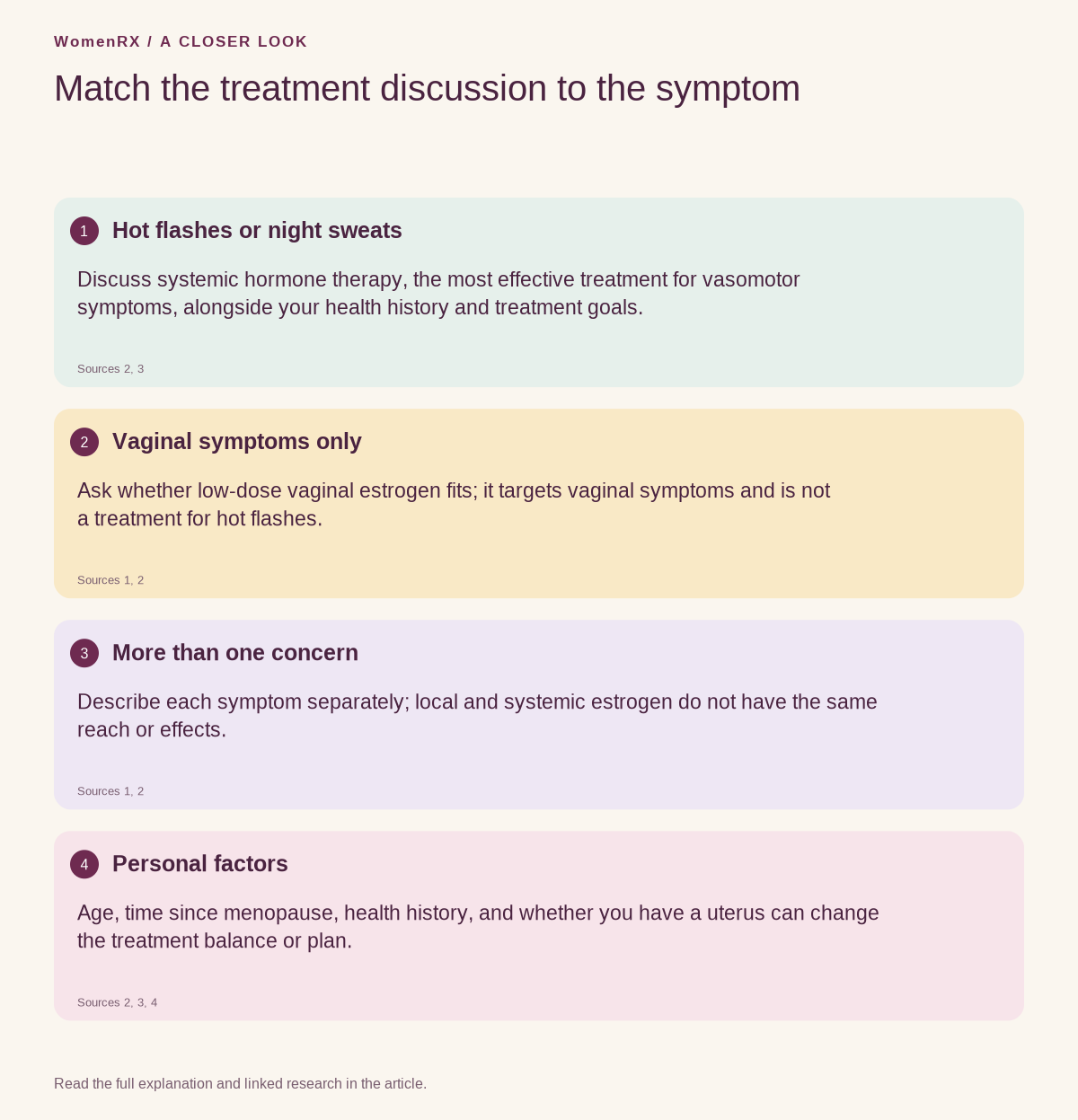
Match the treatment discussion to the symptom
Hot flashes or night sweats: Discuss systemic hormone therapy, the most effective treatment for vasomotor symptoms, alongside your health history and treatment goals.23
Vaginal symptoms only: Ask whether low-dose vaginal estrogen fits; it targets vaginal symptoms and is not a treatment for hot flashes.12
More than one concern: Describe each symptom separately; local and systemic estrogen do not have the same reach or effects.12
Personal factors: Age, time since menopause, health history, and whether you have a uterus can change the treatment balance or plan.234
Read the figure as text
A symptom-first route helps distinguish local vaginal treatment from systemic therapy, then highlights the personal factors that shape the discussion.- Hot flashes or night sweats: Discuss systemic hormone therapy, the most effective treatment for vasomotor symptoms, alongside your health history and treatment goals.23
- Vaginal symptoms only: Ask whether low-dose vaginal estrogen fits; it targets vaginal symptoms and is not a treatment for hot flashes.12
- More than one concern: Describe each symptom separately; local and systemic estrogen do not have the same reach or effects.12
- Personal factors: Age, time since menopause, health history, and whether you have a uterus can change the treatment balance or plan.234
More questions, answered
Does having a uterus mean I can’t use estrogen?
No. It changes how systemic treatment is usually planned: systemic estrogen is generally paired with a progestogen when you have a uterus, to protect the uterine lining. Low-dose vaginal estrogen is a separate, local option and usually doesn’t require a progestogen. 1 4
Does being over 60 rule out hormone therapy?
No. The benefit-risk balance is generally less favorable when therapy is started after age 60 or more than 10 years after menopause, but that isn’t an automatic yes-or-no rule. Symptoms, health history, treatment goals, and the specific type of therapy matter. 2
Sources you can check
- About vaginal oestrogen - NHSAccessed 2026-09-25Return to first citation
- The 2022 hormone therapy position statement of The North American Menopause Society.“The 2022 Hormone Therapy Position Statement of The North American Menopause Society” Advisory Panel. · Menopause (New York, N.Y.) · 2022Return to first citation
- The 2023 nonhormone therapy position statement of The North American Menopause Society.Menopause (New York, N.Y.) · 2023Return to first citation
- Estrogen TherapyValdes A, Patel P, Bajaj T. · 2025Return to first citation