When Menopause Hormone Therapy Needs a Closer Look
A history of blood clots, estrogen-sensitive cancer, or bleeding after menopause can change the plan, but the treatment you’re considering matters too.
A past or current blood clot can rule out certain systemic hormone products. Estrogen-sensitive cancer and unexplained bleeding after menopause also need careful review before treatment. These concerns don’t create one rule for every product: systemic therapy and low-dose vaginal estrogen treat different symptoms and have different patterns of exposure. The useful question is which treatment fits your symptoms and medical history. 2 3 5 6
Start with the symptom you want to treat
If hot flashes are disrupting your day, you’re considering a different kind of treatment from someone seeking relief from vaginal dryness or irritation. Systemic hormone therapy reaches beyond the vaginal tissues. Low-dose vaginal estrogen acts mainly where it’s used and won’t treat hot flashes. That difference can change which options are worth discussing when a health condition raises concern about hormones. 3 5
The exact formulation matters, too. Hormone therapy risks vary by type, dose, route, duration, time since menopause, and whether a progestogen is included. A warning for one product shouldn’t be treated as an answer about every other product. 5
Which histories can change the decision?
A deep-vein thrombosis or pulmonary embolism. The U.S. prescribing information for Prempro, a systemic combination of conjugated estrogens and medroxyprogesterone acetate, lists a current or past deep-vein thrombosis (DVT) or pulmonary embolism (PE) as a contraindication. If you’ve had either diagnosis, say which one, when it happened, and which treatment is being proposed. The Prempro listing is a firm reason not to assume that product is suitable; it isn’t a complete eligibility rule for every menopause treatment. 2 5
An estrogen-sensitive cancer. Estrogen-dependent cancers are identified as a reason hormone therapy may be unsuitable. The type of cancer matters: the phrase “cancer history” doesn’t establish whether your cancer was estrogen-sensitive or settle the choice between systemic and local treatment. Share the diagnosis and treatment history. If you’re considering vaginal treatment after cancer, ask whether the clinician who knows your cancer history should be involved in that decision. 1 2 6 7
Persistent or recurring unexplained bleeding after menopause. This needs attention before it’s written off as a menopause symptom or an expected effect of treatment. Prescribing information calls for evaluation of undiagnosed persistent or recurring abnormal bleeding after menopause to rule out malignancy, with endometrial sampling when indicated. Tell the clinician about the bleeding even if the immediate conversation is about hot flashes or vaginal symptoms. 1 2
Cardiovascular disease, or starting treatment later. Cardiovascular disease can make systemic hormone therapy a poor fit. Age and timing add context rather than supplying a yes-or-no rule: the Menopause Society’s 2022 position statement says the benefit-risk balance appears less favorable for women who start hormone therapy after age 60 or more than 10 years after menopause, partly because absolute risks of coronary heart disease, stroke, blood clots, and dementia are greater. Bring up any cardiovascular diagnosis and discuss it in relation to the treatment being considered. 5 6
A concern may change the regimen, not end the conversation
Having a uterus affects how systemic estrogen is considered. Estrogen used without a progestogen increases endometrial cancer risk in a woman with a uterus; adding a progestogen has been shown to reduce the risk of endometrial hyperplasia, which can precede cancer. That’s a reason to discuss the regimen, not to assume that having a uterus rules out hormone therapy. Low-dose vaginal estrogen is different: little reaches the rest of the body, and it generally does not require an added progestogen. 1 2 3
Mention thyroid replacement medicine as well. Estrogen can change thyroid-binding globulin levels, so someone taking thyroid replacement may need thyroid-function monitoring and possibly a change to that treatment. This is a management detail, not an automatic exclusion. 1 2
If systemic hormones aren’t suitable, the next option still depends on your symptom. For hot flashes, the Menopause Society identifies evidence-supported nonhormonal choices, including cognitive-behavioral therapy, clinical hypnosis, and several prescription medicines. For vaginal dryness or irritation, vaginal moisturizers and lubricants are among the options to discuss; low-dose vaginal estrogen is a separate treatment decision, particularly with a cancer history. You don’t have to decide which category you belong in on your own. Ask about the specific product, why it fits the symptom you want to treat, and how your history changes that choice. 3 4 5 6 7
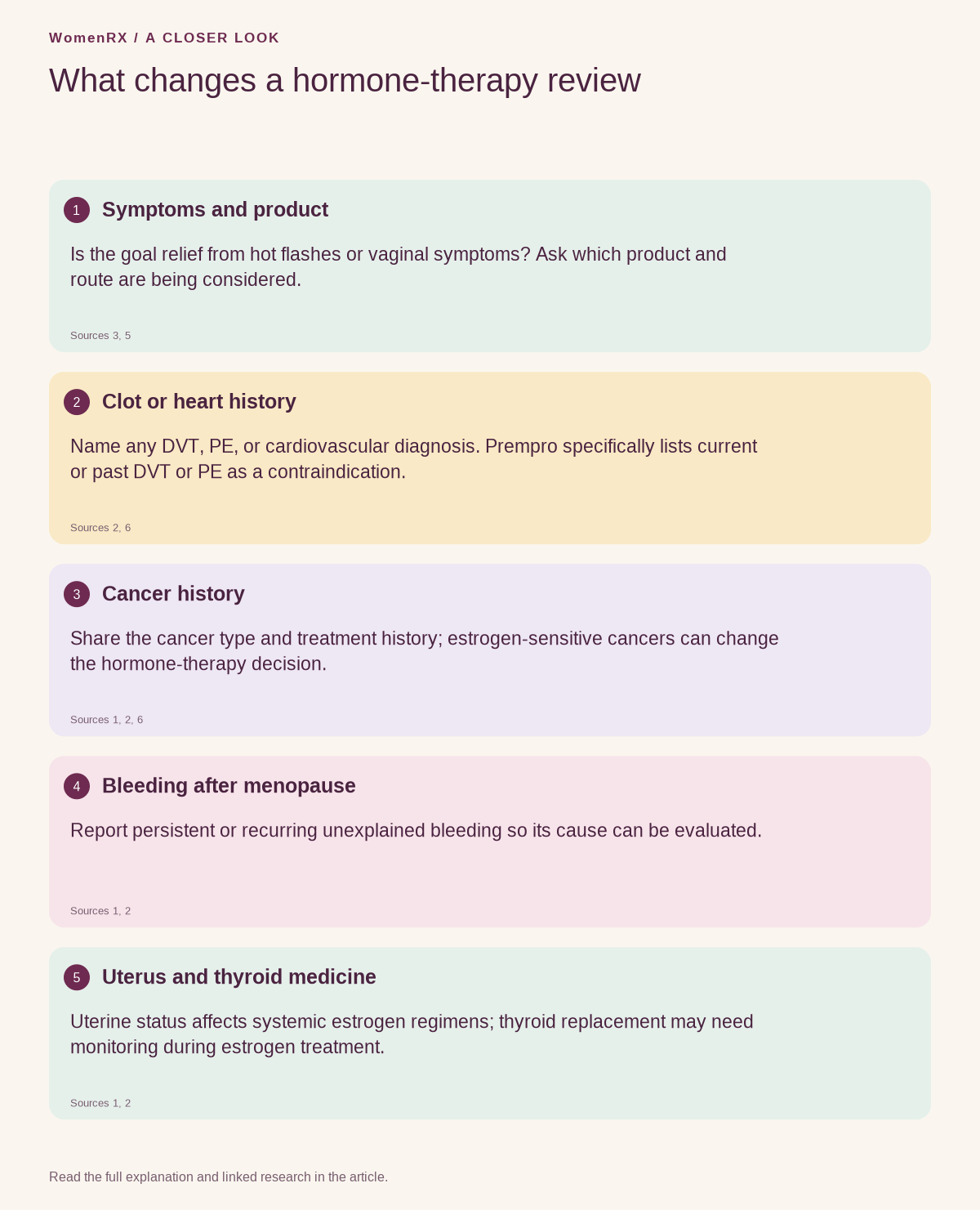
What changes a hormone-therapy review
Symptoms and product: Is the goal relief from hot flashes or vaginal symptoms? Ask which product and route are being considered.35
Clot or heart history: Name any DVT, PE, or cardiovascular diagnosis. Prempro specifically lists current or past DVT or PE as a contraindication.26
Cancer history: Share the cancer type and treatment history; estrogen-sensitive cancers can change the hormone-therapy decision.126
Bleeding after menopause: Report persistent or recurring unexplained bleeding so its cause can be evaluated.12
Uterus and thyroid medicine: Uterine status affects systemic estrogen regimens; thyroid replacement may need monitoring during estrogen treatment.12
Read the figure as text
Use these details to discuss a specific treatment, not to rule yourself in or out of all hormone therapy.- Symptoms and product: Is the goal relief from hot flashes or vaginal symptoms? Ask which product and route are being considered.35
- Clot or heart history: Name any DVT, PE, or cardiovascular diagnosis. Prempro specifically lists current or past DVT or PE as a contraindication.26
- Cancer history: Share the cancer type and treatment history; estrogen-sensitive cancers can change the hormone-therapy decision.126
- Bleeding after menopause: Report persistent or recurring unexplained bleeding so its cause can be evaluated.12
- Uterus and thyroid medicine: Uterine status affects systemic estrogen regimens; thyroid replacement may need monitoring during estrogen treatment.12
Sources you can check
- PREMARIN (ESTROGENS, CONJUGATED) TABLET, FILM COATED [WYETH PHARMACEUTICALS LLC, A SUBSIDIARY OF PFIZER INC.] | US prescribing information and patient instructionsAccessed 2026-09-25Return to first citation
- PREMPHASE (CONJUGATED ESTROGENS AND MEDROXYPROGESTERONE ACETATE) KIT PREMPRO (CONJUGATED ESTROGENS AND MEDROXYPROGESTERONE ACETATE) TABLET, SUGAR COATED [WYETH PHARMACEUTICALS LLC, A SUBSIDIARY OF PFIZER INC.] | US prescribing information and patient instructionsAccessed 2026-09-25Return to first citation
- About vaginal oestrogen - NHSAccessed 2026-09-25Return to first citation
- Common questions about vaginal oestrogen - NHSAccessed 2026-09-25Return to first citation
- The 2022 hormone therapy position statement of The North American Menopause Society.“The 2022 Hormone Therapy Position Statement of The North American Menopause Society” Advisory Panel. · Menopause (New York, N.Y.) · 2022Return to first citation
- The 2023 nonhormone therapy position statement of The North American Menopause Society.Menopause (New York, N.Y.) · 2023Return to first citation
- Treatment of Menopausal Symptoms When Hormone Therapy Is Contraindicated.Niskanen LM, Kärkkäinen HJ, Tuppurainen MT. · Seminars in reproductive medicine · 2025Return to first citation