Can Menopause Hormone Therapy Help With Memory?
Hormone therapy treats some menopause symptoms, but research hasn’t shown a reliable overall benefit for memory.
Menopause hormone therapy isn’t an established treatment for forgetfulness or a way to prevent dementia. Across randomized trials, it had no overall effect on cognitive-domain scores, although some analyses found better verbal-memory scores when estrogen was started near menopause. If forgetfulness worries you, is getting worse, or affects familiar tasks, have it assessed rather than assuming menopause is the cause. 42
What kind of memory change are you noticing?
Losing a name for a moment or wondering where you put your keys can be frustrating. Occasional lapses happen, and memory complaints can be part of the menopause transition, alongside sleep disturbance and mood changes. But noticing those symptoms together doesn’t tell you what’s causing the forgetfulness or whether estrogen would help. 25
It also helps to separate everyday memory from cognitive-test performance. A trial may find a change in how well a group recalls words under test conditions. That result doesn’t necessarily mean a person will notice a difference in keeping up with conversations, remembering plans, or managing daily tasks.
What hormone therapy trials have found
A 2024 systematic review and meta-analysis combined 34 randomized trials, with 14,914 participants receiving menopausal hormone therapy and 12,679 receiving placebo. It found no overall effect on cognitive-domain scores. The results differed, though, depending on the hormone formulation, when treatment began, and which skill was tested. 4
One analysis found better verbal-memory scores with estrogen therapy started in midlife or close to menopause. That’s a finding about a particular type of test, not a dependable treatment effect for someone who feels forgetful. The same review noted that several larger trials in younger menopausal women found predominantly neutral cognitive results, while some smaller studies found benefits. 4
Timing isn’t the only distinction. Starting therapy near menopause and starting it decades later are different clinical situations. So are estrogen-only therapy and estrogen combined with a progestogen. Findings from one group or formulation shouldn’t be used as a promise about another. 43
Why the dementia question has a different answer
Feeling foggy during perimenopause does not mean you have dementia. Nor does a better score on one memory test show that a treatment prevents dementia. Menopausal hormone therapy is not recommended for dementia prevention. 7
There is a specific later-life finding worth keeping in context: in the Women’s Health Initiative Memory Study, postmenopausal women aged 65 or older who took an oral combination of conjugated estrogens and medroxyprogesterone acetate had a higher risk of probable dementia over four years than those taking placebo. Whether that finding applies to younger postmenopausal women is unknown. It does not answer whether starting a different therapy near menopause helps everyday memory. 1
For someone considering therapy because of bothersome hot flashes, the decision has a different starting point. Hormone therapy is an effective treatment for those symptoms, and its benefit-risk balance depends in part on age, time since menopause, formulation, route, and whether a progestogen is used. Treating hot flashes may be a reasonable goal; promising sharper memory is not supported by the overall trial results. 34
When forgetfulness needs a closer look
You don’t have to decide on your own whether a change is “normal menopause.” MedlinePlus advises seeking care if you’re worried about your forgetfulness. Difficulty using a familiar phone or finding your way home are examples of changes that may signal a more serious problem. New problems with familiar tasks, or changes that are becoming more disruptive, deserve attention rather than a trial of hormone therapy in place of an assessment. 2
When you describe the change, be specific: for example, are you occasionally searching for a word, or are you repeatedly unable to complete a task you know well? Mention when you first noticed it, whether it’s changing, and whether sleep or mood problems are happening too. Bring up the medicines you take, since reactions to certain medicines can also affect memory. That wider picture is more useful than assuming a memory complaint must reflect an estrogen level. 25
If you’re already considering hormone therapy for menopause symptoms, keep the two questions separate: What symptom am I treating? and Does this memory change need its own assessment? You can address bothersome hot flashes without dismissing a cognitive change, and you can investigate forgetfulness without assuming hormone therapy is the answer. 324
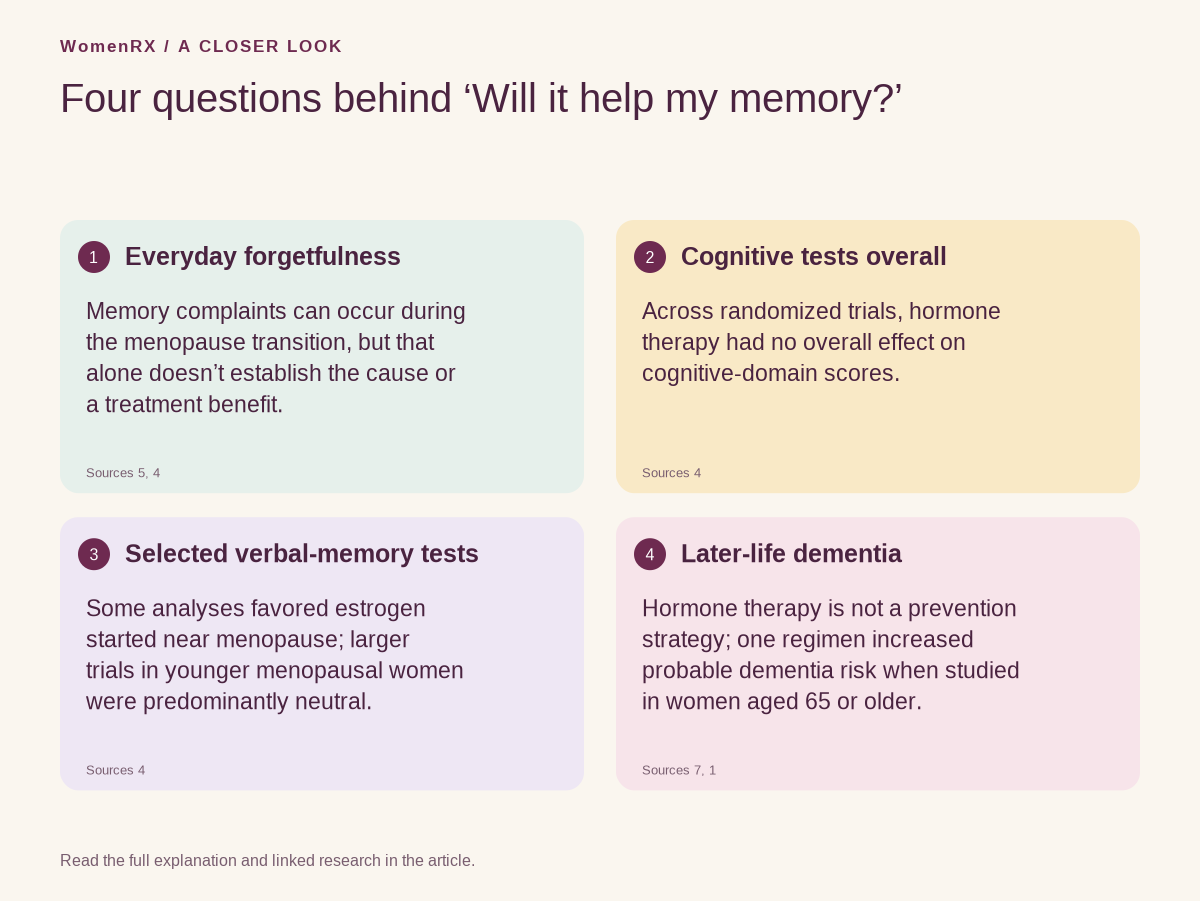
Four questions behind ‘Will it help my memory?’
Everyday forgetfulness: Memory complaints can occur during the menopause transition, but that alone doesn’t establish the cause or a treatment benefit.54
Cognitive tests overall: Across randomized trials, hormone therapy had no overall effect on cognitive-domain scores.4
Selected verbal-memory tests: Some analyses favored estrogen started near menopause; larger trials in younger menopausal women were predominantly neutral.4
Later-life dementia: Hormone therapy is not a prevention strategy; one regimen increased probable dementia risk when studied in women aged 65 or older.71
Read the figure as text
These findings concern different outcomes and stages of life. None should stand in for an assessment of a troubling change in daily functioning.- Everyday forgetfulness: Memory complaints can occur during the menopause transition, but that alone doesn’t establish the cause or a treatment benefit.54
- Cognitive tests overall: Across randomized trials, hormone therapy had no overall effect on cognitive-domain scores.4
- Selected verbal-memory tests: Some analyses favored estrogen started near menopause; larger trials in younger menopausal women were predominantly neutral.4
- Later-life dementia: Hormone therapy is not a prevention strategy; one regimen increased probable dementia risk when studied in women aged 65 or older.71
More questions, answered
Does a memory benefit seen with an estrogen patch mean patches are better for brain health?
No. A study of postmenopausal women found an association between transdermal estradiol use and higher scores on one type of memory test, but it was observational and cannot show that the patch caused the difference. Randomized trials have not found an overall cognitive benefit from hormone therapy. 64
Sources you can check
- PREMPHASE (CONJUGATED ESTROGENS AND MEDROXYPROGESTERONE ACETATE) KIT PREMPRO (CONJUGATED ESTROGENS AND MEDROXYPROGESTERONE ACETATE) TABLET, SUGAR COATED [WYETH PHARMACEUTICALS LLC, A SUBSIDIARY OF PFIZER INC.] | US prescribing information and patient instructionsAccessed 2026-09-25Return to first citation
- Memory | MedlinePlusAccessed 2026-09-25Return to first citation
- The 2022 hormone therapy position statement of The North American Menopause Society.“The 2022 Hormone Therapy Position Statement of The North American Menopause Society” Advisory Panel. · Menopause (New York, N.Y.) · 2022Return to first citation
- Systematic review and meta-analysis of the effects of menopause hormone therapy on cognition.Andy C, Nerattini M, Jett S, Carlton C, Zarate C, Boneu C, Fauci F, Ajila T, Battista M, Pahlajani S, Christos P, Fink ME, Williams S, Brinton RD, Mosconi L. · Frontiers in endocrinology · 2024Return to first citation
- Cognition, Mood and Sleep in Menopausal Transition: The Role of Menopause Hormone Therapy.Gava G, Orsili I, Alvisi S, Mancini I, Seracchioli R, Meriggiola MC. · Medicina (Kaunas, Lithuania) · 2019Return to first citation
- Association Between Menopause Age and Estradiol-Based Hormone Therapy With Cognitive Performance in Cognitively Normal Women in the CLSA.Puri TA, Gravelsins LL, Alexander MW, McGovern AJ, Guterman PD, Rabin JS, Murphy KJ, Galea LAM. · Neurology · 2025Return to first citation
- Cognitive health after menopause: Does menopausal hormone therapy affect it?Stute P, Wienges J, Koller AS, Giese C, Wesemüller W, Janka H, Baumgartner S. · Best practice & research. Clinical endocrinology & metabolism · 2021Return to first citation