What the WHI Found About Menopause Hormone Therapy
The WHI found real risks and benefits, but its two trials tested specific oral regimens in different groups of women.
The Women’s Health Initiative (WHI) compared two oral hormone regimens with placebo in separate trials of postmenopausal women ages 50 to 79. Estrogen plus progestin was linked to higher risks of stroke, blood clots, and breast cancer; estrogen alone had a different risk profile. The results remain relevant, but they aren’t a personal risk estimate for every age, formulation, or treatment goal. 15
First, which WHI trial does a headline mean?
The WHI hormone studies were two placebo-controlled trials, not one head-to-head test of estrogen alone against estrogen plus progestin. Women with a uterus entered the trial of daily oral conjugated equine estrogen (CEE) plus medroxyprogesterone acetate (MPA). Women who had undergone hysterectomy entered the trial of daily oral CEE alone. That distinction matters: the participants and treatments differed between trials, so a result from one cannot simply be assigned to the other. 14
Participants were postmenopausal and ages 50 to 79. Their mean age was 63.4 in a later analysis of both trials. Someone considering treatment soon after menopause may therefore recognize the question WHI raises without being exactly like the average participant. 13
What the original trials found
The hormone studies were designed to assess chronic disease outcomes, including coronary heart disease, invasive breast cancer, stroke, pulmonary embolism, and hip fracture. They did not evaluate relief of menopause symptoms as an outcome. 1
For CEE plus MPA, a WHI summary reported, compared with placebo, 8 more strokes, 10 more pulmonary embolisms, and 8 more invasive breast cancers per 10,000 women-years over 5.6 years of follow-up. It also reported 5 fewer hip fractures per 10,000 women-years. A women-year expresses time under observation: these are group-level differences, not the chance that any one woman will have an event. 1
The coronary heart disease result deserves careful wording. The WHI summary reported 7 more events per 10,000 women-years with CEE plus MPA. A later Cochrane review, using its assessment of the trial, concluded that combined therapy probably makes little to no difference in coronary-event risk; its estimate was uncertain enough to include both a decrease and an increase. That does not erase the other risks, but it does argue against treating the coronary number as a settled prediction. 15
CEE alone produced a different pattern. The WHI summary reported 12 more strokes and 7 fewer hip fractures per 10,000 women-years than placebo. The Cochrane review found that CEE alone probably increased stroke risk, while its estimates for coronary events and breast cancer did not establish an increase. “WHI found that hormones raise breast cancer risk” leaves out which regimen produced that finding. 15
What changed when researchers looked at symptoms and age
A 2025 secondary analysis revisited the WHI trials to examine women who reported moderate or severe vasomotor symptoms, such as hot flashes. Among symptomatic women ages 50 to 59, both WHI regimens reduced symptoms, and neither showed a statistically significant increase in the analysis’s measure of atherosclerotic cardiovascular disease. The cardiovascular estimates were imprecise, though. They do not prove that starting hormone therapy at that age protects the heart or carries no cardiovascular risk. Among symptomatic women ages 70 and older, that analysis found increased cardiovascular risk estimates with both regimens. 3
This newer look adds context rather than overturning the trials. It examines a subgroup and a question closer to why many women seek treatment, but it still concerns the WHI regimens. A systematic review of trials in younger menopausal women did not find demonstrated benefits of hormone therapy for preventing cardiovascular disease, cancer, depression, or cognitive decline. Symptom treatment and disease prevention are different goals. 36
How to use WHI findings today
Current North American Menopause Society guidance describes hormone therapy as the most effective treatment for vasomotor symptoms. For women younger than 60 or within 10 years of menopause onset who have no contraindications, it finds the benefit-risk balance favorable for treating bothersome symptoms or preventing bone loss. It also says risks vary with treatment type, dose, route, duration, timing, and whether a progestogen is used. That guidance takes WHI seriously without claiming its two oral regimens predict the effects of every other option. 2
When a WHI headline sounds absolute, check four things: Which trial? Which age group? Which outcome? Which treatment goal? For example, a breast cancer finding from the CEE-plus-MPA trial cannot be presented as the finding for CEE alone. And a study of chronic disease outcomes cannot, on its own, tell you whether treatment will ease your hot flashes. Those distinctions help you use the WHI findings rather than dismissing them or applying them too broadly. 15
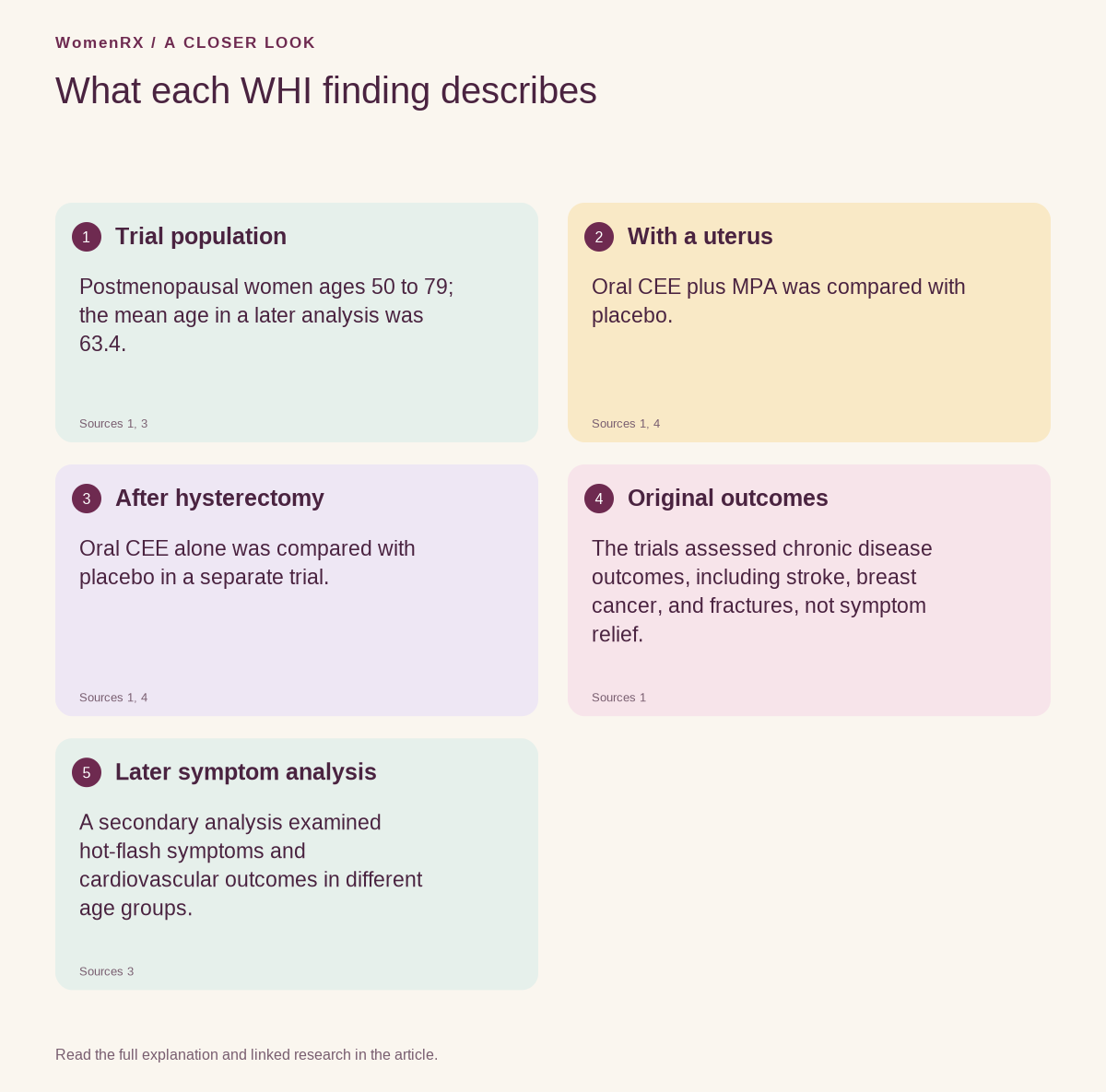
What each WHI finding describes
Trial population: Postmenopausal women ages 50 to 79; the mean age in a later analysis was 63.4.13
With a uterus: Oral CEE plus MPA was compared with placebo.14
After hysterectomy: Oral CEE alone was compared with placebo in a separate trial.14
Original outcomes: The trials assessed chronic disease outcomes, including stroke, breast cancer, and fractures, not symptom relief.1
Later symptom analysis: A secondary analysis examined hot-flash symptoms and cardiovascular outcomes in different age groups.3
Read the figure as text
Read a WHI result by matching its participant group and regimen to the outcome being discussed.- Trial population: Postmenopausal women ages 50 to 79; the mean age in a later analysis was 63.4.13
- With a uterus: Oral CEE plus MPA was compared with placebo.14
- After hysterectomy: Oral CEE alone was compared with placebo in a separate trial.14
- Original outcomes: The trials assessed chronic disease outcomes, including stroke, breast cancer, and fractures, not symptom relief.1
- Later symptom analysis: A secondary analysis examined hot-flash symptoms and cardiovascular outcomes in different age groups.3
More questions, answered
What did the WHI memory study find?
In an ancillary study of participants ages 65 and older, probable dementia risk was higher with the WHI estrogen-plus-progestin regimen than with placebo. The prescribing information says it is unknown whether that finding applies to younger postmenopausal women. 1
Sources you can check
- PREMPHASE (CONJUGATED ESTROGENS AND MEDROXYPROGESTERONE ACETATE) KIT PREMPRO (CONJUGATED ESTROGENS AND MEDROXYPROGESTERONE ACETATE) TABLET, SUGAR COATED [WYETH PHARMACEUTICALS LLC, A SUBSIDIARY OF PFIZER INC.] | US prescribing information and patient instructionsAccessed 2026-09-25Return to first citation
- The 2022 hormone therapy position statement of The North American Menopause Society.“The 2022 Hormone Therapy Position Statement of The North American Menopause Society” Advisory Panel. · Menopause (New York, N.Y.) · 2022Return to first citation
- Menopausal Hormone Therapy and Cardiovascular Diseases in Women With Vasomotor Symptoms: A Secondary Analysis of the Women's Health Initiative Randomized Clinical Trials.Rossouw JE, Aragaki AK, Manson JE, Szmuilowicz ED, Harrington LB, Johnson KC, Allison M, Haring B, Saquib N, Shadyab AH, Rexrode KM, Liu L, Mouton CP, LaCroix AZ. · JAMA internal medicine · 2025Return to first citation
- Menopausal Hormone Therapy and Ovarian and Endometrial Cancers: Long-Term Follow-Up of the Women's Health Initiative Randomized Trials.Chlebowski RT, Aragaki AK, Pan K, Haque R, Rohan TE, Song M, Wactawski-Wende J, Lane DS, Harris HR, Strickler H, Kauntiz AM, Runowicz CD. · Journal of clinical oncology : official journal of the American Society of Clinical Oncology · 2024Return to first citation
- Long-term hormone therapy for perimenopausal and postmenopausal women.Bofill Rodriguez M, Yong LN, Mirkov S, Bekos C, Lethaby A, Farquhar C. · The Cochrane database of systematic reviews · 2026Return to first citation
- The effects of menopausal hormone therapy on cardiovascular disease, cancer, cognition and depression in younger women: A systematic review.Bencivenga PA, Fort N, Fugh-Berman A, Scialli AR. · JRSM open · 2026Return to first citation