Menopause Hormone Therapy and Blood Clot Risk
Clot risk depends on the hormone regimen, how it’s taken, and the risk you bring to treatment.
Some systemic menopause hormone therapies increase the risk of a clot in a vein. Large trials found higher clot rates with specific oral regimens, while reviews report lower risk with transdermal estrogen than with oral estrogen. A patch or gel isn’t a promise of zero risk. Your clot history, other health factors, and the exact treatment all matter. 1 2 5 6
First, what kind of clot are we talking about?
Venous thromboembolism, or VTE, means a blood clot in a vein. It includes deep vein thrombosis (DVT) and pulmonary embolism (PE). Research on menopause hormone therapy often counts these together, so it helps to check which outcome a number describes. 1
“Hormone therapy” also covers different treatments. The North American Menopause Society notes that risks vary by hormone type, dose, duration, route, when treatment starts, and whether a progestogen is used. A finding about one oral combination doesn’t automatically describe a different pill, patch, or gel. 3
What the oral-treatment trials actually found
The Women’s Health Initiative (WHI) compared specific daily oral regimens with placebo. In its estrogen-alone substudy, which included postmenopausal women aged 50 to 79, the rate of VTE was 30 versus 22 events per 10,000 women-years for oral conjugated estrogens versus placebo. That overall VTE difference did not reach statistical significance. The DVT rates were 23 versus 15 per 10,000 women-years, and that difference did. 1
In the separate estrogen-plus-progestin substudy, women taking oral conjugated estrogens plus medroxyprogesterone acetate had 35 VTE events per 10,000 women-years, compared with 17 in the placebo group. DVT rates were 26 versus 13, and PE rates were 18 versus 8 per 10,000 women-years. The differences in this substudy were statistically significant. These are results for that particular combination, not an estimate for every estrogen-plus-progestogen treatment. 2
A rate per 10,000 women-years describes events across a group’s accumulated follow-up time. It isn’t the chance that you personally will have a clot this year. The placebo rates give the treatment rates a meaningful comparison, but neither placebo group represents everyone considering hormone therapy. 1 2
Oral and transdermal: a useful distinction, not a guarantee
Reviews of the evidence report higher VTE risk with oral estrogen than with transdermal estrogen, which is absorbed through the skin. That makes route a worthwhile part of the treatment discussion. It doesn’t establish that transdermal estrogen eliminates clot risk or that changing routes will produce a particular reduction for you. 5 6
A Swedish register-based study offers another view of oral regimens. Among women aged 50 to 58, starting oral continuous estrogen-progestin therapy was associated with a VTE hazard ratio of 1.61 compared with not starting hormone therapy. The corresponding ratios were 2.00 for oral sequential therapy and 1.57 for oral estrogen alone. Those are relative comparisons with non-initiators, not direct comparisons with transdermal users or absolute probabilities. Because this was an observational study, differences between the groups may also affect the results. 7
Together, the studies answer different questions. WHI gives event rates for two tested oral regimens against placebo. The Swedish study compares people starting several oral regimens with people not starting therapy. Reviews help frame the oral-versus-transdermal choice. None turns route alone into a personal risk calculation. 1 2 5 6 7
Put the treatment next to your baseline risk
A personal or family history of VTE, obesity, and systemic lupus erythematosus are among the clot-risk factors identified in US prescribing information for oral hormone therapy. An upcoming surgery associated with increased clot risk or a period of prolonged immobility is also worth raising before treatment decisions are made. These factors matter together; the presence of one doesn’t, by itself, provide your odds of a clot. 1
Age and time since menopause affect the broader balance of hormone therapy’s benefits and risks, too. The North American Menopause Society finds that balance generally more favorable for women younger than 60 or within 10 years of menopause onset who have no contraindications, and less favorable when therapy begins later. That’s not a rule that makes clot risk disappear in younger women. 3
When comparing options, ask about the specific regimen, not just whether it’s “HRT”: Is the estrogen oral or transdermal? Is a progestogen part of the plan? How do your clot history and current circumstances affect the choice? If systemic hormone therapy isn’t a good fit for hot flashes, evidence-supported nonhormone treatments include certain prescription medicines and behavioral approaches. The decision is about treating the symptoms that bother you while accounting for the risks that apply to you. 3 4
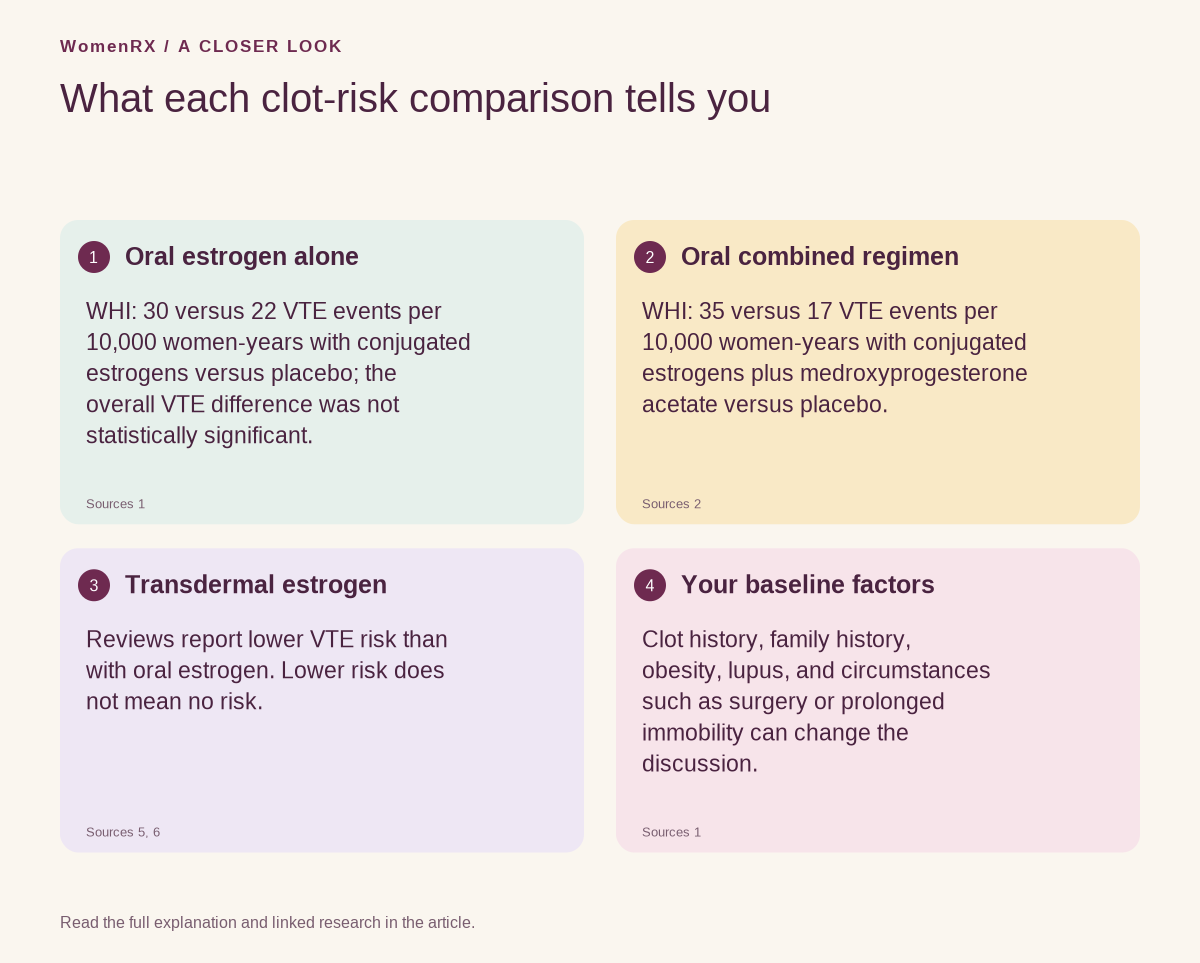
What each clot-risk comparison tells you
Oral estrogen alone: WHI: 30 versus 22 VTE events per 10,000 women-years with conjugated estrogens versus placebo; the overall VTE difference was not statistically significant.1
Oral combined regimen: WHI: 35 versus 17 VTE events per 10,000 women-years with conjugated estrogens plus medroxyprogesterone acetate versus placebo.2
Transdermal estrogen: Reviews report lower VTE risk than with oral estrogen. Lower risk does not mean no risk.56
Your baseline factors: Clot history, family history, obesity, lupus, and circumstances such as surgery or prolonged immobility can change the discussion.1
Read the figure as text
The same word, “risk,” can refer to an event rate, a relative comparison, or a personal factor. These aren’t interchangeable.- Oral estrogen alone: WHI: 30 versus 22 VTE events per 10,000 women-years with conjugated estrogens versus placebo; the overall VTE difference was not statistically significant.1
- Oral combined regimen: WHI: 35 versus 17 VTE events per 10,000 women-years with conjugated estrogens plus medroxyprogesterone acetate versus placebo.2
- Transdermal estrogen: Reviews report lower VTE risk than with oral estrogen. Lower risk does not mean no risk.56
- Your baseline factors: Clot history, family history, obesity, lupus, and circumstances such as surgery or prolonged immobility can change the discussion.1
More questions, answered
What if my main concern is vaginal dryness rather than hot flashes?
That may be a different treatment decision. For bothersome genitourinary symptoms not relieved by over-the-counter options, the North American Menopause Society recommends considering low-dose vaginal estrogen or other therapies when there’s no reason to use systemic hormone therapy. Don’t assume that evidence about oral systemic regimens describes a local vaginal treatment. 3
Sources you can check
- PREMARIN (ESTROGENS, CONJUGATED) TABLET, FILM COATED [WYETH PHARMACEUTICALS LLC, A SUBSIDIARY OF PFIZER INC.] | US prescribing information and patient instructionsAccessed 2026-09-25Return to first citation
- PREMPHASE (CONJUGATED ESTROGENS AND MEDROXYPROGESTERONE ACETATE) KIT PREMPRO (CONJUGATED ESTROGENS AND MEDROXYPROGESTERONE ACETATE) TABLET, SUGAR COATED [WYETH PHARMACEUTICALS LLC, A SUBSIDIARY OF PFIZER INC.] | US prescribing information and patient instructionsAccessed 2026-09-25Return to first citation
- The 2022 hormone therapy position statement of The North American Menopause Society.“The 2022 Hormone Therapy Position Statement of The North American Menopause Society” Advisory Panel. · Menopause (New York, N.Y.) · 2022Return to first citation
- The 2023 nonhormone therapy position statement of The North American Menopause Society.Menopause (New York, N.Y.) · 2023Return to first citation
- Menopausal Hormone Therapy and Cardiovascular Risk: Current Evidence and Clinical Implications.Buzduga CM, Bobu AM, Covali R, Costea CF, Cucu AI, Graur M, Patrascanu E, Solomon-Condriuc I, Carauleanu A. · Medical sciences (Basel, Switzerland) · 2026Return to first citation
- Menopausal Hormone Therapy: A Narrative Review of Contemporary Evidence.Finks SW, Cieri-Hutcherson NE, Vernon V, McBane SE. · Pharmacotherapy · 2026Return to first citation
- Contemporary menopausal hormone therapy and risk of cardiovascular disease: Swedish nationwide register based emulated target trial.Johansson T, Karlsson T, Bliuc D, Schmitz D, Ek WE, Skalkidou A, Center JR, Johansson Å. · BMJ (Clinical research ed.) · 2024Return to first citation