Does Menopause Hormone Therapy Timing Affect Heart Risk?
Starting earlier may make hormone therapy’s overall benefit-risk balance more favorable, but it hasn’t been shown to prevent heart disease.
Yes, timing changes how the risks and benefits are weighed. For women younger than 60 or within 10 years of menopause, the overall balance can be favorable when hormone therapy is used for bothersome symptoms or bone-loss prevention and there are no contraindications. Starting later is generally less favorable because some cardiovascular risks are higher. Neither timing window proves that therapy prevents heart disease. 2
The timing window is about overall balance, not heart protection
The timing hypothesis asks whether starting menopausal hormone therapy closer to menopause has different effects from starting it years later. The answer matters, but it’s easy to read too much into it: an earlier start may make the overall balance of benefits and risks more favorable for some women. It does not mean hormone therapy is a heart-prevention treatment.
The North American Menopause Society says the benefit-risk ratio is favorable for women younger than 60 or within 10 years of menopause who have no contraindications and are treating bothersome hot flashes or preventing bone loss. For women starting after age 60 or more than 10 years after menopause, the balance appears less favorable because absolute risks of coronary heart disease, stroke, blood clots in veins, and dementia are greater. These are guideposts for weighing treatment, not a promise that risk changes abruptly on a birthday or anniversary. 2
What the heart-outcome evidence can say
A 2026 review of randomized trials describes the overall evidence as showing no cardiovascular benefit from hormone therapy. It characterizes earlier initiation as potentially neutral or modestly favorable, while later initiation is associated with a less favorable pattern. That pattern helps explain the timing hypothesis, but it does not establish that starting early prevents heart attacks or other cardiovascular events. 3
The distinction between outcomes matters. A study may look at heart attacks, strokes, blood clots, or a broader collection of heart and blood-vessel conditions. A more favorable result for one measure, or a change in an intermediate measure, would not by itself prove prevention of heart disease overall.
The Women’s Health Initiative findings also need to be read in context. In its estrogen-plus-progestin study, postmenopausal participants aged 50 to 79 taking oral conjugated estrogens with medroxyprogesterone acetate had higher risks of heart attack, stroke, deep-vein thrombosis, and pulmonary embolism than participants taking placebo during 5.6 years of treatment. Those results concern that specific therapy and study population; they shouldn’t be treated as a direct estimate for every hormone therapy formulation or every woman starting near menopause. 1
Earlier doesn’t mean risk-free, and later isn’t one-size-fits-all
Timing is only one part of the risk picture. The menopause position statement says risks also vary with therapy type, dose, duration, route, and whether a progestogen is used. So “started within 10 years” doesn’t describe the whole treatment, and it doesn’t erase a person’s health history. 2
The practical distinction is the reason for taking therapy. If the goal is relief from bothersome menopause symptoms or prevention of bone loss, age and time since menopause help frame the balance of benefits and risks. If the goal is to prevent a future heart attack or stroke, the evidence doesn’t support starting hormone therapy for that purpose. US prescribing information for conjugated estrogens plus medroxyprogesterone acetate specifically says that this combination should not be used to prevent cardiovascular disease. 1
A useful way to compare the options
When weighing a start time, separate three questions: What symptom or health concern is treatment meant to address? How old are you, and how long has it been since menopause? Which therapy and route are being considered, and how does your health history affect the risks? Those questions help keep the timing evidence in its proper place: relevant to an individualized benefit-risk discussion, but not a shortcut to predicting or preventing heart disease. 2
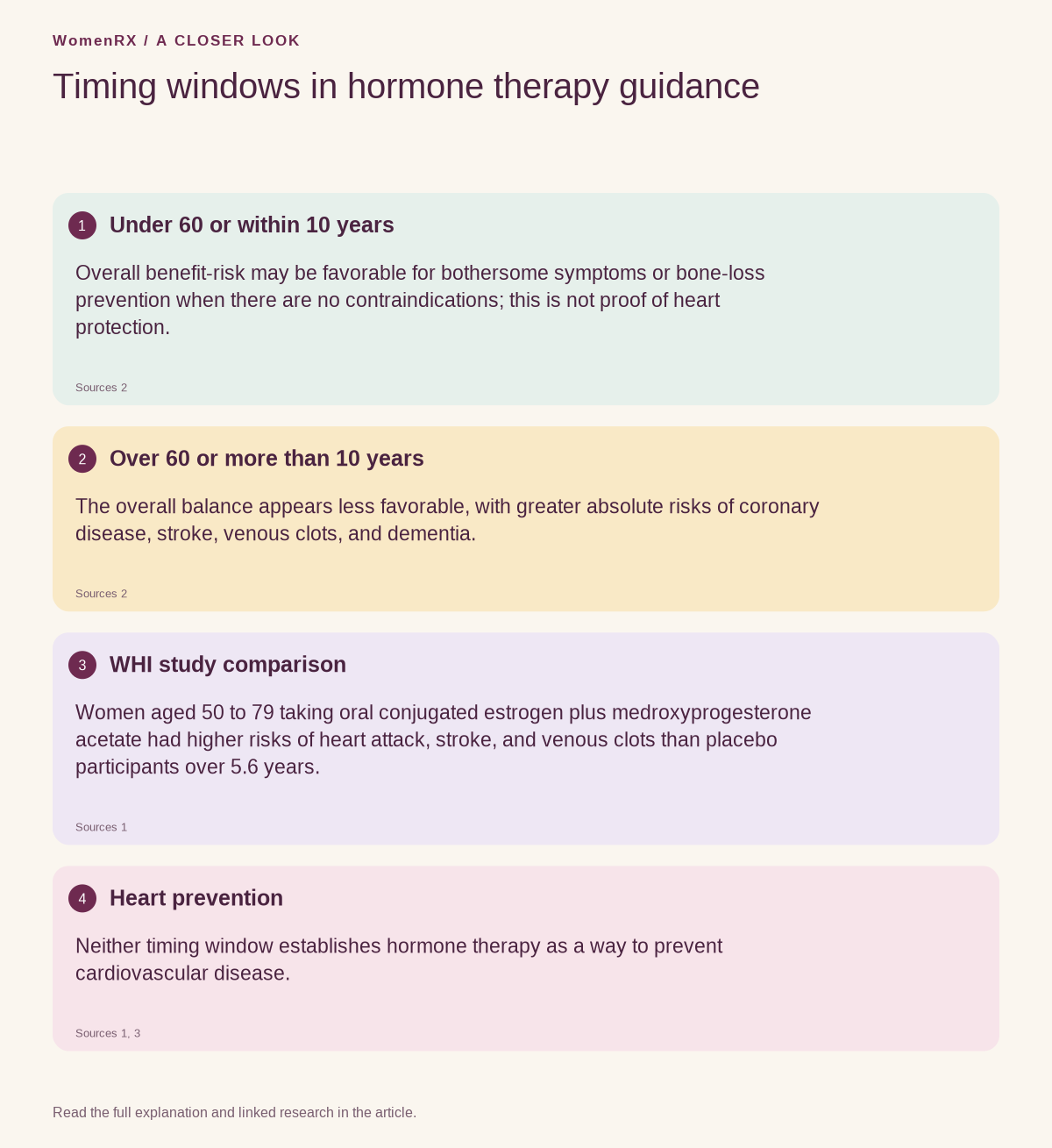
Timing windows in hormone therapy guidance
Under 60 or within 10 years: Overall benefit-risk may be favorable for bothersome symptoms or bone-loss prevention when there are no contraindications; this is not proof of heart protection.2
Over 60 or more than 10 years: The overall balance appears less favorable, with greater absolute risks of coronary disease, stroke, venous clots, and dementia.2
WHI study comparison: Women aged 50 to 79 taking oral conjugated estrogen plus medroxyprogesterone acetate had higher risks of heart attack, stroke, and venous clots than placebo participants over 5.6 years.1
Heart prevention: Neither timing window establishes hormone therapy as a way to prevent cardiovascular disease.13
Read the figure as text
These are comparison points used to weigh overall benefits and risks, not a schedule for starting therapy or a heart-prevention recommendation.- Under 60 or within 10 years: Overall benefit-risk may be favorable for bothersome symptoms or bone-loss prevention when there are no contraindications; this is not proof of heart protection.2
- Over 60 or more than 10 years: The overall balance appears less favorable, with greater absolute risks of coronary disease, stroke, venous clots, and dementia.2
- WHI study comparison: Women aged 50 to 79 taking oral conjugated estrogen plus medroxyprogesterone acetate had higher risks of heart attack, stroke, and venous clots than placebo participants over 5.6 years.1
- Heart prevention: Neither timing window establishes hormone therapy as a way to prevent cardiovascular disease.13
More questions, answered
Does the 10-year mark mean risk suddenly changes?
No. The under-60 and within-10-years categories are guidance for weighing benefits and risks, not evidence of a sudden change on a particular date. The position statement describes a less favorable balance when therapy is started after age 60 or more than 10 years after menopause. 2
Sources you can check
- PREMPHASE (CONJUGATED ESTROGENS AND MEDROXYPROGESTERONE ACETATE) KIT PREMPRO (CONJUGATED ESTROGENS AND MEDROXYPROGESTERONE ACETATE) TABLET, SUGAR COATED [WYETH PHARMACEUTICALS LLC, A SUBSIDIARY OF PFIZER INC.] | US prescribing information and patient instructionsAccessed 2026-09-25Return to first citation
- The 2022 hormone therapy position statement of The North American Menopause Society.“The 2022 Hormone Therapy Position Statement of The North American Menopause Society” Advisory Panel. · Menopause (New York, N.Y.) · 2022Return to first citation
- Menopausal Hormone Therapy and Cardiovascular Risk: Current Evidence and Clinical Implications.Buzduga CM, Bobu AM, Covali R, Costea CF, Cucu AI, Graur M, Patrascanu E, Solomon-Condriuc I, Carauleanu A. · Medical sciences (Basel, Switzerland) · 2026Return to first citation